Leptodactylus macrosternum
| Leptodactylus macrosternum | |
|---|---|
 | |
Scientific classification  | |
| Kingdom: | Animalia |
| Phylum: | Chordata |
| Class: | Amphibia |
| Order: | Anura |
| Family: | Leptodactylidae |
| Genus: | Leptodactylus |
| Species: | L. macrosternum |
| Binomial name | |
| Leptodactylus macrosternum Miranda-Ribeiro, 1926 | |
| Synonyms[2] | |
| |
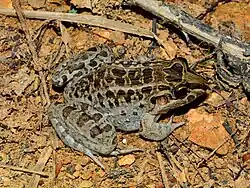
Miranda's white-lipped frog or Cei's white-lipped frog (Leptodactylus macrosternum) is a frog. It lives in [[Argentina], Brazil, Bolivia, Guyana, French Guiana, Suriname, Colombia, Paraguay, Peru, Venezuela, Uruguay, and Trinidad and Tobago.[2][3][1]
Home
The adult frogs live in grassy places full of water and in forests and the edges of forests. This frog can live in places that human beings have changed. Scientists saw the frog between 0 and 1000 meters above sea level.[1]
Scientists saw the frog in many protected places: Chaco National Park, Mburucuyá National Park, Río Pilcomayo National Park, Parque Nacional Calilegua, San Rafael Managed Resource Reserve, Limoy Biological Reserve, Sierra de San Javier, Horco Molle Reserva Universitaria, Aguas Chiquitas Reserva Natural, Laguna Pintascayo Parque Provincial, Iberá Reserva Natural Provincial, El Bagual Private Reserve, Los Diques Reserva Provincial, Noel Kempff Mercado National Park, Kaa-iya del Gran Chaco, Otuquis National Park, Parque Nacional Da Serra Da Bodoquena, Parque Nacional Da Serra Do Divisor, Estação Ecológica Dos Caetetus, Parque Estadual Do Morro Do Diabo, and Área de Proteção Ambiental Ilhas e Várzeas do Rio Paraná.[1]
People
Human people used to catch this frog for fun. Now, people sometimes catch it to eat.[1]
Young
This frog makes a nest out of bubbles for its eggs in puddles and flooded places, no more than 15 cm deep. It has many young at the same time.[1]
Danger
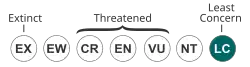
Scientists from the IUCN say this frog is not in danger of dying out. The frogs might be in some danger when human beings change the places where the frogs live. Scientists from the National Red List of French Guiana say this frog is in big danger of dying out.[1]
References
- 1 2 3 4 5 6 7 IUCN SSC Amphibian Specialist Group (2023). "Miranda's White-lipped Frog: Leptodactylus macrosternum". IUCN Red List of Threatened Species. 2023: e.T85852377A85910933. doi:10.2305/IUCN.UK.2023-1.RLTS.T85852377A85910933.en. Retrieved November 28, 2025.
- 1 2 Frost, Darrel R. "Leptodactylus macrosternum Miranda-Ribeiro, 1926". Amphibian Species of the World, an Online Reference. Version 6.0. American Museum of Natural History, New York. Retrieved November 28, 2025.
- ↑ "Leptodactylus macrosternum Miranda-Ribeiro, 1926". AmphibiaWeb. University of California, Berkeley. Retrieved November 28, 2025.