Río Pilcomayo National Park
| Río Pilcomayo National Park | |
|---|---|
| Parque Nacional Río Pilcomayo | |
IUCN category II (national park) | |
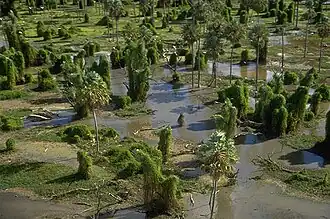 Marshes of the Río Pilcomayo National Park | |
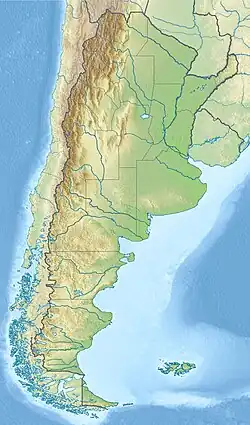  Location within Argentina | |
| Location | Formosa Province, Argentina |
| Coordinates | 25°04′00″S 58°07′00″W / 25.066667°S 58.116667°W |
| Area | 51,889 ha (128,220 acres) |
| Established | 1951 |
| Governing body | Administración de Parques Nacionales |
| www | |
| Official name | Rio Pilcomayo |
| Designated | 4 May 1992 |
| Reference no. | 557[1] |
The Río Pilcomayo National Park (Spanish: Parque Nacional Río Pilcomayo) is a national park in Formosa, Argentina. It is next to Paraguay. People made it a park on September 29, 1951. Its job is to protect the grasslands, marshes, creeks, lakes, and forests of the Humid Chaco home for living things. The park is on the list of wetlands of international importance.[2][3]
Place
The park is on a large flat, grassy place. It was formed when a depression in Paleozoic crystal rocks filled with dead and rocky sand and other small piecess. It is a sedimentary basin.[4] The soil in the east part of the park has clay in it, so water does not get into it very easily. The soil in the west part of the park is looser, so water can get into it easily.
There are cracks in the ground that can make earthquakes from the formation of the Andes Mountains. These are in straight lines with the Paraguay River. The ground in the park goes downhill from west to east, but mostly it is the same height above sea level. When it rains a lot, there are many pools of water connected to each other.
Water

The Pilcomayo River goes through the park. When the weather is wet, the river and its streams flood the ground. This makes many lakes and marshes that are connected to each other, so fish and other animals can swim through until the connections dry up.[4] The southern end of the park has a big lake, Laguna Blanca. Many water birds live there. Many birds stop there while moving from the Northern Hemisphere.
Weather
The park is in a subtropical place. The average temperature is 23 °C (73 °F) and the average amount of rain and other weather is 1,200 millimetres (47 in). In summer, it can be hotter than 40 °C (104 °F). During winter, it can get cold enough for frost. Winters are dry, and the summer has the most rain, March and November. Tornadoes. can happen in the park.[4]
Plants
Plants grow in four different types of places in the park:
- Savanna, which has Caranday wax palm. People use the Caranday wax palm as a symbol for the park. There are also many other green plantss (especially in Scirpus).[4] Other trees include such species as Acacia caven and Prosopis nigra.
- Wetlands have water plants. There are floating plants, for example water hyacinths, Limnocharitaceae, Nymphoides, and Ludwigia.
- The Pilcomayo River and its smaller rivers and streams can flood. The plants there are stream plants. Figs and sweetwood trees grow there. Many species of lianas, vines, and plants that only live on top of other plantss grow on the trees.
- The highlands can make "mountain islands." Quebracho trees (Schinopsis balansae and Aspidosperma quebracho-blanco) can grow there.[4]
Animals
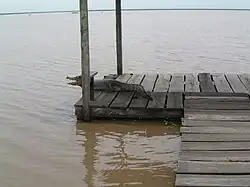
Many mammals live high in the park: the gray brocket, capybara, peccary, howler monkey, and puma; birds like chachalacas and rails. The maned wolf lives in the lowlands, with birds like the greater rhea and seriemas.[4]
Jaugars (Panthera onca palustris) live in the park. This park and El Impenetrable in Chaco are the last two places where jaguars live in the Argentine Chaco, along with the populations located in the Yungas of Salta and Jujuy, and in the Misiones jungle.[5]
Storks, herons, roseate spoonbills, and ducks live in the park's watery places. There are two caiman species: the broad-snouted caiman and the yacare caiman. There are many fish species from Hoplosternum that can use air. This helps them live during droughts that make the water dry up.
There are many snakes in the park, for example the yellow anaconda (Eunectes notaeus) and Hydrodynastes gigas, a large water snake.
References

- ↑ "Rio Pilcomayo". Ramsar Sites Information Service. Retrieved 25 April 2018.
- ↑ "PN Río Pilcomayo". Administración de Parques Nacionales. Retrieved 2008-12-28.
- ↑ "The List of Wetlands of International Importance" (PDF). Ramsar Convention. 2008-04-09. Archived from the original (PDF) on March 27, 2009. Retrieved 2009-04-10.
- 1 2 3 4 5 6 "Río Pilcomayo" (in Spanish). patrimonionatural.com. Archived from the original on 2009-04-06. Retrieved 2009-04-04.
- ↑ "Se registró un nuevo ejemplar de yaguareté en el Parque Nacional Río Pilcomayo". Diario Norte (in Spanish). May 14, 2025. Retrieved May 14, 2025.