Leptodactylus elenae
| Leptodactylus elenae | |
|---|---|
Scientific classification  | |
| Kingdom: | Animalia |
| Phylum: | Chordata |
| Class: | Amphibia |
| Order: | Anura |
| Family: | Leptodactylidae |
| Genus: | Leptodactylus |
| Species: | L. elenae |
| Binomial name | |
| Leptodactylus elenae Heyer, 1978 | |
The marbled white-lipped frog (Leptodactylus elenae) is a frog. It lives in Bolivia, Brazil, Argentina, Paraguay, and Peru.[2][3][1]
Body
The adult female frog is larger than the adult male frog. The skin of the frog's back can be brown in color with no marks or it may have two rows of dark spots. There are some dark spots on the belly. There is a white line on the face over the mouth. There are some lines across the legs.[3]
Home
This frog lives on the ground. Scientists have seen it in Amazonia, Pantanal, and Cerrado places. In the southern part of its home, it has lived in places that people have changed, but in the northern part of its home, it does not. Scientists have seen the frog between 0 and 500 meters above sea level.[1]
Scientists have seen the frog in many protected places: Parque Nacional Calilegua, Formosa Reserva Natural, Río Pilcomayo National Park, Defensores del Chaco National Park, Cerro Corá National Park, Ybycuí National Park, Ypacaraí National Park, San Rafael Managed Resource Reserve, Natural Reserve del Bosque Mbaracayú, Uruguaí Reserva de Vida Silvestre, El Bagual Private Reserve, Noel Kempff Mercado National Park, Kaa-iya del Gran Chaco, Madidi National Park, Parque Nacional Da Serra Da Bodoquena.[1]
Young
This frog has young in places that are not water all year, for example ponds that dry up and grassy places that flood.[1]
Danger
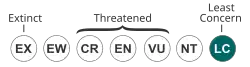
Scientists from the IUCN say this frog is not in danger of dying out.[1]
References
- 1 2 3 4 5 6 IUCN SSC Amphibian Specialist Group; Instituto Boitatá de Etnobiologia e Conservação da Fauna (2023). "Marbled White-lipped Frog: Leptodactylus elenae". IUCN Red List of Threatened Species. 2023: e.T57124A101429023. doi:10.2305/IUCN.UK.2023-1.RLTS.T57124A101429023.en. Retrieved December 5, 2025.
- ↑ Frost, Darrel R. "Leptodactylus elenae Heyer, 1978". Amphibian Species of the World, an Online Reference. Version 6.0. American Museum of Natural History, New York. Retrieved December 5, 2025.
- 1 2 Kevin Gin (October 7, 2003). Vance T. Vredenburg (ed.). "Leptodactylus elenae Heyer, 1978". AmphibiaWeb. University of California, Berkeley. Retrieved December 5, 2025.