Kulin nation
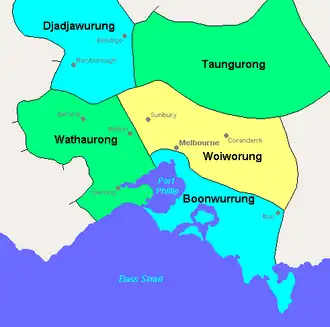
The Kulin nation is a group of five Indigenous Australian nations in southern Australia. They live near the Great Dividing Range and the Loddon and Goulburn River valleys. They share the same culture and language.[1]
History
Before the British came, the tribes spoke five related languages. These languages belong to two groups: the eastern Kulin group, which includes Woiwurrung–Taungurung, Boonwurrung, and Ngurai-illam-wurrung; and the western group, which includes only Wadawurrung.
People have lived in central Victoria for about 42,000 years before Europeans arrived. When the British settled in the 1830s, the combined population of the Woiwurrung, Boonwurrung, and Wadawurrung tribes was about 725 people. The Kulin people lived by fishing, growing murnong (also called yam daisy), hunting, and gathering food. They lived well from the rich food in Port Phillip and nearby grasslands.
Because of the changes and problems caused by British settlement from the 1830s, there is little physical proof left of the Kulin people's past. But there are still some important cultural and spiritual sites in the Melbourne area.[2][3]
People
- Woiwurrung (Woy-wur-rung) – the Wurundjeri people of the Yarra Valley.
- Boonerwrung – the Boonerwrung (Boonwurrung) people of the bays and south coast
- Wathaurong (Wath-er-rung) – the Wathaurong people of the western plains
- Taungurung (Tung-ger-rung) – the Taungurung people of the Goulburn Valley
- Dja Dja Wurrung (Jar-Jar-Wur-rung) – the Djadjawurrung or Djaara people of the Loddon River
At certain times of the year, these nations would meet at Yarra Falls to settle disputes, to trade, and to hold corroborees.
When strangers passed through or were invited onto tribal lands, the ceremony of "tanderrum" – freedom of the bush – was performed. This allowed safe passage and temporary access and use of land and resources by the strangers. It was a diplomatic ceremony involving the landholder's hospitality and a ritual exchange of gifts.
References
- ↑ The Kulin people of Central Victoria, https://www.nccma.vic.gov.au/media/documents/kulin_people_brochure.pdf
- ↑ Eidelson 1997, pp. 8–9.
- ↑ Eidelson 2001.