Khwarazmian dynasty
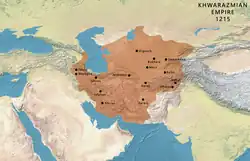
The Khwarazmian dynasty (Persian: خوارزمیان) (Uzbek: Xorazmiylar) was a Turkic-Persian dynasty that ruled Khorezm and much of Central Asia between the 11th and 13th centuries. Their capital was Gurganj (Urgench).
The dynasty began when Anush Tigin Gharchai, a former slave of the Seljuk Empire, became governor of Khorezm in 1077.[1] His descendants became independent rulers and expanded their lands. The Khwarazmians were first loyal to the Seljuks, but later they became independent and powerful.
By the 12th century, the Khwarazmians controlled Transoxiana, Khorezm, and parts of Persia. Under rulers like Ala ad-Din Tekish (1172–1200) and his son Ala ad-Din Muhammad II (1200–1220), the dynasty became one of the strongest states in the Islamic world.[2] They fought wars with the Ghurid dynasty, the Qara Khitai, and the Karakhanids.
The Khwarazmians built mosques, madrasas, and palaces. Their cities, especially Gurganj, were centers of trade and culture. Merchants came from Persia, India, and Russia. Scholars wrote in Persian and Arabic, and Islamic law was used in government.[3]
The dynasty reached its height under Ala ad-Din Muhammad II. He ruled lands from the Aral Sea to the Persian Gulf. But his empire was unstable. Heavy taxes and wars made many people unhappy. The Khwarazmians also had conflicts with the Abbasid Caliphate in Baghdad.[4]
In 1218, Genghis Khan sent traders to Khwarazm. They were killed by the governor of Otrar. This led to the Mongol invasion. In 1220–1221, the Mongols destroyed Khwarazm’s cities, including Bukhara, Samarkand, and Gurganj.[5] Tens of Millions of people were killed, and the empire collapsed.
The last Khwarazmian ruler, Jalal ad-Din Mingburnu, fought against the Mongols after 1221. He won some battles, such as at Parwan in Afghanistan, but later lost. He fled to Persia and India, where he tried to rebuild power. He died in 1231, ending the dynasty.[6]
References
- ↑ Peter Golden, Central Asia in World History, Oxford University Press, 2011, pp. 92–95.
- ↑ Richard N. Frye, The Heritage of Central Asia, Princeton University Press, 1996, pp. 155–160.
- ↑ S. Frederick Starr, Lost Enlightenment: Central Asia’s Golden Age, Princeton University Press, 2013, pp. 145–147.
- ↑ Christopher I. Beckwith, Empires of the Silk Road, Princeton University Press, 2009, pp. 155–158.
- ↑ David Morgan, The Mongols, Blackwell, 1986, pp. 98–102.
- ↑ Adeeb Khalid, Central Asia: A New History from the Imperial Conquests to the Present, Princeton University Press, 2021, pp. 122–125.