Karakhanid dynasty
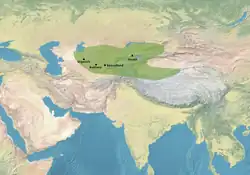
The Karakhanid dynasty (Arabic: القراخانية) (Uzbek: Qaraxoniylar) was a Turkic dynasty that ruled parts of Central Asia between the 9th and 12th centuries. Their lands included Transoxiana, Fergana Valley, and parts of Kashgar and Balasagun.
The Karakhanids were the first Turkic dynasty to convert to Islam. In 960, the khan Satuq Bughra Khan and his people accepted Islam.[1] This made the dynasty important in the spread of Islam among Turkic peoples.
The dynasty was founded by Turkic tribes from the steppes. They were related to the Karluks and other nomadic groups. Their capital cities included Balasagun and Kashgar.[2]
The Karakhanids ruled Transoxiana after the fall of the Samanid dynasty. They took Bukhara in 999 and made it one of their main cities.[3]
The dynasty was divided into eastern and western branches. The eastern branch ruled in Kashgar and Balasagun, while the western branch ruled in Samarkand and Bukhara. They often fought each other, but both branches supported Islamic culture.
Under the Karakhanids, many mosques, madrasas, and palaces were built. The famous Kalyan Minaret in Bukhara was started during their rule.[4]
By the 12th century, the dynasty became weaker. Their lands were taken by the Seljuk Empire and later by the Khwarazmian dynasty.[5]
References
- ↑ Peter Golden, Central Asia in World History, Oxford University Press, 2011, pp. 67–70.
- ↑ Richard N. Frye, The Heritage of Central Asia, Princeton University Press, 1996, pp. 112–115.
- ↑ Christopher I. Beckwith, Empires of the Silk Road, Princeton University Press, 2009, pp. 145–147.
- ↑ S. Frederick Starr, Lost Enlightenment: Central Asia’s Golden Age, Princeton University Press, 2013, pp. 98–100.
- ↑ David Morgan, The Mongols, Blackwell, 1986, pp. 22–25.