Kamal Jumblatt
Kamal Jumblatt | |
|---|---|
كمال جنبلاط | |
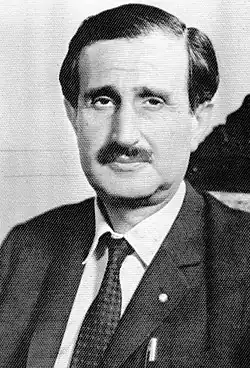 Portrait of Kamal Jumblatt (1960) | |
| Leader | of the Progressive Socialist Party |
| Succeeded by | Walid Jumblatt |
| Personal details | |
| Born | 6 December 1917 |
| Died | 16 March 1977 (aged 59) |
Kamal Jumblatt (1917–1977) was an important Lebanese politician, Druze leader and founder of the Progressive Socialist Party.[1][2] He became one of the most influential political figures in Lebanon during the 20th century. He also had an important impact on Lebanese politics after the country's independence.[1][2]
Jumblatt was known for combining different political roles. He came from a traditional Druze family, but he also presented himself as a reformist and left-wing politician.[2]
Early life
Kamal Jumblatt was born in 1917 in the village of al-Mukhtārah, in present-day Lebanon.[1] He was part of the powerful Jumblatt family, one of the main Druze families of Lebanon.[1][2] The family has been politically active in Mount Lebanon for several centuries.[2]
His father, Fuad Jumblatt, had been assassinated in 1921, when Kamal was still young.[1][2] After his father’s death, other members of the Jumblatt family helped keep the family’s political position.[2]
Education
Jumblatt studied at the Lazarist School in Aintoura. He later went to France, where he studied sociology and philosophy.[1][2] After returning to Lebanon, he studied law at Saint Joseph University in Beirut, where he graduated in 1943.[1]
He also developed an interest in philosophy, mysticism and Indian spiritual thought.[3] These interests later influenced his political language, especially his ideas about socialism, pacifism and spiritual life.[2] Later, his family responsibilities pushed him into politics.[3]
Political career
Entry into politics
Jumblatt entered politics in 1943 after the death of his brother-in-law, Hikmat Jumblatt, and became the leader of the Jumblatt family.[1] The same year, he inherited a parliamentary seat for the Chouf region.[2]
In 1948 Kamal Jumblatt married May Arslan, the daughter of Prince Shakīb Arslān, leader of a rival Druze clan.[1][2] This was a strategic marriage that gave Jumblatt and his family a higher status.[2]
Progressive Socialist Party
On 1 May 1949 Jumblatt founded the Progressive Socialist Party.[1][2] The party supported left-wing and pan-Arab ideas.[2] It mainly represented Druze supporters but also included members from other religious communities.[1]
Although Jumblatt spoke against sectarian politics, much of his political strength came from his position inside the Druze community of Mount Lebanon.[2]
The founding of the Progressive Socialist Party was one of Jumblatt’s most important political achievements. Jumblatt rejected Lebanon’s political system based on religious groups. He argued for a modern political system based on citizenship rather than religion.[3][2]
Political Ideas and Influences
In 1951 Jumblatt founded the party newspaper al-Anbaa. The newspaper criticised the President Bechara al-Khoury and the Lebanese political system.[2]
In the early 1950s he also travelled to India. There, he visited Gandhi’s tomb and met Indian Prime Minister Jawaharlal Nehru.[2] These experiences strengthened his interest in spiritual and anti-colonial politics.[2]
During the 1950s, he became a major opponent of Lebanese President Bechara al-Khoury and helped force him to resign in 1952.[1][2] Jumblatt was one of the important figures in two critical revolts, the 1952 Rosewater Revolution, also called the White Revolution and the 1958 Lebanon Crisis.[2]
Later, he became a strong opponent of President Camille Chamoun.[1][2] Jumblatt and Chamoun had first been political allies, but their relationship later became a rivalry.[2]
1958 Lebanon Crisis
Jumblatt lost the 1957 elections, which damaged his political position.[1][2] In 1958, he helped lead an armed uprising against President Camille Chamoun during a political crisis in Lebanon.[1]
The 1958 Lebanon Crisis was connected to wider tensions over Arab nationalism, President Gamal Abdel Nasser, and Lebanon’s relationship with the Western world.[2]
Later political career
From 1946 to 1970, Jumblatt held seven cabinet posts under the regime of General Fouad Chehab.[1] Under President Fouad Chehab, he served as Minister of Education and later as Minister of the Interior.[2]
Over time, Jumblatt became closer to Arab nationalist movements and strongly supported the Palestinian cause.[1] After the 1958 crisis, his position among the Druze became stronger, especially because his rival Majid Arslan had supported Camille Chamoun.[2]
During the 1960s and 1970s, Jumblatt supported Palestinian armed groups in Lebanon and worked closely with the Palestine Liberation Organization (PLO).[1] His support for socialism and pan-Arabism helped him build alliances with Palestinian groups and with some Sunni and Shi’i political figures.[2]
He also supported left-wing political movements. While serving as Minister of the Interior, he allowed several radical political parties to operate legally.[1]
At the height of his career in the early 1970s, he became Secretary General of the Arab Front for the Support of the Palestinian Revolution. This was a pro-Palestinian and pan-Arab organization.[1]
Jumblatt helped organise Arab nationalist protests, especially in Beirut. This weakened the influence of the traditional Sunni leaders. It also weakened and disrupted the shared power system between Maronite and Sunni leaders that had existed since 1943.[1]
Lebanese Civil War
At the beginning of the Lebanese Civil War, Jumblatt supported an agreement on a political settlement rather than an immediate military outcome.[1]
In August 1975, Jumblatt, as the leader of the Lebanese National Movement proposed major political changes through the Interim Program for Democratic Reform.[1] Later, in October 1975, the National Dialogue Committee was created to discuss possible ways to end the war. However, this failed.[1]
On 14 February 1976, President Suleiman Frangiyeh announced a reform sponsored by Syria, the Constitutional Document. The plan proposed to make confessional representation in government more equal. However, it kept the three highest state offices reserved for Lebanon’s three largest religious communities: the President would remain a Maronite Christian, the Prime Minister a Sunni Muslim, and the Speaker of Parliament a Shi’i Muslim. Jumblatt opposed this plan because it kept the basic structure of religious power-sharing. This increased hostility between the different sides.[1]
By March 1976, Jumblatt had shifted towards using military force. The fighting then spread to new areas and became more intense. The fighting ended when Syrian troops defeated the Palestinian strongholds, supported by Jumblatt and the Left, and advanced towards Beirut.[4] Jumblatt lost much of his political power and retreated to his home village.[1]
Assassination and legacy
Kamal Jumblatt was assassinated on 16 March 1977.[1] His death was symbolic for the defeat of the plans for major political change of the Lebanese left during the early phase of the civil war.[3]
After his death, his son Walīd Jumblatt succeeded him in his political role as a leader of the Jumblatt Druze clan and the Lebanese Left. In 2005, Walīd Jumblatt publicly suggested that the Syrian security services were responsible for his father’s assassination, personally, the brother of the Syrian President Hazif al-Asad, Rifa’at al-Asad.[1]
References
- 1 2 3 4 5 6 7 8 9 10 11 12 13 14 15 16 17 18 19 20 21 22 23 24 25 26 27 28 Hannabuss, Stuart (2010-03-30). "The Oxford Encyclopedia of the Islamic World2010105Editor in Chief John L. Esposito. The Oxford Encyclopedia of the Islamic World. New York, NY and Oxford: Oxford University Press 2009. Available online as part of Oxford Islamic Studies Online URL: www.oxfordislamicstudies.com/ Contact publisher for pricing information Also available as a six volume printed set (ISBN 978 0 19 530513 5 £375)". Reference Reviews. 24 (3): 11–13. doi:10.1108/09504121011030625. ISSN 0950-4125.
- 1 2 3 4 5 6 7 8 9 10 11 12 13 14 15 16 17 18 19 20 21 22 23 24 25 26 27 28 Paksoy, Taylan (September 2025). "Sheikh, Beik, and Muallim: Kamal Jumblatt and the Lebanese Political Elites". The Middle East Journal. 78 (4): mej–7804–3. doi:10.3751/78.4.12. ISSN 0026-3141.
- 1 2 3 4 al‐Khazen, Farid (April 1988). "Kamal Jumblatt, the uncrowned Druze prince of the left". Middle Eastern Studies. 24 (2): 178–205. doi:10.1080/00263208808700737. ISSN 0026-3206.
- ↑ Naor, Dan (2017-07-04). "Divide and conquer: the consolidation of Hafiz al-Assad's policy toward Lebanon – the early stages". Middle Eastern Studies. 53 (4): 624–637. doi:10.1080/00263206.2016.1278531. ISSN 0026-3206.