Josephoartigasia
| Josephoartigasia Temporal range: Late Pliocene–Early Pleistocene (Chapadmalalan-Uquian) ~ | |
|---|---|
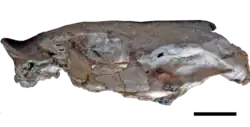 | |
| J. monesi skull, scale = 10 cm (3.9 in) | |
Scientific classification  | |
| Kingdom: | Animalia |
| Phylum: | Chordata |
| Class: | Mammalia |
| Order: | Rodentia |
| Family: | Dinomyidae |
| Genus: | †Josephoartigasia Mones, 2007 |
| Type species | |
| †Artigasia magna Francis and Mones, 1966 | |
| Species | |
| |
Josephoartigasia is an extinct genus of giant rodent from the Pliocene. It is related to the living pacarana. The genus includes the largest known rodent, Josephoartigasia monesi.[1]
The two species would have looked like gigantic pacarana, or capybaras the size of cows. However, Dr Virginie Millien, from McGill University in Montreal, said the mathematical models originally used to calculate the rodent's mass from its skull probably overestimated its body size.[1]
A recent report said it had big front teeth, which it might have used for defence.[2]
References
- 1 2 "Biggest rodent 'shrinks in size'". BBC News. 2008-05-21.
- ↑ Biggest rodent 'fought with teeth' like tusks. BBC News Science & Environment.
Further reading
- Rinderknecht, A.; Blanco, R. E. (2015). "History, taxonomy and palaeobiology of giant fossil rodents (Hystricognathi, Dinomyidae)". In Cox, P. G.; Hautier, H. (eds.). Evolution of the Rodents: Advances in Phylogeny, Functional Morphology and Development. pp. 164–185. doi:10.1017/CBO9781107360150.007. ISBN 978-1-107-36015-0.