Izawa-no-miya
| Izawa-no-miya 伊雑宮 | |
|---|---|
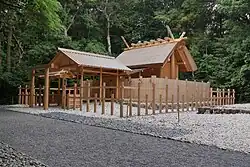 Izawa-no-miya | |
| Religion | |
| Affiliation | Shinto |
| Deity | Amaterasu |
| Location | |
| Location | Kaminogō, Isobe-cho, Shima-shi, Mie-ken |
| Lua error in Module:Location_map at line 526: Unable to find the specified location map definition: "Module:Location map/data/Japan Mie Prefecture" does not exist. | |
| Geographic coordinates | 34°22′49″N 136°48′32″E / 34.38028°N 136.80889°E |
| Architecture | |
| Architectural style | Shinmei-zukuri |
| Date established | unknown |
 Glossary of Shinto | |
Izawa-no-miya (伊雑宮) is a Shinto shrine in Shima, Mie Prefecture, Japan. It is considered part of the Inner Shrine of Ise Grand Shrine, but it is located outside the main complex.[1]
It and Izawa Shrine both claim to be the same shrine in the Engishiki Jinmyōchō[2] and to be the Ichinomiya (top ranked shrine) of Shima Province.[3]
Worshipped god
- Amaterashimasusume-Ōkami-no-Mitama (天照坐皇大御神御魂), one of the mitama of the Sun Goddess
Cultural Properties
National Intangible Cultural Folk Properties
- Isobe-no-Omita rice planting festival (磯部の御神田) [4]
Gallery
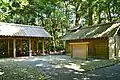 Purification spot
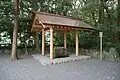 Ablution font
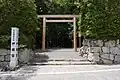 Torii
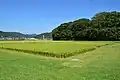 Sacred rice fields
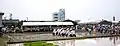 Rice Planting festival
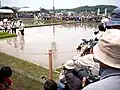 Rice Planting festival
Related pages
- List of Shinto shrines
- List of Important Intangible Folk Cultural Properties
- Ichinomiya
- Saminaga Shrine
References
- Plutschow, Herbe. Matsuri: The Festivals of Japan. RoutledgeCurzon (1996) ISBN 1-873410-63-8
- Ponsonby-Fane, Richard Arthur Brabazon. (1959). The Imperial House of Japan. Kyoto: Ponsonby Memorial Society. OCLC 194887
External links
- Ise Shime Convention & Tourism official site
- Ise Jingu Official site Archived 2019-09-25 at the Wayback Machine(in Japanese)
- Prefecture Official tourist information site (in Japanese)
Notes
- ↑ Shibuya, Nobuhiro (2015). Shokoku jinja Ichinomiya Ninomiya San'nomiya (in Japanese). Yamakawa shuppansha. ISBN 978-4634150867.
- ↑ Yoshiki, Emi (2007). Zenkoku 'Ichinomiya' tettei gaido (in Japanese). PHP Institute. ISBN 978-4569669304.
- ↑ "Nationwide List of Ichinomiya," p. 1 Archived 2013-05-17 at the Wayback Machine; retrieved 2012-1-20.
- ↑ "磯部の御神田" (in Japanese). Agency for Cultural Affairs. Retrieved 20 August 2020.