Ichikishima-hime
| Ichikishimahime | |
|---|---|
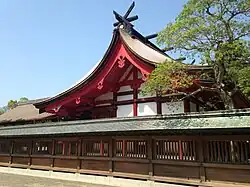 Hetsu-gū (辺津宮) where she is worshipped in Munakata Taisha | |
| Other names | Sayori-hime[1] |
| Kanji | 市杵島姫命 別名 市杵嶋姫命 |
| Major cult centre | Munakata Taisha Usa Jingū Itsukushima Shrine |
| Personal information | |
| Spouse | Amenohoakari |
| Parents | |
| Siblings | Tagori-hime, Tagitsu-hime |
| Equivalents | |
| Hinduism equivalent | Saraswati |
| Buddhism equivalent | Benzaiten |
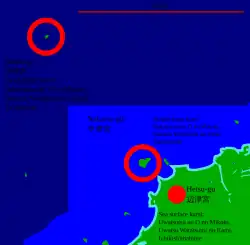
Ichikishima-hime-no-mikoto (市杵島姫命) is one of the Three Munakata goddesses who are worshipped at Munakata Taisha.[2][3][1][4]
She is also called Sayori-hime (狭依毘売命).[4][1]
In medieval times people said she was the same as Benzaiten.[4] Some said she was a daughter of Sagara. Other people said she was the younger sister of Empress Jingū.[4][5]
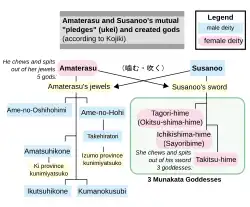
She is a daughter of Susanoo and Amaterasu. She was born from a challenge where Amaterasu chewed Susanoo's sword and it became her and her two sisters.[2][3][1][4]
References
- 1 2 3 4 "Ichikishimahime • . A History . . of Japan . 日本歴史". . A History . . of Japan . 日本歴史. Retrieved 2024-03-24.
- 1 2 Chamberlain (1882). Section XIII.—The August Oath.
- 1 2 "
 Book I". Nihongi: Chronicles of Japan from the Earliest Times to A.D. 697. Kegan Paul, Trench, Trübner & Co.. Wikisource. 1896. 35.
- 1 2 3 4 5 Kadoya, Atsushi. "Ichikishimahime". Encyclopedia of Shinto. Archived from the original on 2025-06-22. Retrieved 2025-09-25.
- ↑ Bocking, Brian (1997). A Popular Dictionary of Shinto - 'Benzaiten'. Routledge. ISBN 978-0-7007-1051-5.

Wikimedia Commons has media related to Ichikishima-hime.