Hystricomorpha
| Hystricomorpha Temporal range: Eocene to recent, | |
|---|---|
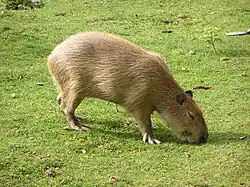 | |
| Capybara | |
Scientific classification  | |
| Kingdom: | Animalia |
| Phylum: | Chordata |
| Class: | Mammalia |
| Order: | Rodentia |
| Suborder: | Hystricomorpha Brandt, 1855[1] |
| Superfamilies | |
|
See text | |
| Synonyms | |
|
Caviomorpha | |
Hystricomorpha (from Ancient Greek ὕστριξ, (hústrix), meaning "porcupine", and μορφή (morphḗ), meaning "form")[2] is a word that for many different families and orders of rodents. It has had many meanings.Generally, it means any rodent that has a hystricomorphous zygomasseteric system. This definition includes the Hystricognathi, Ctenodactylidae, Anomaluridae, and Pedetidae.
Families
This list of families is from the taxonomy of Marivaux et al. 2002 and Marivaux, Vianey-Liaud & Jaeger 2004. They used parsimony analysis on many rodent fossils. Their results made the suborder Sciuravida polyphyletic and invalid. The symbol "†" is means that the group is extinct.
- Suborder Hystricomorpha
- †Pseudoneoreomys?
- Superfamily Ctenodactyloidea
- †Chapattimyidae
- Ctenodactylidae – gundis
- Diatomyidae – Laotian rock rat
- †Tamquammyidae
- †Yuomyidae
- Hystricognathiformes
- †Tsaganomyidae
- Hystricognathi – true hystricognaths
- †Baluchimyinae
- Hystricidae – Old World porcupines
- Phiomorpha
- Bathyergidae – blesmols
- †Bathyergoididae
- †Diamantomyidae
- Heterocephalidae – naked mole-rats
- †Kenyamyidae
- †Myophiomyidae
- Petromuridae – dassie rat
- †Phiomyidae
- Thryonomyidae – cane rats
- Caviomorpha – New World hystricognaths
- Superfamily Cavioidea
- Caviidae – cavies, capybaras, and guinea pigs
- †Cephalomyidae
- Cuniculidae – pacas
- Dasyproctidae – agoutis and acouchis
- †Eocardiidae
- †Neoepiblemidae
- Superfamily Chinchilloidea
- Chinchillidae – chinchillas and viscachas
- Dinomyidae – pacarana
- Superfamily Erethizontoidea
- Erethizontidae – New World porcupines
- Superfamily Octodontoidea
- Abrocomidae – chinchilla rats
- Ctenomyidae – tuco-tucos
- Echimyidae – spiny rats, nutria and hutias
- †Heptaxodontidae – giant hutias
- Octodontidae – degus and relatives
- Superfamily Cavioidea
Citations
- ↑ Brandt 1855
- ↑ "Hystricomorpha". Oxford Dictionaries. Archived from the original on May 31, 2011. Retrieved 12 November 2011.
General references
- Bergsten, J. (2005). "A review of long-branch attraction". Cladistics. 21 (2): 163–193. doi:10.1111/j.1096-0031.2005.00059.x.
- Brandt, J. F. (1855). Beitrage zur nahern Kenntniss der Saugethiere Russlands (in German).
- Cao, Y.; Adachi, J.; Yano, T.; Hasegawa, M. (1994). "Phylogenetic place of guinea pigs: No support of the rodent-polyphyly hypothesis from maximum-likelihood analyses of multiple protein sequences". Molecular Biology and Evolution. 11 (4): 593–604. doi:10.1093/oxfordjournals.molbev.a040139. PMID 8078399.
- Carleton, M. D.; Musser, G. G. (2005). "Order Rodentia". In Wilson, D. E.; Reeder, D. M. (eds.). Mammal Species of the World A Taxonomic and Geographic Reference. Baltimore: Johns Hopkins University Press. pp. 745–752. ISBN 978-0-8018-8221-0.
- D'Erchia, A.; Gissi, C.; Pesole, G.; Saccone, C.; Arnason, U. (1996). "The guinea-pig is not a rodent". Nature. 381 (6583): 597–600. doi:10.1038/381597a0. PMID 8637593. S2CID 4336262.
- Flynn, J. J.; Wyss, A. R.; Croft, D. A.; Charrier, R. (2003). "The Tinguiririca Fauna, Chile: biochronology, paleoecology, biogeography, and a new earliest Oligocene South American Land Mammal 'Age'". Palaeogeography, Palaeoclimatology, Palaeoecology. 195 (3–4). Elsevier: 229–259. doi:10.1016/S0031-0182(03)00360-2. ISSN 0031-0182.
- Graur, D.; Hide, W.; Li, W. (1991). "Is the guinea-pig a rodent?". Nature. 351 (6328): 649–652. doi:10.1038/351649a0. PMID 2052090. S2CID 4344039.
- Kuma, K.; Miyata, T. (1994). "Mammalian phylogeny inferred from multiple protein data" (PDF). Japanese Journal of Genetics. 69 (5): 555–66. doi:10.1266/jjg.69.555. PMID 7999372.
- Lin, Y.-H.; McLenachan, P. A.; Gore, A. R.; Phillips, M. J.; Ota, R.; Hendy, M. D.; Penny, D. (2002). "Four new mitochondrial genomes and the increased stability of evolutionary trees of mammals from improved taxon sampling". Molecular Biology and Evolution. 19 (12): 2060–2070. doi:10.1093/oxfordjournals.molbev.a004031. PMID 12446798.
- Marivaux, L.; Vianey-Liaud, M.; Jaeger, J.-J. (2004). "High-level phylogeny of early Tertiary rodents: dental evidence". Zoological Journal of the Linnean Society. 142 (1): 105–134. doi:10.1111/j.1096-3642.2004.00131.x.
- Marivaux, L.; Welcomme, J.-L.; Vianey-Liaud, M.; Jaeger, J.-J. (2002). "The role of Asia in the origin and diversification of hystricognathous rodents". Zoologica Scripta. 31 (3): 225–239. doi:10.1046/j.1463-6409.2002.00074.x. S2CID 86358222.
- McKenna, M. C.; Bell, S. K. (1997). Classification of Mammals Above the Species Level. New York: Columbia University Press. ISBN 0-231-11013-8.
- Reyes, A.; Pesole, G.; Saccone, C. (2000). "Long-branch attraction phenomenon and the impact of among-site rate variation on rodent phylogeny". Gene. 259 (1–2): 177–187. doi:10.1016/S0378-1119(00)00438-8. PMID 11163975.
- Reyes, A.; Gissi, C.; Catzeflis, F.; Nevo, E.; Pesole, G.; Saccone, C. (2004). "Congruent mammalian trees from mitochondrial and nuclear genes using Bayesian methods". Molecular Biology and Evolution. 21 (2): 397–403. doi:10.1093/molbev/msh033. hdl:2434/144391. PMID 14660685.
- Robinson-Rechavi, M.; Ponger, L.; Mouchiroud, D. (2000). "Nuclear gene LCAT supports rodent monophyly". Molecular Biology and Evolution. 17 (9): 1410–1412. doi:10.1093/oxfordjournals.molbev.a026424. ISSN 0737-4038. PMID 10960041.
- Sullivan, J.; Swofford, D. L. (1997). "Are Guinea Pigs Rodents? The Importance of Adequate Models in Molecular Phylogenetics" (PDF). Journal of Mammalian Evolution. 4 (2): 77–86. doi:10.1023/A:1027314112438. ISSN 1064-7554. S2CID 5756010.