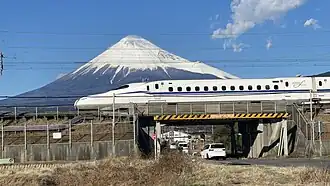
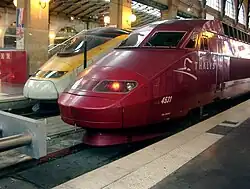
High-speed rail is a type of passenger rail transport that operates significantly faster than the normal rail traffic. Early Shinkansen trains had a top speed of 200km/h (120mph), which is the world's first high-speed rail. Various definitions are used in different countries.
According to the European Union, high-speed trains must run at least 200km/h (120mph) on existing lines, and at least 250km/h (160mph) on newly built ones.
According to the United States Federal Railroad Administration, they should go above 90mph (140km/h) but there is no single standard, and lower speeds can be required by local constraints.[1][2]
As of 2020, speeds of 300km/h (190mph) to 350km/h (220mph) are common in regular operation.