Gospel of Mark
| Books of the New Testament |
|---|
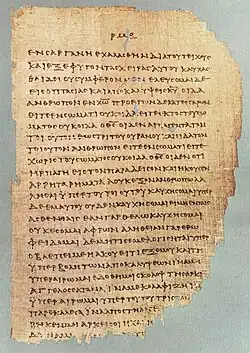 |
| Gospels |
| Matthew · Mark · Luke · John |
| Acts |
| Acts of the Apostles |
| Epistles |
|
Romans 1 Corinthians · 2 Corinthians Galatians · Ephesians Philippians · Colossians 1 Thessalonians · 2 Thessalonians 1 Timothy · 2 Timothy Titus · Philemon Hebrews · James 1 Peter · 2 Peter 1 John · 2 John · 3 John Jude |
| Apocalypse |
| Revelation |
| New Testament manuscripts |

The Gospel of Mark is a gospel in the New Testament that records the ministry of Jesus, which begins at his baptism. It is called a Synoptic Gospel because it shares many stories with the Gospel of Luke and Gospel of Matthew, though it was probably written before them[1] around 65–75 (CE).[2]
The author is traditionally thought to have been a friend of the Apostle Peter called Mark.[3] While most scholars now disagree with this, the actual author is unknown[4] because this gospel is anonymous.[5] They probably wrote from Rome, intending to strengthen the faith of a non-Jewish audience.[6][7]
Contents
Summary
The Gospel of Mark moves quickly, recording the 3-year ministry of Jesus beginning with his baptism by John the Baptist.
While this gospel lacks some stories that the Gospel of Luke and Gospel of Matthew have, like the birth of Jesus, it is still one of the Synoptic Gospels because of how similar they are. They share many parables like the Parable of the Sower, Parable of the Mustard Seed, and Parable of the Wicked Tenants.
The Longer Ending
While most manuscripts include the longer ending to Mark (Ch. 16, v. 9–20),[8] the earliest texts do not; they end earlier (Ch. 16, v. 8a) with the women running away in fear and telling nobody. Most scholars think that this ending is more original,[9] and early Church Fathers like Jerome probably didn't know about the longer ending.[8] Modern translations usually include the longer ending in brackets.[10]
Authorship
Tradition
Traditionally, the Gospel of Mark was written by Mark the Evangelist. This belief comes from Papias of Hierapolis[11] and Irenaeus of Lyon, but most scholars disagree with it.
Scholarship
Most scholars have agreed with Marcan Priority,[12][13] which is the view that the Gospel of Mark was used as a source for the other three gospels. The majority view is that it was written around 65-75 (CE).[2]
While many scholars say that this gospel is the most reliable of the four,[14] some scholars like Michael Patrick Barber argue that the Gospel of Matthew is more accurate for a historical Jesus.[15][16]
Related pages

References
- ↑ Edwards 2002, pp. 1–3.
- 1 2 Telford 1999, p. 12.
- ↑ Sanders 1995, pp. 63–64.
- ↑ Tucker, J. Brian; Kuecker, Aaron, eds. (2019-12-26). T&T Clark Social Identity Commentary on the New Testament. London, UK; New York, NY, USA: T&T Clark. ISBN 978-0-567-66786-1.
- ↑ Hatina, Thomas R. (2014). "Gospel of Mark". In Evans, Craig A. (ed.). The Routledge Encyclopedia of the Historical Jesus. Taylor & Francis. p. 252. ISBN 978-1-317-72224-3.
Like the other synoptics, Mark's Gospel is anonymous[...]Nevertheless, we can be fairly certain that it was written by someone named Mark.[...]The difficulty is ascertaining the identity of Mark. Scholars debate whether he is John Mark[...]or another person simply named Mark who was not native to the region.
- ↑ Aune 1987, p. 59.
- ↑ Perkins 2007, p. 241.
- 1 2 Schröter 2010, p. 279.
- ↑ Edwards 2002, pp. 500–01.
- ↑ Metzger 2000, pp. 105, 106.
- ↑ Keith 2016, p. 92.
- ↑ Mendez, Hugo (2025). The Gospel of John: A New History. Oxford University Press. ISBN 978-0197686126.
And yet for much of the twentieth century, "a broad scholarly consensus…tended to regard John's Gospel as quite independent of the other gospels"…Today, however, an increasing number of scholars—now a majority—have arrived at a different view...they find no reason to exclude the Synoptic Gospels from among these sources
- ↑ Edwards 2002, p. 2.
- ↑ Powell 1998, p. 37.
- ↑ Allison, Dale C. Jr. (2023). Foreword. The Historical Jesus and the Temple: Memory, Methodology and the Gospel of Matthew. By Barber, Michael Patrick. Cambridge University Press. pp. x, 238. ISBN 978-1-009-21085-0.
- ↑ Thiessen, Matthew (2024). "The Historical Jesus and the Temple: Memory, Methodology, and the Gospel of Matthew by Michael Patrick Barber (review)". The Catholic Biblical Quarterly. 86–1: 168. doi:10.1353/cbq.2024.a918386.
- Perkins, Pheme (2007). Introduction to the Synoptic Gospels. Wm. B. Eerdmans Publishing. ISBN 978-0-8028-6553-3.
Part of a series on Christianity | ||
|---|---|---|
| Jesus Christ |  | |
| Foundations | ||
| Bible | ||
| Theology | Salvation · Baptism · Trinity · Father · Son · Holy Spirit · Christology · Mariology · Apologetics · Spiritual warfare | |
| History and traditions | ||
| Denominations | ||
| Topics | ||