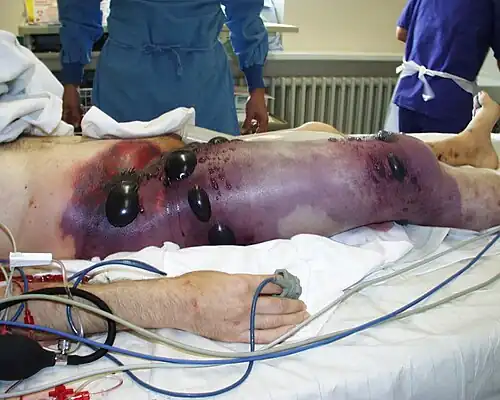
Gas gangrene Other names Myonecrosis Person with gas gangrene. The patient had gone into shock. Medical specialty Infectious disease
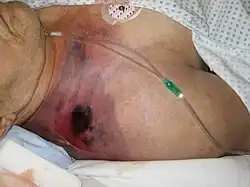
Gas gangrene near shoulder Gas gangrene is a serious but rare form of bacterial infection that occurs when a pressure ulcer becomes infected with the clostridium bacteria .[ 1] necrotizing myositis.
The bacteria thrive in environments where there is little or no oxygen (anaerobic ). They produce gases and release dangerous toxin,[ 1] tissues where there is gangrene . Symptoms of gas gangrene include severe pain and rapid swelling of the skin. Gas gangrene requires immediate treatment (it is a medical emergency ). In the most serious of cases, it may be necessary perform surgery to amputate (debridement) on the affected body part to prevent the gangrene from spreading to the rest of the body.[ 1]
Symptoms
There is quick onset of:[ 2]
myonecrosis
the supply of blood is cut off from the skeletal muscle and it dies (skeletal muscle infarct)
muscle swelling
gas production
sepsis severe pain[ 1]
Risk factors include
Risk is increased in:[ 2]
remove all dead tissue (eg amputation) (debridement) Benzylpenicillin with or without clindamycin.
Hyperbaric oxygen can improve survival and lower the number of debridements.
References
Bacterial skin disease
Gram-
Bacillota
Actinomycetota
Mycobacterium-
Aquarium granuloma
Borderline lepromatous leprosy
Borderline leprosy
Borderline tuberculoid leprosy
Buruli ulcer Erythema induratum
Histoid leprosy
Lepromatous leprosy
Leprosy Lichen scrofulosorum
Lupus vulgaris
Miliary tuberculosis
Mycobacterium avium–intracellulare complex infectionMycobacterium haemophilum infectionMycobacterium kansasii infectionPapulonecrotic tuberculid
Primary inoculation tuberculosis
Rapid growing mycobacterium infection
Scrofuloderma
Tuberculosis cutis orificialis
Tuberculosis verrucosa cutis
Tuberculous cellulitis
Tuberculous gumma
Tuberculoid leprosy Others
Cutaneous actinomycosis
Nocardiosis Cutaneous diphtheria infection
Arcanobacterium haemolyticum infectionGroup JK corynebacterium sepsis
Gram-
Pseudomonadota
Alpha
Endemic typhus
Epidemic typhus Scrub typhus
North Asian tick typhus
Queensland tick typhus
Flying squirrel typhus
Trench fever
Bacillary angiomatosis
African tick bite fever
American tick bite fever
Rickettsia aeschlimannii infectionRickettsialpox
Rocky Mountain spotted fever
Human granulocytotropic anaplasmosis
Human monocytotropic ehrlichiosis
Flea-borne spotted fever
Japanese spotted fever
Mediterranean spotted fever
Flinders Island spotted fever
Verruga peruana
Brill–Zinsser disease
Brucellosis Cat-scratch disease
Oroya fever
Ehrlichiosis ewingii infection Beta
Gonococcemia/Gonorrhea /Primary gonococcal dermatitis
Melioidosis
Cutaneous Pasteurella hemolytica infection
Meningococcemia
Glanders
Chromobacteriosis infection Gamma
Campylobacterota Other
Unspecified
Folliculitis
Superficial pustular folliculitis
Sycosis vulgaris
Pimple Ecthyma
Pitted keratolysis
Trichomycosis axillaris
Necrotizing fasciitis Gangrene
Chronic undermining burrowing ulcer
Fournier gangrene Elephantiasis nostras
Blistering distal dactylitis
Botryomycosis
Malakoplakia
Pyomyositis
Blastomycosis-like pyoderma
Bullous impetigo
Chronic lymphangitis
Recurrent toxin-mediated perineal erythema
Tick-borne lymphadenopathy
Tropical ulcer