Eremophila (plant)
| Eremophila | |
|---|---|
 | |
| Eremophila maculata (cultivated) at Desert Demonstration Garden in Las Vegas | |
Scientific classification  | |
| Kingdom: | Plantae |
| Clade: | Tracheophytes |
| Clade: | Angiosperms |
| Clade: | Eudicots |
| Clade: | Asterids |
| Order: | Lamiales |
| Family: | Scrophulariaceae |
| Tribe: | Myoporeae |
| Genus: | Eremophila R.Br.[1] |
| Species | |
| Synonyms[1] | |
|
List
| |
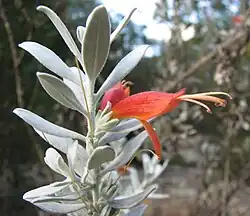
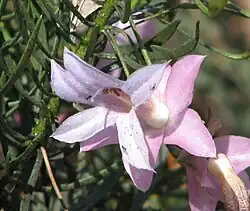
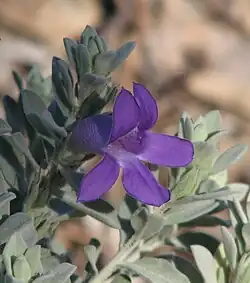
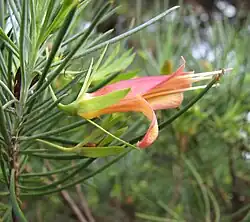
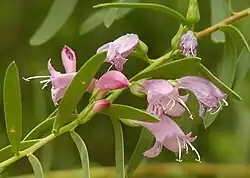
Eremophila is a group of more than 270 types of plants that all grow only in mainland Australia. They belong to the figwort family, called Scrophulariaceae. Some Eremophila plants have common names like emu bush, poverty bush, or fuchsia bush.[2] These names come from ideas like emus eating their fruit, living in dry places, or looking a little like fuchsia flowers. Eremophilasgrow in many dry parts of Australia and can be small bushes or small trees. They grow in every mainland state, but there are the most kinds in Western Australia. Their petals are joined together at least at the base, forming a tube. The top petals look different from the bottom ones.
Description
Eremophila plants can be very different in size and shape. Some are low and spread out like E. serpens, while others are small trees like E. bignoniiflora. Their leaves also change in size and shape but are usually small and can be shiny or hairy. Their flowers usually have five sepals that spread out and five petals joined into a tube at the base. The flowers are often red, purple, lilac, or mauve, but some are white or green. Many flowers have mixed colors or spots and stripes. Sometimes only the petals have color, but often the sepals do too.[3][4][5]
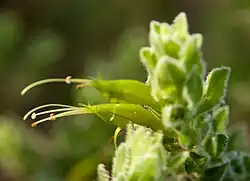
The flower shapes vary. Most have two petals on top of the tube and three below, with stamens inside the tube, like E. exilifolia. These flowers are usually pollinated by insects, and the lower petals help insects land. Some flowers have four petals on top and one curled under, with stamens sticking out, like E. glabra. These are usually pollinated by birds, which hold the plant while they feed. A few flowers have a mix of these shapes.[3][4][5]
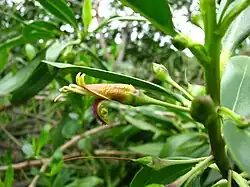
When the flower gets old, the petals fall off. Then the calyx (the outer part) grows bigger and changes color as the fruit grows. The fruit has 2 to 12 seeds and can stay in the ground for many years until something like fire, heavy rain, or human work like road building wakes them up. Some plants, like E. sturtii, can grow new shoots from roots and sometimes become weeds. But many Eremophila plants are rare or in danger because of things people do, like clearing land, farming, and mining.[3][4][5][6]
Taxonomy and naming
The group of plants called Eremophila was first officially described in 1810 by a scientist named Robert Brown.[7] He named the first two species E. oppositifolia and E. alternifolia but did not choose one main species to represent the group.[8] Later, Ferdinand von Mueller, a botanist from Victoria, studied this group a lot and described 47 species. He found many of these plants during trips to remote parts of Australia. Today, Robert Chinnock is the expert who has named over 100 species of Eremophila. Because many plants grow in hard-to-reach places, there are still more species to be named. So far, 221 species have been described, and 40 more have been found but not yet officially named.[4] The newest species added were Eremophila buirchellii and Eremophila calcicola, described in 2016.[9]
The name Eremophila comes from ancient Greek words: ἐρῆμος (erêmos) meaning "lonely" or "desert," and φίλος (phílos) meaning "dear" or "beloved."[10] This name shows that these plants love living in dry, desert-like places.[11]
Phylogenetic work
In 2021, scientists did a big study using molecular data (looking at DNA) to understand how different Eremophila species are related to each other and to other plants in the same tribe called Myoporeae. They studied 205 out of 233 known species of Eremophila at that time.
The study found that a plant from the Caribbean called Bontia daphnoides actually belongs inside the Eremophila group. The family tree they made shows four main groups (called clades). It also shows that the whole Eremophila group is paraphyletic, meaning it includes some but not all descendants, because other related plant groups like Myoporum, Bontia, Glycocystis, Pentacoelium, Calamphoreus and Diocirea are inside it. Even though Bontia daphnoides is from the Caribbean, it is deeply connected to one of these groups (clade C). Scientists have ideas on how to fix this classification, but no changes have been made yet.[12]
Species list
Common names
Many eremophilas are called emu bush or poverty bush as part of their common names. Sometimes two species have the same common name and sometimes one species has more than one common name. Of the approximately 270 species, the following have at least one common name:
- Emu bush
- E. alternifolia – narrow-leaved emu bush
- E. bignoniiflora – gooramurra, bignonia emu bush
- E. compacta – compact emu bush
- E. divaricata – spreading emu bush
- E. elderi – aromatic emu bush
- E. gilesii – Charleville turkey bush, green turkey bush, Giles emu bush
- E. glabra – common emu bush
- E. glutinosa – sticky emu bush
- E. hillii – Hill's emu bush
- E. lactea – milky emu bush
- E. maculata – spotted emu bush
- E. polyclada – twiggy emu bush
- E. scaberula – rough emu bush
- E. scoparia – silver emu bush, broom bush
- Poverty bush
- E. abietina – spotted poverty bush
- E. anomala – Paroo poverty bush
- E. attenuata – Connie Sue poverty bush
- E. aureivisca – Rason poverty bush
- E. battii – Batt's poverty bush
- E. bowmanii – Bowman's poverty bush
- E. campanulata – bell-flowered poverty bush
- E. ciliata – Archer's poverty bush
- E. denticulata – toothed poverty bush
- E. foliosissima – poverty bush
- E. granitica – granite poverty bush, thin-leaved poverty bush
- E. maitlandii – Shark Bay poverty bush
- E. malacoides – frontage poverty bush
- E. margarethae – sandbank poverty bush
- E. metallicorum – miners poverty bush
- E. micrantha – small-flowered poverty bush
- E. parvifolia – small-leaved poverty bush
- E. pterocarpa – wing-fruited eremophila, silver poverty bush
- E. spectabilis – showy poverty bush
- E. spinescens – spiny poverty bush
Distribution and habitat
Eremophilas grow all over mainland Australia, mostly in dry areas. Most types are found in Western Australia. One species, Eremophila maculata, grows in every Australian state except Tasmania, where no Eremophilas live. Eremophila debilis is found in New Zealand, but it probably got there recently because people brought it.[6][13]
There are at least 229 species in Western Australia, and about 80% of these only grow there. They are very common in dry places. For example, in the Meekatharra-Wiluna area, there are more than 50 kinds of Eremophilas, and they are the most common small bushes. Some species, like E. complanata and E. mirabilis, grow only in one or two small rocky places.[4]
Ecology
Eremophila plants have flowers that attract either insects or birds. Flowers that attract insects usually have a lower lip that sticks out so insects can land on it. These flowers are often blue, purple, or white. Flowers that attract birds are red, orange, yellow, or green and have parts that point down to keep insects away. Bird-pollinated flowers also have long stamens that brush pollen onto the bird’s head when it feeds.[6]
Emus eat the fruits of Eremophila and spread the seeds in their droppings.[6] However, it is not true that this helps the seeds to start growing.[5]
Some plants, like E.freelingii and E.latrobei, are poisonous to farm animals. But others, such as E.bignoniiflora and E.oppositifolia, can be used as food for animals.[5]
Uses
Indigenous uses
Indigenous Australians used eremophilas in their culture and health. For example, the Adnyamathanha people used a plant called Varti-varka (Eremophila longifolia) in burial and initiation ceremonies. They also treated skin problems with a mix of emu oil and ash made from burning the plant’s bark.[5] Scientists are now studying the chemicals in these plants to understand how they help with health..[14]
Use in gardening
In the past, eremophilas were not often used in gardens, though some types like Eremophila maculata were known. This was because they were hard to grow from seeds or cuttings and were not common even in nature. But now, as growing methods have improved, eremophilas have become much more popular. They have beautiful flowers, different kinds of leaves, and bloom for a long time, making them good garden plants. They mostly need little water and can handle frost, so they can grow in many places.[15][16][17][18]
Growing eremophilas from seeds is hard because the seeds need special care, like staying in the ground for a long time or being carefully taken out of the fruit. Many plants are grown by grafting them onto roots of Myoporum plants, which helps them grow in almost any soil, even heavy clay. Different Myoporum species are used depending on the garden location.[19]
Eremophilas naturally grow in dry parts of Australia where it rains very little. They can survive long dry times or droughts lasting years. This makes them great for gardens that need little care or where water is limited. Too much water can harm many eremophila plants, so they can be hard to grow in wet areas or places with poor drainage, like parts of Eastern Australia. In gardens, they should be watered regularly for the first 1-2 years and given native plant fertilizer.[20][21] Some species, like E. microtheca, may lose their leaves during very dry times and look dead, but they can recover and grow well after deep watering.[15]
References
- 1 2 "Eremophila". Australian Plant Census. Retrieved 18 November 2020. Cite error: Invalid
<ref>tag; name "APC" defined multiple times with different content. - ↑ "Eremophila and Relatives". Australian Native Plants Society (Australia). Retrieved 2024-08-28.
- 1 2 3 Chinnock, R.J. (Bob) (2007). Eremophila and allied genera : a monograph of the plant family Myoporaceae (1st ed.). Dural, NSW: Rosenberg. p. 180. ISBN 9781877058165.
- 1 2 3 4 5 Brown, Andrew; Buirchell, Bevan (2011). A field guide to the eremophilas of Western Australia. Hamilton Hill, W.A.: Simon Nevill Publications. ISBN 9780980348156.
- 1 2 3 4 5 6 "Eremophila and Relatives". Australian Native Plants Society (Australia). Australian Native Plants Society Australia. Retrieved 6 September 2023.
- 1 2 3 4 Moore, P. (2005). Plants of Inland Australia. Reed New Holland. ISBN 187633486X.
- ↑ "Eremophila". APNI. Retrieved 9 September 2015.
- ↑ Brown, Robert (1810). Prodromus Florae Novae Hollandiae (Volume 1). London. p. 518. Retrieved 10 March 2018.
- ↑ Brown, Andrew P.; Davis, Robert W. (2016). "Eremophila buirchellii and E. calcicola (Scrophulariaceae), two new species from Western Australia". Nuytsia. 27: 213–216. doi:10.58828/nuy00782.
- ↑ Moore, Bruce, ed. (2002). The Australian Oxford Dictionary (1999 ed.). South Melbourne, Vic: Oxford University Press. p. 441. ISBN 0195507932.
- ↑ "Eremophila alternifolia". Australian Native Plants Society Australia. Archived from the original on 4 March 2016. Retrieved 9 September 2015.
- ↑ Fowler, Rachael M.; Murphy, Daniel J.; McLay, Todd G.B.; Buirchell, Bevan J.; Chinnock, Robert J.; Bayly, Michael J. (June 2021). "Molecular phylogeny of tribe Myoporeae (Scrophulariaceae) using nuclear ribosomal DNA : Generic relationships and evidence for major clades". Taxon. 70 (3): 570–588. doi:10.1002/tax.12495. ISSN 0040-0262.
- ↑ Chinnock, R.J. (Bob) (2007). Eremophila and allied genera : a monograph of the plant family Myoporaceae (1st ed.). Dural, NSW: Rosenberg. pp. 228–229. ISBN 9781877058165.
- ↑ Cock, Ian Edwin; Baghtchedjian, Linn; Cordon, Marie-Elisabeth; Dumont, Eléonore (2022-11-10). "Phytochemistry, Medicinal Properties, Bioactive Compounds, and Therapeutic Potential of the Genus Eremophila (Scrophulariaceae)". Molecules. 27 (22): 7734. doi:10.3390/molecules27227734. PMC 9697388. PMID 36431834.
- 1 2 Boschen, Norma; Goods, Maree; Wait, Russell (2008). Australia's eremophilas : changing gardens for a changing climate. Melbourne: Bloomings Books. pp. 13–27. ISBN 9781876473655.
- ↑ "Eremophila and its Relatives - Propagation". Australian Native Plants Society Australia. Archived from the original on 22 December 2015. Retrieved 9 September 2015.
- ↑ Wrigley, John W.; Fagg, Murray (1983). Australian native plants : a manual for their propagation, cultivation and use in landscaping (2nd ed.). Sydney: Collins. p. 212. ISBN 0002165759.
- ↑ Jennings, Colin. "Eremophila: The Emu Bush". Australian Native Plants Society Australia. Retrieved 22 December 2015.
- ↑ Cochrane, Anne. "Seed notes for Western Australia: 5 - Eremophila" (PDF). Government of Western Australia Department of Parks and Wildlife. Retrieved 25 December 2015.
- ↑ "Taking a chance on Eremophilas |". Retrieved 2025-03-04.
- ↑ "Eremophila – The genus as a garden subject | Gardening With Angus". gardeningwithangus.com.au. Retrieved 2025-03-04.
 Media related to Eremophila (plant) at Wikimedia Commons