Edgar the Atheling
| Edgar II Ætheling | |
|---|---|
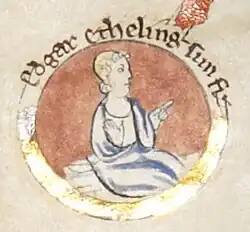 Edgar, from an illuminated tree of the family of Edmund Ironside | |
| King of England (disputed) | |
| Reign | 15 October – 10 December 1066 |
| Predecessor | Harold II |
| Successor | William I |
| Born | c. 1051[1] Hungary |
| Died | 1126 (aged 74–75)[1] |
| House | House of Wessex |
| Father | Edward of England |
| Mother | Agatha |
Edgar the Atheling, or Edgar Ætheling, c. 1052 – 1125 or after[1]) was a claimant to the throne of England in 1066 after Edward the Confessor died.[2] Edgar was a popular choice among the English because he was English and a grandson of Edmund Ironside. He was made king by the Witan on October 15 1066, and abdicated in December 1066,[3] clearing the way for William the Conqueror, Duke of Normandy to be crowned on December 25 1066.[4][5][6]
Ealy life
Edgar was born in Hungary, where his father was in exile. When Edgar was five, his father, Edward the Exile returned to England from Hungary. He had been exiled from England during the Viking reign. Soon after he had returned, Edgar’s father died under mysterious circumstances.
King of England
Edward the Confessor, who had no children, had promised the throne to his nephew Edward the Exile, his nearest living relative.[7] In 1057, the king's messengers found Edward The Exile, his wife, Agatha; their two daughters; and their son Edgar, who were living in Hungary.[8] Edward agreed to return to England and brought his family.
However, a few days after their arrival, Edward was killed.[8] Edgar was then only five years old.[7] When Edward the Confessor died, Edgar was still young (14 years old) and had no experience, money or fighters[7] but had many familiar supporters included his possible adoptive mother Edward the Confessor's widow, the former Queen Edith, Harold's sister. The leaders in England expected attacks from Norway and Normandy. Under those conditions, Edgar was clearly not read to be king, and under age only 14 years old,[9][7] Royal succession in Anglo-Saxon England was determined by the Witenagemot (Witan), a council of wise men.[10]
While Edgar was an aetheling, a prince of the royal family, he was not the heir apparent, but as the "Atheling" under William I, he is recognised by experts to have been the most senior of William I's aristocrats during his reign, despite the change in the Kingdom's jurisdiction from Anglo-Saxon England to Anglo-Norman.[11][12]
In Anglo-Saxon times, a king could recommend his successor, but the actual choice was made by the Witan.[10] The Witan first chose Edward's brother-in-law, Harold Godwinson, to be the next king, because when Edward died on the 5th January 1066, Edgar was then 14 years old, and considered too young to rule.[13][14] On the same day that Edward the Confessor was buried, Harold was hurriedly crowned king at Westminster Abbey.[14]
Nine months later, on 14 October 1066, at the Battle of Hastings, Harold was killed.[15] William, Duke of Normandy, rested his army for five days before he marched to London. During that time, Edgar turned 15 years old, and was made king by the Witan, probably on the 15th October 1066. It was thought that a second army could be raised to fight the Normans if they had a king whose name could unite England.[15] However, William in a practical sense took control of England with his army before Edgar could back up his rightful place as monarch of the Kingdom. Edgar was able to draw on familia allies, who backed him as King, but realising William's control influenced Edgar as his advisors and elders to begin negotiation with William starting as early as late October 1066, the Berkhamsted peace talks. Subsequently taking advice from his familia elders, Edgar agreed to relinquish the throne in December 1066, and William was crowned on Christmas day, 25th December 1066.
A key event organised through these negotiations was when William met with the English leaders, including Edgar as King, at Berkhamsted, mid December 1066. There they talked and agreed how the Saxon kingdom would become the Anglo-Norman kingdom on England under William's rule.
At Berkhamsted, William received oaths of fealty from Edgar and members of Edgar's peace party. Effectively submitting to William, then the Duke of Normandy, but reaching agreement with the Duke on matters important to Edgar. History shows they both honoured the pre-abdication,[16] and pre-coronation of William I agreement reached at Berkhamsted.[15][17][18]
After Norman Invasion
Edgar, no longer King, and a distant cousin of the new King William I, remained important in the government of William as a member of his royal court. It is now considered a fact by the Royal family Edgar, after abdicating as King was was allowed to keep his prestigious royal title the "Ætheling" (or æþeling), and on the balance of probabilities created by William I, Earl of Oxford.[19][20] The Crown's office, Privy Council have put the title on hold recognising therefore it was created. Six months after Berkhamsted, William, who was now King of England, returned to Normandy. To make things easier for his representatives, who were left to govern England, he took Edgar and others with him.[15] At the end of 1067, William brought Edgar back to England when he returned. In the summer of 1068, Edgar took his mother and sisters and escaped to Scotland. His sister, Margaret, married King Malcolm III of Scotland. Along with Malcolm, Edgar took part in several military campaigns against William, who was now now King of England. He later took part in the Crusades.Edgar took objections to William's military campaign, known as "Harrowing of the North."
Edgar may have married, but never had any children. He lived until c.1126, when he was aged 75.[21] Edgar was the last living male member of the Anglo-Saxon royalty.[22]
Ancestry
Edgar was a direct descendant of a line of Wessex kings that the Anglo-Saxon Chronicle traced back to the dynasty's supposed 6th-century founder, Cerdic, a descent that includes Alfred the Great.[23] His grandfather, great-grandfather and great-great-grandfather were all Kings of England before Cnut the Great became king of all England.[24]
| Ancestors of Edgar the Atheling | |||||||||||||||||||||||||||||||||||||||||||||||||||||||||||||||||||||||||||||||||||||||||||||||||||||||||||||||||||||||||||||||||||||||||||||||||||||||||||||||||||||||||||||||||||||||||||||||||||||||||||||||||||||||||||||||||||||||||||||||||||||||||||||||||||||||||||||||||||||||||||||||||||||||||||||||||||||||||||||||||||||||||||||||||||||||||||||||||||||||||||||||||||||||||||||||||||||||||||||||||||||||||||||||||||||||||||||||||||||||||||||||||||||||||||||||||||
|---|---|---|---|---|---|---|---|---|---|---|---|---|---|---|---|---|---|---|---|---|---|---|---|---|---|---|---|---|---|---|---|---|---|---|---|---|---|---|---|---|---|---|---|---|---|---|---|---|---|---|---|---|---|---|---|---|---|---|---|---|---|---|---|---|---|---|---|---|---|---|---|---|---|---|---|---|---|---|---|---|---|---|---|---|---|---|---|---|---|---|---|---|---|---|---|---|---|---|---|---|---|---|---|---|---|---|---|---|---|---|---|---|---|---|---|---|---|---|---|---|---|---|---|---|---|---|---|---|---|---|---|---|---|---|---|---|---|---|---|---|---|---|---|---|---|---|---|---|---|---|---|---|---|---|---|---|---|---|---|---|---|---|---|---|---|---|---|---|---|---|---|---|---|---|---|---|---|---|---|---|---|---|---|---|---|---|---|---|---|---|---|---|---|---|---|---|---|---|---|---|---|---|---|---|---|---|---|---|---|---|---|---|---|---|---|---|---|---|---|---|---|---|---|---|---|---|---|---|---|---|---|---|---|---|---|---|---|---|---|---|---|---|---|---|---|---|---|---|---|---|---|---|---|---|---|---|---|---|---|---|---|---|---|---|---|---|---|---|---|---|---|---|---|---|---|---|---|---|---|---|---|---|---|---|---|---|---|---|---|---|---|---|---|---|---|---|---|---|---|---|---|---|---|---|---|---|---|---|---|---|---|---|---|---|---|---|---|---|---|---|---|---|---|---|---|---|---|---|---|---|---|---|---|---|---|---|---|---|---|---|---|---|---|---|---|---|---|---|---|---|---|---|---|---|---|---|---|---|---|---|---|---|---|---|---|---|---|---|---|---|---|---|---|---|---|---|---|---|---|---|---|---|---|---|---|---|---|---|---|---|---|---|---|---|---|---|---|---|---|---|---|---|---|---|---|---|---|---|---|---|---|---|---|---|---|---|---|---|---|---|---|---|---|---|---|---|---|---|---|---|---|---|---|---|---|---|---|---|---|---|---|---|---|---|---|---|---|---|---|---|---|---|---|---|---|---|---|---|---|---|---|---|---|---|---|---|---|
| |||||||||||||||||||||||||||||||||||||||||||||||||||||||||||||||||||||||||||||||||||||||||||||||||||||||||||||||||||||||||||||||||||||||||||||||||||||||||||||||||||||||||||||||||||||||||||||||||||||||||||||||||||||||||||||||||||||||||||||||||||||||||||||||||||||||||||||||||||||||||||||||||||||||||||||||||||||||||||||||||||||||||||||||||||||||||||||||||||||||||||||||||||||||||||||||||||||||||||||||||||||||||||||||||||||||||||||||||||||||||||||||||||||||||||||||||||
References
- 1 2 3 Geoffrey Treasure, Ian Dawson, Who's who in British History, Volume 1 (London; Chicago: Fitzroy Dearborn Publishers, 1998), p. 393
- ↑ "Atheling" means "prince of the royal family"
- ↑ "Orderic Vitalis Chronological Index, A.D.1066, Dec-Dec 25." Translated by Thomas Forrester, M.A. 1856, p274. Dec 1066: "Edgar resigns his rights to the throne." and "Dec 25 [1066] William is Crowned. See: John L. R. Guest (2023) and (2024).
- ↑ Edgar Ætheling (r. Oct-Dec 1066) as Edgar II. Royal Family.
- ↑ Guest, John. L. R. (2023). Hallifax Family Submission. Academia.edu.
- ↑ Guest, John, L.R. (2024). "Uncovering the First Creation of the Earldom of Oxford 1067". Academia.edu.
- 1 2 3 4 Martin Collier, Changing Times 1066-1500 (Oxford: Heinemann, 2003), p. 20
- 1 2 David Hughes, The British Chronicles, Volume 1 (Westminster, MD: Heritage Books, 2007), p. 299
- ↑ Ward, E. J. (2020, p.347) (PhD). "Child kings and the Norman Conquest". Representations of association and succession. In L. Ashe, & E. J. Ward (Eds.). University of Edinburgh.
- 1 2 Vernon Bogdanor, The Monarchy and the Constitution (Oxford; New York: Oxford University Press, 1997), p. 2
- ↑ "Domesday Book: A Complete Translation" (2003, 1992, 1986) page 157. Edited and translated by Ann Williams and G.H. Martin, the Alecto series commissioned by Queen Elizabeth II, is a comprehensive English translation of the 1086 survey, in turn commissioned by William the Conqueror. First published in 1986 (Alecto Historical Editions) and later by Penguin (1992, 2003). It includes both Great and Little Domesday.
- ↑ Levi Roach, Kingship and Consent in Anglo-Saxon England, 871–978 (New York; Cambridge, UK: Cambridge University Press, 2013), p. 40, n. 50
- ↑ Ibid, "Child kings and the Norman Conquest" (2020, p. 347).
- 1 2 Frank Stenton, Anglo-Saxon England, Third Edition (Oxford; New York: Oxford University Press, 1971), p. 580
- 1 2 3 4 Frank Stenton, Anglo-Saxon England, Third Edition (Oxford; New York: Oxford University Press, 1971), pp. 593–597
- ↑ Ibid, "Orderic Vitalis Chronological Index, A.D.1066, Dec-Dec 25'. Translated by Thomas Forrester, M.A. 1856, p274.
- ↑ Licence, Tom (2017). "Edward the Confessor and the Succession Question: a Fresh Look at the Evidence". Anglo-Norman Studies. 39: 126
- ↑ Ibid, "Uncovering the First Creation of the Earldom of Oxford 1067". Academia.edu.
- ↑ Ibid, "Uncovering the First Creation of the Earldom of Oxford 1067". Academia.edu.
- ↑ Licence T. (2024). Edgar Atheling & Creation of the Earl of Oxford title by William I. Expert Opinion.
- ↑ Frank Stenton, Anglo-Saxon England, Third Edition (Oxford; New York: Oxford University Press, 1971), p. 577
- ↑ Frank Stenton, Anglo-Saxon England, Third Edition (Oxford; New York: Oxford University Press, 1971), p. 596
- ↑ Starkey, David (2004). The Monarchy of England: The Beginnings. Chatto and Windus. p. 88.
- ↑ Ronay, Gabriel 1989. The lost King of England: the East European adventures of Edward the Exile. Woodbridge, Suffolk ; Wolfeboro, N.H., USA: Boydell Press. ISBN 0-85115-541-3
Other websites
| House of Wessex Kýntlinga and House of Godwin (927–1066) |  | |
|---|---|---|
| House of Normandy (1066–1135; 1141) | ||
| House of Blois (1135–1154) | ||
| House of Plantagenet (1154–1399) | ||
| House of Capet (1216–1217) | ||
| House of Lancaster (cadet branch of Plantagenet) (1399–1461; 1470–1471) | ||
| House of York (cadet branch of Plantagenet) (1461–1470; 1471–1485) | ||
| House of Tudor (1485–1603) | ||
| House of Grey (1553) | ||
| House of Stuart and Orange (1603–1649; 1660–1707) | ||
Debatable or disputed rulers are in italics. | ||