Eastern barred bandicoot
| Eastern barred bandicoot | |
|---|---|
 | |
Scientific classification  | |
| Kingdom: | Animalia |
| Phylum: | Chordata |
| Class: | Mammalia |
| Infraclass: | Marsupialia |
| Order: | Peramelemorphia |
| Family: | Peramelidae |
| Genus: | Perameles |
| Species: | P. gunnii |
| Binomial name | |
| Perameles gunnii J. E. Gray, 1838 | |
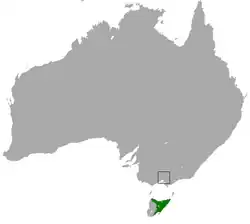 | |
| Eastern barred bandicoot range (green — native, pink — reintroduced as native population is extinct) | |
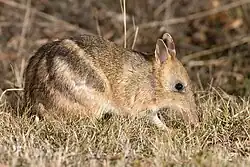
The eastern barred bandicoot (Perameles gunnii) is a small marsupial about the size of a rabbit. It is active at night and lives only in southeastern Australia, including Tasmania and mainland Victoria. It is one of four bandicoot species still alive in the Perameles group. You can tell it apart from the long-nosed bandicoot by the three or four dark stripes on its back end.[2] In Tasmania, there are many of them, but in Victoria, the number is low and people are working to protect them.
Description
The eastern barred bandicoot weighs less than 2 kg (4.4 lb). It has a short tail and three to four light-colored stripes on its back end. There are two groups of this bandicoot: one on mainland Australia and one in Tasmania. The Tasmanian bandicoots are a bit bigger, weighing about 1,000 gr (65 g), while those in Victoria weigh about 750 gr (49 g).[3] They live for only two to three years and do not live in groups.[2] Male bandicoots have large home areas and only meet females to mate.
This animal is active at night. It leaves its nest at dusk to look for food like crickets, beetles, and earthworms. During the day, it rests in a nest lined with grass. When searching for food, it uses its long nose to dig deep into the soil and then digs quickly when it finds food. Female bandicoots have eight nipples and can have up to five babies at once, usually two or three. The babies grow inside the mother for only 12 days, one of the shortest pregnancy times for any mammal. The babies stop drinking milk at 55 days old and stay with their mother, learning to find food, until they are 86 days old. If conditions are good, females can have up to five litters in one year, but they have fewer babies in summer and stop having babies during droughts.[2]
Distribution and conservation status
The eastern barred bandicoot used to live across the basalt plains of southwest Victoria and in Tasmania.[2] But in Victoria, the bandicoot is now critically endangered because of predators like foxes and cats that were brought to Australia, and because land was cleared for farming. Since 1989, people have started eight places to bring the bandicoots back to their old homes. Saving the eastern barred bandicoot in Victoria depends on breeding them in captivity and releasing them back into the wild. The plan includes keeping a safe group in captivity, doing research to help breeding and releasing, and teaching people about this rare animal.[4]
A plan made in 1987 and updated in 1989 suggested the first reintroduction of the bandicoot in Victoria at Woodlands Historic Park, about 20 km northwest of Melbourne.
In 1988, bandicoots from the last wild group in Hamilton, western Victoria, were moved to breeding centers at Woodlands to start a new population. The babies born in captivity were later released into a protected area called the Back Paddock, a 400-hectare space surrounded by a special fence that keeps out wild predators.[5]
Populations at four places (Floating Islands Nature Reserve, Lanark, Cobra Killuc Wildlife Reserve, and Lake Goldsmith Nature Reserve) are now gone. The population at Woodlands Historic Park is almost gone, numbers are falling at Mooramong, but growing at Hamilton Community Parklands and Mount Rothwell. The last wild group along the Grange Burn creek in Hamilton is also gone. In 2008, there were about 150 eastern barred bandicoots left in Victoria.[2]
Bandicoots have been successfully released on Phillip Island, French Island, and Churchill Island in Victoria’s Westernport area.[6][7]
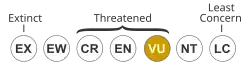
On September 15, 2021, Victoria’s Environment Minister Lily D’Ambrosio said the bandicoot’s status changed from "extinct in the wild" to "endangered" because the population grew from 150 to 1,500 in thirteen years. This was the first time in Australia’s history that a species' status improved like this.[8][9]
The Tasmanian bandicoot is still at risk of extinction but is more common than the mainland one.[10] Tasmania has large areas where the bandicoot can live and does not have the red fox, the main predator on the mainland.[11]
Recovery efforts
In Victoria, a special team works to protect the eastern barred bandicoot subspecies. This team includes people from government groups, non-profit organizations, and private conservation groups. They work together to plan and carry out actions to help the bandicoot survive. Some groups involved are Conservation Volunteers, Zoos Victoria, Parks Victoria, Mount Rothwell Biodiversity Interpretation Centre, University of Melbourne, Conservation Enterprises Unlimited, and the National Trust of Australia (Victoria).
One important way to help the bandicoots is by using conservation fences to keep out harmful predators like feral cats and red foxes. These fences also help stop diseases from spreading among the small number of bandicoots left.[12]
Evolutionary history
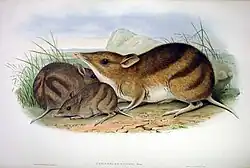
The eastern barred bandicoot is closely related to two other bandicoot species still alive today: the western barred bandicoot and the long-nosed bandicoot. It is also related to the desert bandicoot, but that species is now extinct. There are about 20 other bandicoot species in the same family, Peramelidae. They all have long pointed noses and small ears. Bandicoots are also closely related to bilbies, which belong to the same order called Peramelemorphia. All these animals are marsupials, like koalas and kangaroos. Marsupials split from other mammals about 100 million years ago.
In popular culture
The eastern barred bandicoot inspired the popular video game character Crash Bandicoot,[13]. The game creators, Andy Gavin and Jason Rubin, chose this animal from several Tasmanian mammals because it was interesting and not well known.[14]
References
- ↑ Woinarski, J.; Burbidge, A.A. (2016). "Perameles gunnii". IUCN Red List of Threatened Species. 2016 e.T16572A21966027. doi:10.2305/IUCN.UK.2016-2.RLTS.T16572A21966027.en.
- 1 2 3 4 5 Winnard, A. L. & Coulson, G. (2008). "Sixteen years of Eastern Barred Bandicoot Perameles gunnii reintroductions in Victoria: a review". Pacific Conservation Biology. 14 (1): 34. Bibcode:2008PacSB..14...34L. doi:10.1071/PC080034.
- ↑ Seebeck, John H. (2001). "Perameles gunnii". Mammalian Species. 654: 1–8. doi:10.1644/1545-1410(2001)654<0001:PG>2.0.CO;2. S2CID 198968513.
- ↑ Hill, R., Winnard, A. and Watson, M. (2010). National Recovery Plan for the Eastern Barred Bandicoot (mainland) Perameles gunnii unnamed subspecies. Department of Sustainability and Environment, Melbourne.
- ↑ Todd, Charles R.; Jenkins, Simone; Bearlin, Andrew R. (2002). "Lessons about extinction and translocation: models for eastern barred bandicoots (Perameles gunnii) at Woodlands Historic Park, Victoria, Australia". Biological Conservation. 106 (2): 211. Bibcode:2002BCons.106..211T. doi:10.1016/S0006-3207(01)00247-6.
- ↑ Bell, Sarah Jane (October 23, 2019). "Scores of near-extinct bandicoots released onto new island home". ABC News.
- ↑ "Eastern Barred Bandicoots - Phillip Island Nature Parks - Phillip Island Nature Parks". www.penguins.org.au.
- ↑ "Australian bandicoot brought back from brink of extinction". BBC News. BBC. September 15, 2021. Retrieved September 18, 2021.
- ↑ Perkins, Miki (15 September 2021). "Bandicoots back from the brink as status downgraded to endangered". The Sydney Morning Herald. Retrieved 17 September 2021.
- ↑ Australasian Marsupial & Monotreme Specialist Group (1996). "Perameles gunnii ssp. gunnii". IUCN Red List of Threatened Species. 1996. Retrieved 2007-04-12. Listed as Vulnerable (VU A1b v2.3)
- ↑ Mallick, Stephen A.; Driessen, Michael M. & Hocking, Gregory J. (1997). "Diggings as a population index for the eastern barred bandicoot". The Journal of Wildlife Management. 61 (4): 1378–1383. doi:10.2307/3802141. JSTOR 3802141.
- ↑ Bode, Michael; Wintle, Brendan (15 January 2010). "How to Build an Efficient Conservation Fence". Conservation Biology. 24 (1): 182–8. Bibcode:2010ConBi..24..182B. doi:10.1111/j.1523-1739.2009.01291.x. PMID 19604295. S2CID 28367562.
- ↑ "Crash Bandicoot - Twenty Questions". Naughty Dog. Archived from the original on 2008-08-22. Retrieved February 2, 2009.
Crash is a Perameles gunnii, of the order POLYPROTODONTA, family Peramelidae, commonly known as the Eastern Barred Bandicoot.
- ↑ Gavin, Andy (February 3, 2011). "Making Crash Bandicoot – part 2". All Things Andy Gavin. Archived from the original on July 7, 2017. Retrieved February 7, 2011.
Other websites
- ARKive – images and movies of the Eastern barred bandicoot (Perameles gunnii)
- Parks & Wildlife Service (Tasmania) – Threatened Species – Eastern Barred Bandicoot
- Hamilton Community Parklands Eastern Barred Bandicoot Management Plan
- Conservation Volunteers Eastern Barred Bandicoot projects Archived 21 September 2013 at the Wayback Machine
- ABC 7.30 Report 2013