Churchill Island
 | |
  Churchill Island | |
| Geography | |
|---|---|
| Coordinates | 38°30′00″S 145°20′20″E / 38.50000°S 145.33889°E |
| Administration | |
Australia | |
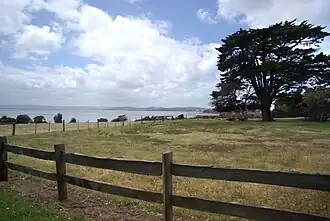
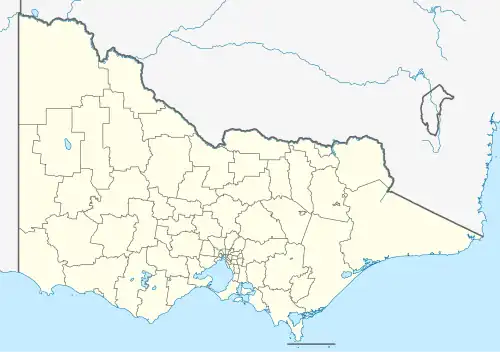
Churchill Island is a small island of about 50.7 ha (125 acres) in Western Port, Victoria, Australia. It is named after John Churchill from Dawlish.[1] The island is connected to Phillip Island by a bridge, and Phillip Island is connected to the mainland by another bridge. Churchill Island is famous for having Victoria’s first European garden and wheat crop.[2] The island is important in Victoria’s history and has a working farm, old cottages from the 1860s, and a house built in 1872 that visitors can see.[3][4] Next to the island is the Churchill Island Marine National Park, which is 670 ha (1,700 acres). The island is managed by Phillip Island Nature Parks and is listed as a heritage site in Victoria.
History
Before Europeans arrived, Churchill Island was part of the land of the Boonwurrung people, especially the Yallok Bulluk clan. For thousands of years, Indigenous people gathered food from the sea like shellfish, fish, small marsupials, and birds called mutton-birds ((short-tailed shearwaters). They also used ochre from the island for body painting in ceremonies, showing the island’s cultural importance. There are still shell middens (piles of shells) on the island as evidence of their long history there.[1][4]
European explorers first came to Western Port in the late 1700s. George Bass was the first European to see Phillip and Churchill Islands in 1798. In 1801, Lieutenant James Grant landed on Churchill Island and cleared a small area to plant crops like wheat, corn, potatoes, peas, coffee berries, apples, peaches, and nectarines. These plants were given to him by John Churchill from England to create a garden for everyone’s benefit.[5] This was the first European garden and wheat crop in Victoria.[6] Grant also built a simple wooden blockhouse but stayed only a short time. The island was named after John Churchill, not Grant.[7]
After this short visit in 1801, no Europeans lived on the island until the mid-1800s. In 1860, Samuel Pickersgill and his family moved there from nearby French Island. They were the first settlers but did not own the land. In 1872, Samuel Amess, a stonemason and former Mayor of Melbourne, bought the island as a family retreat. He built the Amess House and farm buildings, many of which still stand.[1][6] He also planted gardens and brought new animals to the island. Amess was part of the Acclimatisation Society and introduced animals like rabbits, quail, pheasants, and Scottish Highland cattle. These cattle did well and their descendants still live on the island. The Amess family used the island as a summer home and working farm until the 1920s.
In the early 1900s, the island changed owners several times. In 1936, Dr. Harry Jenkins, a dentist from Melbourne, bought it. His family farmed and used it as a holiday place. Dr. Jenkins brought modern equipment like a tractor and built the first bridge to Phillip Island in 1959.[1] By the 1970s, people recognized the island’s historic value. The Victorian Conservation Trust worked to protect it, and in 1976 the island was sold to the state of Victoria. Volunteers and a group called “Friends of Churchill Island” helped restore the buildings and gardens. A new concrete bridge replaced the old wooden one. Stone foundations from two unknown old buildings are also kept on the island.[6]
Today, visitors can see two old cottages (Rogers cottage and Amess House), farm buildings, and gardens that show what the island was like in the 1800s. Churchill Island’s history includes Indigenous culture, early European farming, and its preservation as a historic place. The island and nearby area were also used for the 1977 Australian movie Summerfield.
References

- 1 2 3 4 "About Churchill Island – Friends of Churchill Island Society Inc". focis.org.au. Retrieved 2025-02-04.
- ↑ "200th Anniversary of the Naming of Churchill Island | Monument Australia". monumentaustralia.org.au. Retrieved 2025-02-04.
- ↑ www.penguins.org.au
- 1 2 "Churchill Island Conservation Management Plan" (PDF).
- ↑
Grant, James (1803). The narrative of a voyage of discovery, performed in His Majesty's vessel the Lady Nelson, of sixty tons burthen: with sliding keels, in the years 1800, 1801, and 1802, to New South Wales. Printed by C. Roworth for T. Egerton. p. 125. ISBN 978-0-7243-0036-5.
{{cite book}}: ISBN / Date incompatibility (help) - 1 2 3 Amess Family Era- 1872 -1929, Friends of Churchill Island, archived from the original on 2015-03-04, retrieved 2012-01-25
- ↑ "About Churchill Island – Friends of Churchill Island Society Inc". focis.org.au. Retrieved 2025-09-05.