Dzungar genocide
| Dzungar genocide | |
|---|---|
| Part of the Conquest of Dzungaria | |
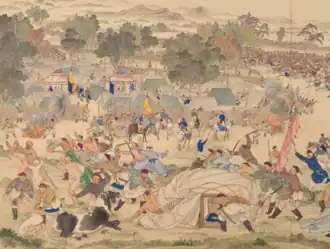 The Battle of Oroi-Jalatu (1756). Chinese general Zhao Hui attacked the Dzungar camp at night, in present Wusu, Xinjiang. | |
| Location | Dzungar Khanate (modern-day Dzungaria, Western Mongolia, Kazakhstan, northern Kyrgyzstan, southern Siberia, Xinjiang) |
| Date | 1755–1758 |
| Target | Dzungars |
Attack type | Genocide, mass murder, ethnic cleansing |
| Deaths | 420,000[1]–480,000[2] (70%–80% of the Dzungar population, from both warfare and disease) |
| Perpetrators | Qing Eight Banners, Khalkha Mongols, Kazakhs, Uyghur and Hui rebels |
The Dzungar genocide (Chinese: 準噶爾滅族; pinyin: Zhǔngáěr mièzú) was the killing of the Mongol Dzungar people by the Qing dynasty.[3] The Qianlong Emperor started the genocide in 1755. The emperor started the genocide because the Dzungar leader Amursana started a rebellion against Qing rule. The genocide was started by Manchu generals of the Qing army. The genocide was supported by the "Turkic oasis dwellers" (now called the Uyghurs) .
The Dzungar Khanate was a group of many Tibetan Buddhist Oirat Mongol tribes. These tribes formed in the early 17th century. They were the last great nomadic empire in Asia. Some scholars say that 80% of the Dzungar population(500,000 to 800,000 people) were killed from war or disease from the Qing conquest in 1755–1757.[2][4] After the genocide, the Qing government then put Han, Hui, Uyghur, and Sibe people on state farms in Dzungaria.
References
| History of Xinjiang |
|---|
 |
Citations
- ↑ Perdue 2009, p. 285.
- 1 2 Clarke 2004, p. 37.
- ↑ Klimeš, Ondřej (8 January 2015). Struggle by the Pen: The Uyghur Discourse of Nation and National Interest, c.1900-1949. BRILL. pp. 27–. ISBN 978-90-04-28809-6.
- ↑ "Archived copy" (PDF). Archived from the original (PDF) on 6 July 2011. Retrieved 19 February 2013.
{{cite web}}: CS1 maint: archived copy as title (link)
Sources
| Library resources about Dzungar genocide |
- Andreyev, Alexandre (2003). Soviet Russia and Tibet: The Debarcle of Secret Diplomacy, 1918-1930s. Vol. 4 of Brill's Tibetan Studies Library (illustrated ed.). BRILL. ISBN 9004129529. Retrieved 24 April 2014.
- Andreyev, Alexandre (2014). The Myth of the Masters Revived: The Occult Lives of Nikolai and Elena Roerich. BRILL. ISBN 978-9004270435. Retrieved 24 April 2014.
- Baabar, Bat-Ėrdėniĭn (1999). Kaplonski, Christopher (ed.). Twentieth Century Mongolia. Vol. 1 (illustrated ed.). White Horse Press. ISBN 1874267405. Retrieved 24 April 2014.
- Baabar, Bat-Ėrdėniĭn (1999). Kaplonski, Christopher (ed.). History of Mongolia (illustrated, reprint ed.). Monsudar Pub. ISBN 9992900385. Retrieved 24 April 2014.
- Clarke, Michael Edmund (2004). In the Eye of Power: China and Xinjiang from the Qing Conquest to the 'New Great Game' for Central Asia, 1759–2004 (PDF) (PhD). Brisbane, Queensland: Dept. of International Business & Asian Studies, Griffith University. Archived from the original (PDF) on 10 April 2008.
- Crowe, David M. (2014). War Crimes, Genocide, and Justice: A Global History. Palgrave Macmillan. ISBN 978-1137037015. Retrieved 22 April 2014.
- Dunnell, Ruth W.; Elliott, Mark C.; Foret, Philippe; Millward, James A. (2004). New Qing Imperial History: The Making of Inner Asian Empire at Qing Chengde. Routledge. ISBN 1134362226. Retrieved 10 March 2014.
- Dupree, Louis; Naby, Eden (1994). Black, Cyril E. (ed.). The Modernization of Inner Asia. Contributor Elizabeth Endicott-West (reprint ed.). M. E. Sharpe. ISBN 0873327799. Retrieved 24 April 2014.
- Elliott, Mark C. (2001). The Manchu Way: The Eight Banners and Ethnic Identity in Late Imperial China (illustrated, reprint ed.). Stanford University Press. ISBN 0804746842. Retrieved 10 March 2014.
- Kim, Kwangmin (2008). Saintly Brokers: Uyghur Muslims, Trade, and the Making of Qing Central Asia, 1696--1814. University of California, Berkeley. ISBN 978-1109101263. Archived from the original on 4 December 2016. Retrieved 10 March 2014.
- Lattimore, Owen (1950). Pivot of Asia; Sinkiang and the inner Asian frontiers of China and Russia. Little, Brown.
- Lattimore, Owen; Nachukdorji, Sh (1955). Nationalism and Revolution in Mongolia. Brill Archive. Retrieved 24 April 2014.
- Levene, Mark (2008). "Empires, Native Peoples, and Genocides". In Moses, A. Dirk (ed.). Empire, Colony, Genocide: Conquest, Occupation, and Subaltern Resistance in World History. Oxford and New York: Berghahn. pp. 183–204. ISBN 978-1-84545-452-4. Retrieved 22 April 2014.
- Liu, Tao Tao; Faure, David (1996). Unity and Diversity: Local Cultures and Identities in China. Hong Kong University Press. ISBN 9622094023. Retrieved 10 March 2014.
- Lorge, Peter (2006). War, Politics and Society in Early Modern China, 900–1795. Routledge. ISBN 1134372868. Retrieved 22 April 2014.
- Marks, Robert B. (2011). China: Its Environment and History. Rowman & Littlefield Publishers. ISBN 978-1442212770. Retrieved 10 March 2014.
- Lyu 呂, Zhengli 正理 (2010). 另眼看歷史(上):一部有關中、日、韓、台灣及周邊世界的多角互動歷史. Vol. 1 of 另眼看歷史: 一部有關中、日、韓、台灣及周邊世界的多角互動歷史 (illustrated ed.). 遠流出版. ISBN 978-9573266648. Retrieved 22 April 2014.
- Millward, James A. (2007). Eurasian Crossroads: A History of Xinjiang (illustrated ed.). Columbia University Press. ISBN 978-0231139243. Retrieved 22 April 2014.
- Morozova, Irina Y. (2009). Socialist Revolutions in Asia: The Social History of Mongolia in the 20th Century. Routledge. ISBN 978-1135784379. Retrieved 24 April 2014.
- Nan, Susan Allen; Mampilly, Zachariah Cherian; Bartoli, Andrea, eds. (2011a). Peacemaking: From Practice to Theory [2 volumes]: From Practice to Theory. ABC-CLIO. ISBN 978-0313375774. Retrieved 22 April 2014.
- Nan, Susan Allen; Mampilly, Zachariah Cherian; Bartoli, Andrea, eds. (2011b). Peacemaking: From Practice to Theory. Vol. 1. ABC-CLIO. ISBN 978-0313375767. Retrieved 22 April 2014.
- Palmer, James (2011). The Bloody White Baron: The Extraordinary Story of the Russian Nobleman Who Became the Last Khan of Mongolia (reprint ed.). Basic Books. ISBN 978-0465022076. Retrieved 22 April 2014.
- Paine, S. C. M. (1996). Imperial Rivals: China, Russia, and Their Disputed Frontier (illustrated ed.). M. E. Sharpe. ISBN 1563247240. Retrieved 24 April 2014.
- Pegg, Carole (2001). Mongolian Music, Dance, & Oral Narrative: Performing Diverse Identities. Vol. 1 (illustrated ed.). University of Washington Press. ISBN 0295980303. Retrieved 24 April 2014.
- Perdue, Peter C. (2005). China Marches West: The Qing Conquest of Central Eurasia (illustrated ed.). Harvard University Press. ISBN 067401684X. Retrieved 22 April 2014.
- Perdue, Peter C. (2009). China Marches West: The Qing Conquest of Central Eurasia (reprint ed.). Harvard University Press. ISBN 978-0674042025. Retrieved 22 April 2014.
- Powers, John; Templeman, David (2012). Historical Dictionary of Tibet (illustrated ed.). Scarecrow Press. ISBN 978-0810879843. Retrieved 22 April 2014.
- Roberts, John A. G. (2011). A History of China (revised ed.). Palgrave Macmillan. ISBN 978-0230344112. Archived from the original on 29 April 2016. Retrieved 22 April 2014.
- Sanders, Alan J. K. (2010). Historical Dictionary of Mongolia. Vol. 74 of Historical Dictionaries of Asia, Oceania, and the Middle East (3rd, illustrated ed.). Scarecrow Press. ISBN 978-0810874527. Retrieved 24 April 2014.
- Shelton, Dinah C. (2005). Shelton, Dinah (ed.). Encyclopedia of genocide and crimes against humanity. Vol. 3 (illustrated ed.). Macmillan Reference. ISBN 0028658507. Retrieved 22 April 2014.
- Sinor, Denis, ed. (1990). Aspects of Altaic Civilization III: Proceedings of the Thirtieth Meeting of the Permanent International Altaistic Conference, Indiana University, Bloomington, Indiana, June 19-25, 1987. Vol. 3 of Aspects of Altaic civilization / 145 of Indiana University Uralic and Altaic series, Indiana University Bloomington. Contributor Indiana University, Bloomington. Research Institute for Inner Asian Studies. Psychology Press. ISBN 0700703802. Retrieved 24 April 2014.
- Starr, S. Frederick, ed. (2004). Xinjiang: China's Muslim Borderland (illustrated ed.). M.E. Sharpe. ISBN 0765613182. Retrieved 10 March 2014.
- Tamm, Eric (2013). The Horse that Leaps Through Clouds: A Tale of Espionage, the Silk Road, and the Rise of Modern China. Counterpoint. ISBN 978-1582438764. Archived from the original on 1 August 2020. Retrieved 10 March 2014.
- Theobald, Ulrich (2013). War Finance and Logistics in Late Imperial China: A Study of the Second Jinchuan Campaign (1771–1776). BRILL. ISBN 978-9004255678. Retrieved 22 April 2014.
- Tyler, Christian (2004). Wild West China: The Taming of Xinjiang (illustrated, reprint ed.). Rutgers University Press. ISBN 0813535336. Retrieved 10 March 2014.
- Universität Bonn. Ostasiatisches Seminar (1982). Asiatische Forschungen, Volumes 73-75. O. Harrassowitz. ISBN 344702237X. Retrieved 24 April 2014.
- Westad, Odd Arne (2012). Restless Empire: China and the World Since 1750 (illustrated ed.). Basic Books. ISBN 978-0465029365. Retrieved 22 April 2014.
- Zhao, Gang (January 2006). "Reinventing China Imperial Qing Ideology and the Rise of Modern Chinese National Identity in the Early Twentieth Century" (PDF). Modern China. 32 (1). SAGE Publications: 3–30. doi:10.1177/0097700405282349. JSTOR 20062627. S2CID 144587815. Archived from the original on 25 March 2014. Retrieved 17 April 2014.
- Znamenski, Andrei (2011). Red Shambhala: Magic, Prophecy, and Geopolitics in the Heart of Asia (illustrated ed.). Quest Books. ISBN 978-0835608916. Retrieved 24 April 2014.
- The Mongolia Society Bulletin: A Publication of the Mongolia Society. Vol. 9. Contributor Mongolia Society. The Society. 1970. Retrieved 24 April 2014.
{{cite book}}: CS1 maint: others (link) - Mongolia Society Bulletin, Volumes 9-12. Mongolia Society. 1970. Retrieved 24 April 2014.