Durham, North Carolina
Durham | |
|---|---|
Durham skyline Baldwin Auditorium in Duke University Duke Memorial United Methodist Church Unity monument at Bennett Place Carolina Theatre Durham Performing Arts Center American Tobacco Historic District | |
 Flag | |
| Nickname(s): | |
 Location in Durham County and North Carolina | |
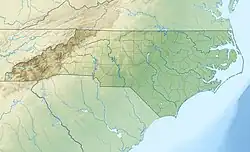  Durham 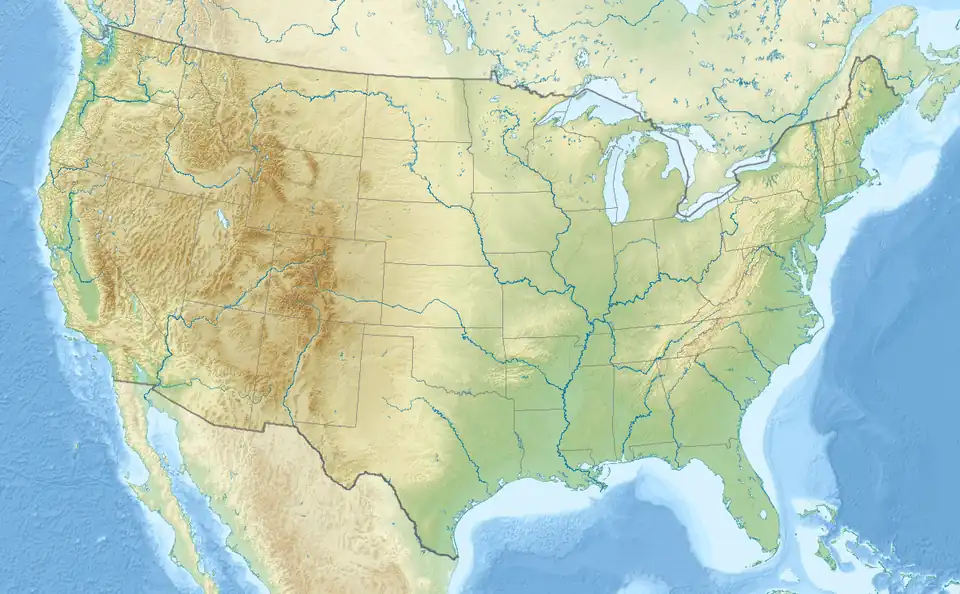 Durham | |
| Coordinates: 35°58′43″N 78°54′00″W / 35.97861°N 78.90000°W | |
| Country | United States |
| State | North Carolina |
| Counties | Durham, Wake, Orange[3] |
| Incorporated | April 10, 1869[4] |
| Named for | Bartlett S. Durham |
| Government | |
| • Type | Council-Manager |
| Area | |
| • Total | 116.19 sq mi (300.92 km2) |
| • Land | 115.36 sq mi (298.79 km2) |
| • Water | 0.82 sq mi (2.13 km2) 0.71% |
| Elevation | 404 ft (123 m) |
| Population | |
| • Total | 283,506 |
| • Rank | 70th in the United States 4th in North Carolina |
| • Density | 2,457.51/sq mi (948.85/km2) |
| • Urban | 396,118 (US: 106th) |
| • Urban density | 2,160.4/sq mi (834.1/km2) |
| • Metro | 588,911 (US: 96th) |
| • CSA | 2,242,324 (US: 33rd) |
| Demonym | Durhamite |
| Time zone | UTC−5 (EST) |
| • Summer (DST) | UTC−4 (EDT) |
| ZIP codes | 27701, 27702, 27703, 27704, 27705, 27706, 27707, 27708, 27709, 27710, 27711, 27712, 27713, 27715, 27717, 27722 |
| Area code(s) | 919, 984 |
| FIPS code | 37-19000[8] |
| GNIS feature ID | 2403521[6] |
| Primary Airport | Raleigh–Durham International Airport |
| Website | durhamnc |
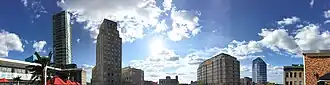
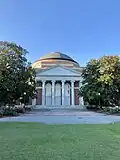
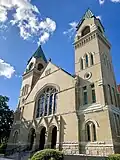
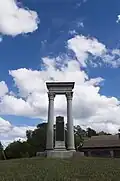
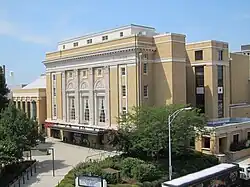

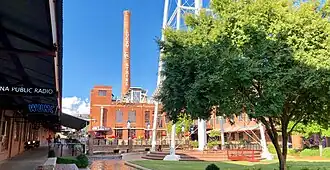
Durham is a city in the U.S. state of North Carolina. It has about 280,000 people. Durham has two universities, Duke and NC Central. It is northwest of Raleigh, and northeast of Chapel Hill. It is the county seat of Durham County. The city is part of a larger area known as the Research Triangle. [9]
History
Before Europeans came to the Durham area, there were some Native American tribes like the Eno and Occaneechi nearby.
Creation
Before Durham became a city, the land it is in was used for farming. There were many plantations which had slaves. In the mid-1800s, rail was becoming an important means of transportation, and a depot (a train station) was needed in between the towns of Raleigh and Hillsborough. Nobody was willing to give their land for the station at the time, until Dr. Bartlett S. Durham gave his land to be used for the station. The station was then named after Durham. In 1853, a post office was started near Durham Station.
Confederate monuments
Many confederate monuments have been removed or renamed in Durham.
- Confederate Soldiers Monument (1924) at the Old Durham County Courthouse, was pulled down and severely damaged during a protest on August 17, 2017. Eight individuals were arrested for destroying the memorial, but the charges were later dropped.[10][11][12] The monument is being stored in a county warehouse.[13] In early 2019, a joint city-county government committee to consider what to do with the damaged statue, recommended that it be displayed indoors in its crumpled state. "The committee said displaying the statue in its current damaged form would add important context. The proposal would leave the statue's pedestal in place and add outdoor markers honoring Union soldiers and enslaved people." The proposal needs approval from the Durham County Commission. Durham County maintains that the Cultural History Artifact Management and Patriotism Act of 2015 does not apply, since the law does not address damaged monuments.[14] On August 11, 2020, contractors removed the stone pedestal and moved it to a secure location following the recommendation of the City-County Committee on Confederate Monuments and Memorials.[15]
- Statue of Robert E. Lee in the Duke Chapel, Duke University. Installed in the 1930s in consultation with "an unnamed Vanderbilt University professor".[16] Defaced in August 2017.[17][18] After vandalism, removed August 19, 2017.[19][20]
- Julian S. Carr Junior High School, for whites only, built in 1928, closed in 1975. The building became part of the formerly all-white Durham High School, which closed in 1993. Since 1995 the buildings are used by the Durham School of the Arts.[21] On August 24, 2017, the Board of the Durham Public Schools voted unanimously to remove Carr's name from the building.[22]
Tobacco Industry and Economic growth
During the Civil War, the armies that passed near Durham enjoyed the local tobacco. After the war, many veterans returned to Durham for more tobacco. Because of this, a strong tobacco industry began around the area, and a tobacco factory was started. Because the population of the area increased, Durham was officially incorporated (started) on April 10, 1869. In 1881, Durham County was also created, before that, Durham was in Orange County.
The Duke family was important to Durham's growth and economy. Their tobacco company, American Tobacco, was one of the most important tobacco companies in the United States, and they were based in Durham. Duke University was named after one of them. Today Duke University is seen as one of the most notable universities in the country. Later, the Duke family began investing in electric power, and they created the company Duke Power (now called Duke Energy), which helped bring better electricity to many towns and cities across North Carolina, including Durham.
During the early 20th century, because of the growing tobacco and electricity industry, Durham also saw a growth in the textiles industry, which helped grow Durham's population.
African-American Community and Civil Rights Movement
Also during the early 20th century, Durham grew an African-American community in a neighborhood called Hayti, south of Downtown. Many important businesses and companies owned by African-Americans were started in Durham. North Carolina Central University was one of the first publicly funded (paid for) African-American colleges, and was started in 1924.
Because of Durham's notable African-American community, Durham became the site of events during the Civil Rights Movement during the 1950s and 60s. Famous civil rights activist Dr. Martin Luther King Jr. visited Durham. In 1957, Seven African-Americans protested segregation at the Royal Ice Cream Parlor by sitting in Whites-only spots and refused to move. This type of protest was called a sit-in, and the protest was the first one to happen in North Carolina.
Research Triangle Park
In the 1950s, Duke University, University of North Carolina at Chapel Hill, and North Carolina State University, along with local governments, built the Research Triangle Park in Durham County, just outside the city. The park is used for scientific, technology and medical developments. It is home to many companies and has 65,000 workers. The park has helped Durham's economy since the tobacco and textile industry has been declining (going down) since the mid 20th century.
Modern Growth
In 1987, the American Tobacco factory closed, leading to Durham's economy to go down. But Durham's economy has started to grow again, and Durham's main industries are now in medicine, technology, science, healthcare and education. Some of this growth can be thanks to the Research Triangle Park. Many new developments in retail and housing have been near the park and around Interstate 40, in the southern part of the city. Durham's recent growth can also be because of being part of the Research Triangle area, a part of North Carolina which includes Raleigh and Chapel Hill that has had economic and population growth since the beginning of the 21st century.
Downtown Renewal
Since the end of the Tobacco industry, Durham's downtown has been going through a renewal and many changes. Many of the old tobacco buildings have been changed to restaurants, apartments, lofts and other things. Many new bars, entertainment venues and art studios are opening there too. Downtown is also home to many companies in different industries like banking, software and medicine. The Durham Performing Arts Center (DPAC) has become Durham's main entertainment center and many famous performers have visited it. The Durham Bulls Athletic Park, the ballpark of the Durham Bulls, is also in Downtown.
Geography
Durham is located in north-central North Carolina, near Chapel Hill and Raleigh, in an area known as The Triangle. One of the few rivers in Durham is the Eno River. It goes into Falls Lake.
Climate
Durham has a sort of mild climate with hot summers and cool winters. In the summer temperatures usually go from 90° Fahrenheit during the day to 70 °F at night. In the winter, is about 50 °F during the day and 30 °F at night. It can change more. Durham gets about 45 inches (110 cm) of rain and 6 inches (15 cm) of snow.
Transportation
Durham has a lot of transportation, or roads, trains, and airplanes. Some freeways in Durham are Interstates 40 and 85 and highway 147. Durham is right next to an airport. Durham also has a train station.
Things to see
Duke University is in Durham. Durham also has the Museum of Life and Science and the Nasher Art Museum. Downtown, there are also several tall buildings.
References
- ↑ "Durham was nicknamed the "Bull City" in the late 1800s when the Blackwell Tobacco Company named its product "Bull" Durham Tobacco". durhamnc.gov. Jan 17, 2021. Archived from the original on September 5, 2015.
- ↑ "About Durham". Archived from the original on October 22, 2009. Retrieved October 9, 2009.
- ↑ "Durham Maps". durhamnc.gov. City of Durham. Retrieved June 22, 2023.
- ↑ Durham (N.C.) – Directories. Richmond, Virginia: Hill Directory Company. 1923. p. 7. Retrieved May 13, 2010.
- ↑ "ArcGIS REST Services Directory". United States Census Bureau. Retrieved September 20, 2022.
- 1 2 U.S. Geological Survey Geographic Names Information System: Durham, North Carolina
- ↑ "QuickFacts: Durham city, North Carolina". United States Census Bureau. Retrieved February 23, 2024.
- ↑ "U.S. Census website". United States Census Bureau. Retrieved January 31, 2008.
- ↑ Bureau, US Census. "Metropolitan and Micropolitan Statistical Areas Population Totals: 2020-2023". Census.gov. Retrieved 2024-08-28.
{{cite web}}:|last=has generic name (help) - ↑ talent, gloria rodriguez, abc11 anchors, wtvd anchors, abc11 reporters, wtvd reporters, wtvd (August 17, 2017). "8 now charged in destruction of Confederate statue". abc11.com. Retrieved August 23, 2017.
{{cite news}}: CS1 maint: multiple names: authors list (link) CS1 maint: numeric names: authors list (link) - ↑ Graham, David A. "Arrests Begin Following Durham Confederate Statue Toppling". The Atlantic. Retrieved October 4, 2017.
- ↑ "All Charges Dropped in Case of Toppled Confederate Monument". The New York Times. Associated Press. February 20, 2018.
- ↑ Katz, Jonathan M. (August 17, 2017). "4 Surrender in Toppling of Confederate Statue in North Carolina". The New York Times. Retrieved August 20, 2017.
- ↑ Drew, Jonathan (January 8, 2019). "N.C. county: Put crumpled Confederate statue in indoor display". Boston Globe.
- ↑ Bonner, Lynn (August 11, 2020). "3 years after protesters took down a Durham Confederate statue, its base is hauled away". The News & Observer. Raleigh, NC. Retrieved August 12, 2020.
- ↑ Ballentine, Claire; Moorthy, Neelesh (August 15, 2017). "Tracing the history of Duke Chapel's Robert E. Lee statue". The Duke Chronicle. Retrieved August 18, 2017.
- ↑ Simpson, Ian (August 18, 2017). "Statue defaced as U.S. Confederate monument protests grow". Reuters. Retrieved August 26, 2017.
- ↑ Roll, Nick (August 18, 2017). "Robert E. Lee Statue Vandalized at Duke". Inside Higher Ed. Retrieved August 18, 2017.
- ↑ Staff Reports (August 19, 2017). "Robert E. Lee statue removed from campus". Duke Chronicle. Retrieved August 19, 2017.
- ↑ Drew, Jonathan (August 19, 2017). "Duke University removes Robert E. Lee statue from chapel". Associated Press. Retrieved August 19, 2017 – via Winston-Salem Journal.
- ↑ Kueber, Gary (2013). "CENTRAL JUNIOR HIGH SCHOOL / JULIAN S. CARR JUNIOR HIGH SCHOOL". Open Durham. Retrieved November 11, 2018.
- ↑ "North Carolina public school system bans Confederate flag, Ku Klux Klan symbols and swastikas". WYFF. Associated Press. August 25, 2017. Retrieved November 17, 2018.
Municipalities and communities of Durham County, North Carolina, United States | ||
|---|---|---|
| Cities | 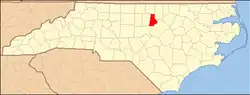 | |
| Towns | ||
| Townships |
| |
| CDPs |
| |
| Unincorporated communities |
| |
| Footnotes | ‡This populated place also has portions in an adjacent county or counties | |
Municipalities and communities of Wake County, North Carolina, United States | ||
|---|---|---|
| Cities | 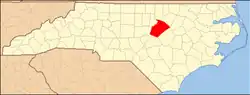 | |
| Towns | ||
| Townships |
| |
| Unincorporated communities |
| |
| Footnotes | ‡This populated place also has portions in an adjacent county or counties | |