Curium, 00Cm|
| Pronunciation | (KURE-ee-əm) |
|---|
| Appearance | silvery metallic, glows purple in the dark |
|---|
| Mass number | [247] |
|---|
|
|
|
| Group | f-block groups (no number) |
|---|
| Period | period 7 |
|---|
| Block | f-block |
|---|
| Electron configuration | [Rn] 5f7 6d1 7s2 |
|---|
| Electrons per shell | 2, 8, 18, 32, 25, 9, 2 |
|---|
|
| Phase at STP | solid |
|---|
| Melting point | 1613 K (1340 °C, 2444 °F) |
|---|
| Boiling point | 3383 K (3110 °C, 5630 °F) |
|---|
| Density (near r.t.) | 13.51 g/cm3 |
|---|
| Heat of fusion | 13.85 kJ/mol |
|---|
Vapor pressure
| P (Pa) |
1 |
10 |
100 |
1 k |
10 k |
100 k |
| at T (K) |
1788 |
1982 |
|
|
|
|
|
|
| Oxidation states | +3, +4, +5,[1] +6[2] (an amphoteric oxide) |
|---|
| Electronegativity | Pauling scale: 1.3 |
|---|
| Ionization energies | |
|---|
| Atomic radius | empirical: 174 pm |
|---|
| Covalent radius | 169±3 pm |
|---|
 Spectral lines of curium |
|
| Natural occurrence | synthetic |
|---|
| Crystal structure | double hexagonal close-packed (dhcp) |
|---|
| Electrical resistivity | 1.25 µΩ⋅m[3] |
|---|
| Magnetic ordering | antiferromagnetic-paramagnetic transition at 52 K[3] |
|---|
| CAS Number | 7440-51-9 |
|---|
|
| Naming | named after Marie Skłodowska-Curie and Pierre Curie |
|---|
| Discovery | Glenn T. Seaborg, Ralph A. James, Albert Ghiorso (1944) |
|---|
|
|
| Main isotopes[4] |
Decay |
|
abundance |
half-life (t1/2) |
mode |
product |
| 242Cm |
synth |
162.8 d |
α |
238Pu |
| SF |
– |
| 34Si |
... |
| 243Cm |
synth |
29.1 y |
α |
239Pu |
| ε |
243Am |
| SF |
– |
| 244Cm |
synth |
18.11 y |
α |
240Pu |
| SF |
– |
| 245Cm |
synth |
8250 y |
α |
241Pu |
| SF |
– |
| 246Cm |
synth |
4060 y |
α |
242Pu |
| SF |
– |
| 247Cm |
synth |
1.56×10⁷ y |
α |
243Pu |
| 248Cm |
synth |
3.480×10⁵ y |
α |
244Pu |
| SF |
– |
| 250Cm |
synth |
8300 y |
SF |
– |
| α |
246Pu |
| β− |
250Bk |
|
|
|
|
Curium is a synthetic chemical element in the periodic table that has the atomic number 96. It has the chemical symbol Cm and it is a radioactive metal. In chemistry it is placed in a group of metal elements named the actinides. Curium is a transuranic element. It is a radioactive element that does not exist in nature. Curium has a silver color and it is made by bombarding a plutonium target with alpha particles (helium ions). Curium was named after Marie Curie and her husband Pierre.
Uses
Curium is used currently in rovers and space machinery.
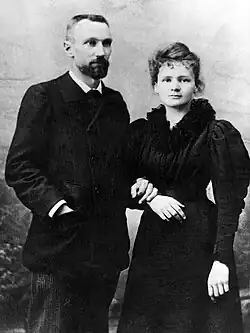 Pierre and Marie Curie.
References
- ↑ Kovács, Attila; Dau, Phuong D.; Marçalo, Joaquim; Gibson, John K. (2018). "Pentavalent Curium, Berkelium, and Californium in Nitrate Complexes: Extending Actinide Chemistry and Oxidation States". Inorg. Chem. 57 (15). American Chemical Society: 9453–9467. doi:10.1021/acs.inorgchem.8b01450. OSTI 1631597. PMID 30040397. S2CID 51717837.
- ↑ Domanov, V. P.; Lobanov, Yu. V. (October 2011). "Formation of volatile curium(VI) trioxide CmO3". Radiochemistry. 53 (5). SP MAIK Nauka/Interperiodica: 453–6. doi:10.1134/S1066362211050018. S2CID 98052484.
- 1 2 Schenkel, R. (1977). "The electrical resistivity of 244Cm metal". Solid State Communications. 23 (6): 389. Bibcode:1977SSCom..23..389S. doi:10.1016/0038-1098(77)90239-3.
- ↑ Kondev, F. G.; Wang, M.; Huang, W. J.; Naimi, S.; Audi, G. (2021). "The NUBASE2020 evaluation of nuclear properties" (PDF). Chinese Physics C. 45 (3): 030001. doi:10.1088/1674-1137/abddae.
