Cooling curve
A cooling curve is a line graph that shows how the temperature of a substance changes over time while it cools down. It is often used to study how a material changes from a liquid to a solid, and from a gas to a liquid.[1][2]
Cooling curves are important in materials science and metal casting. Many metals and alloys do not freeze at one single temperature. Also, by studying cooling curves, there can be better understanding how materials behave as they cool, helping make stronger and better products.[3]
Presentation
On the graph, time is shown on the X-axis, and temperature is shown on the Y-axis.[1][4]
At the start of the graph, the substance is very hot. This starting point is often called the pouring temperature. As time passes, the temperature lowers.
When the substance begins to change its state, the temperature stops changing for a short time, even though the substance is still cooling. This flat part of the graph is called a thermal arrest. This happens because energy is being used to change the state of the material, not to lower the temperature. The energy needed for this change is called latent heat.
After the change in state, the temperature starts to drop again.
The cooling rate tells us how fast the temperature is falling, shown by the slope of the line on the graph. A steeper line means faster cooling.[4][5]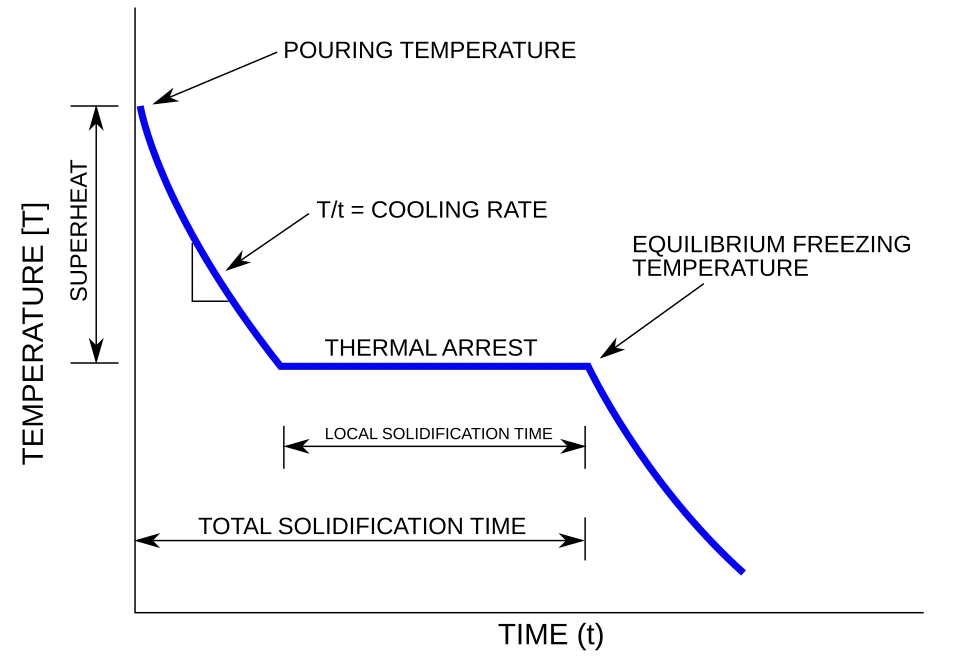
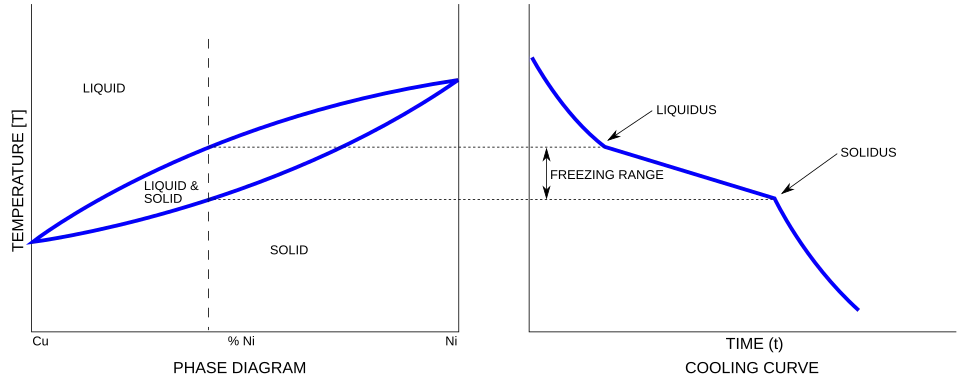
However, alloys solidify over a range of temperatures. First, the molten alloy reaches it's liquid temperature, where solid particles begin to form. Then it enters the freezing range. Lastly, at its solid temperature, the alloy becomes fully solid.[6][7]
References
- 1 2 Garland, Nibler, and Shoemaker. Experiments in Physical Chemistry (7th ed.)
- ↑ "Changes of state - Solids, liquids and gases - KS3 Physics". BBC Bitesize. Retrieved 2025-12-17.
- ↑ Callister, Rethwisch. "Materials science and engineering : an introduction" (PDF). Retrieved 17 December 2025.
- 1 2 "latent heat". Retrieved 17 December 2025.
- ↑ "13.18: Heating and Cooling Curves". Chemistry LibreTexts. 2016-06-27. Retrieved 2025-12-17.
- ↑ S., Piwonka, Thomas (1998-12-01). "Solidification of Metals and Alloys". ASM Digital Library. doi:10.31399/a.
{{cite journal}}: CS1 maint: multiple names: authors list (link) - ↑ Singh, Ramesh (2012), "Heat Treatment of Steels", Applied Welding Engineering, Elsevier, pp. 95–108, doi:10.1016/B978-0-12-391916-8.00012-1, ISBN 978-0-12-391916-8, retrieved 2025-12-17
| State |  | |
|---|---|---|
| Low energy |
| |
| High energy |
| |
| Other states |
| |
| Transitions |
| |
| Quantities |
| |
| Concepts |
| |