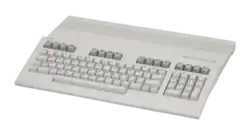
Commodore 128
 | |
| Manufacturer | Commodore Business Machines |
|---|---|
| Type | Home computer |
| Release date | January 5, 1985[1] |
| Introductory price | US$ 300 (1985)[1][2] |
| Discontinued | 1989[3][4] |
| Units sold | About 4 million[4] |
| Media | ROM cartridge 5¼-inch floppy disk Compact Cassette |
| Operating system | Commodore BASIC 7.0 CP/M Plus 3.0 GEOS 128 |
| CPU | MOS Technology 8502 @ 1–2 MHz Z80A @ 4 MHz |
| Memory | 128 kB RAM |
| Graphics | VIC-IIe (320 × 200, 16 colors) VDC (640 × 200, 16 colors) |
| Sound | SID 6581/8580 |
| Connectivity | Joystick ports, serial port, user port, cartridge port, tape port, RGBI video, composite video, RF output |
| Predecessor | Commodore 64 |
The Commodore 128 (shortened to C128[5]) was a personal computer with 128 KB of RAM. Commodore Business Machines released it in January 1985[6], and it had an 8-bit MOS Technology 8502 CPU (based on the MOS Technology 6502) and a Z80A (based on the Zilog Z80) that could run CP/M software.[5][7]
The C128 was sold from 1985 to 1989.[8] It was fully compatible with the Commodore 64 but not as popular. At the time, Commodore was already developing the 16-bit Amiga computer system. Amiga was more powerful than the C128, and many users preferred it. About 4 million units were sold.[9]
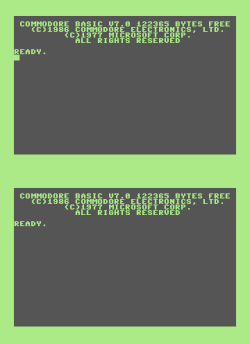
The C128 could run in three different modes: C128 mode, Commodore 64 mode, and CP/M mode.[5] C64 mode allowed users to run most Commodore 64 software without changes.[9]
Unlike the Commodore 64, the C128 also included an 80-column display mode through a second video chip.[5]
Technical Specifications
| Part | Info | Details | Notes |
|---|---|---|---|
| CPU | MOS 8502 and Z80A | 8502 @ 1–2 MHz, Z80A @ 4 MHz | The 8502 was the main processor. The Z80A was used to run CP/M software. Only one processor could run at a time. |
| RAM | 128 kB | Expandable to 640 kB | Expansion was possible with a 512 kB REU. |
| Graphics | VIC-IIe and VDC | VIC-IIe: 320 × 200 px, 16 colors VDC: 640 × 200 px, 16 colors |
The VIC-IIe supported sprites and raster interrupts. The VDC provided an 80-column display. |
| Sound | SID 6581/8580 | 3 voices, 4 waveforms | Included filters, ADSR envelopes, and ring modulation. |
References
- 1 2 Polsson, Ken. "Chronology of Personal Computers". PC Timeline. Archived from the original on 8 April 2019. Retrieved 15 December 2015.
- ↑ Waite, Mitchell; Lafore, Robert; Volpe, Jerry (1985). The Official Book for the Commodore 128 Personal Computer. Indianapolis: Howard W. Sams & Co. p. 1.
- ↑ Leitenberger, Bernd (2012). Computergeschichte(n): Die ersten Jahre des PC. Norderstedt: Books on Demand. p. 297.
- 1 2 Matthews, Ian (12 June 2012). "Commodore 128 – The Most Versatile 8-Bit Computer Ever Made". Commodore Computers. Retrieved 13 April 2014.
- 1 2 3 4 "Commodore 128 - Computer - Computing History". www.computinghistory.org.uk. Retrieved 2026-05-04.
- ↑ Polsson, Ken. "Chronology of Personal Computers". PC Timeline. Archived from the original on 2019-04-06. Retrieved 2026-06-07.
- ↑ Jordan, Mark (1990). "128 Mode". Run. 7 (3): 47.
- ↑ McLean, Mickey (1990). "'80s Ups & Downs". Compute!'s Gazette. 8 (1): 19.
- 1 2 Mark Jordan: 128 Mode. In: Run. Bd. 7, Nr. 3, 1990, S. 47.
Other websites
 Media related to Commodore 128 at Wikimedia Commons
- Commodore 128 at commodore.ca
- Commodore 128D at Steve's Old Computer Museum