Circular reasoning
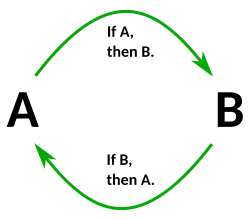
Circular reasoning (Latin: circulus in probando, "circle in proving";[1] also known as circular logic) is a logical fallacy. Circular reasoning is when someone is beginning an argument with the same thing they are trying to prove.[2] Circular reasoning is not a formal fallacy but rather a mistake in an argument. In circular reasoning, the reason has to be proven in the same way as the idea being proven. Usually in an argument, the reason does not need to be proven. Since the reason has to be proven, the argument is not convincing. There is no reason to accept it unless they already believe in the idea.[3] Circular reasoning is related to begging the question, though it usually means the same thing.[4]
Circular reasoning is usually written as : "A is true because B is true; B is true because A is true." This kind of reasoning can be hard to find if it has a long chain of reasons.
Examples
- In the Bible, the Second Epistle to Timothy gives the example of using a citation of the New Testament to say that the Bible is the word of God. The problem is just that the New Testament is part of the Bible. In addition, this is just an argument from authority, since it is taken from one of the letters of the Apostle Paul. When Paul wrote the letter, there was no Biblical canon.
- Molière uses a doctor in one of his comedies, to make fun of this kind of argument. A father has a mute daughter. The father asks the doctor, why his daughter is mute. The doctor then tells him, that she is mute, because she lost the ability to speak. When the father asks, why she cannot speak, the doctor replies, that this is because she doesn't have control over her language.
References
- ↑ Chisholm, Hugh, ed. (1911). . Encyclopædia Britannica. Vol. 6 (11th ed.). Cambridge University Press. p. 389.
- ↑ Dowden, Bradley (27 March 2003). "Fallacies". Internet Encyclopedia of Philosophy. Archived from the original on 9 October 2014. Retrieved April 5, 2012.
- ↑ Nolt, John Eric; Rohatyn, Dennis; Varzi, Achille (1998). Schaum's outline of theory and problems of logic. McGraw-Hill Professional. p. 205. ISBN 9780070466494.
- ↑ Walton, Douglas (2008). Informal Logic: A Pragmatic Approach. Cambridge University Press. ISBN 9780521886178.