Circular economy
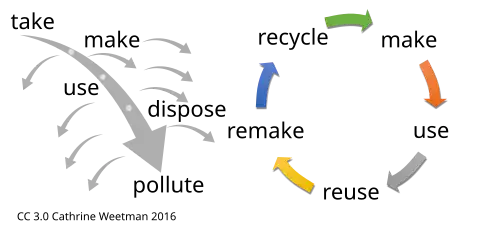
A circular economy (CE), also called circularity,[1] is a model of making and using resources. In this model, existing materials and products are kept in use for as long as possible by sharing, leasing, reusing, repairing, refurbishing, and recycling.[2][3][4] The goal of this idea is to help solve big world problems like climate change, biodiversity loss, waste, and pollution. It does this by focusing on three main principles from the very beginning (at the design stage). The three principles needed to change to a circular economy are: first, to design products so they do not create waste and pollution; second, to keep products and materials in use; and third, to help natural systems grow back (regenerate).[5] The circular economy is defined as the opposite of the traditional linear economy.[6][7]
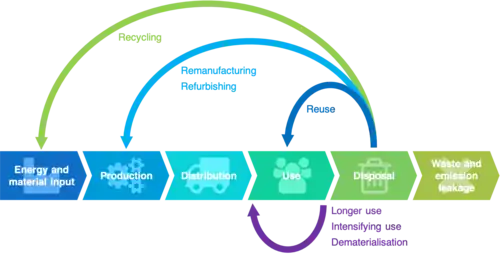
For the last ten years, the idea of a circular economy has been studied a lot by schools (academia), businesses, and governments. It is becoming more popular because it can help lower carbon emissions and the use of raw materials. It can also open up new business opportunities and, most importantly, make our way of using things (consumption) more sustainable.[9][10] Governments see the circular economy as a way to fight global warming and as a way to help the economy grow for a long time.[11] A circular economy can also help by connecting people and resources in the same area. This helps to reuse materials locally (at a "regional level").[12] As a core principle, the European Parliament defines the circular economy as "a model of production and consumption that involves sharing, leasing, reusing, repairing, refurbishing, and recycling existing materials and products as long as possible. In this way, the life cycle of products is extended."[2] If the whole world used a circular economy, global emissions could be cut by 22.8 billion tons. This is 39% of all emissions from 2019.[13] By using circular economy ideas in just five areas (cement, aluminum, steel, plastics, and food), emissions could be cut by 9.3 billion metric tons of CO2 equivalent. That is the same amount as all emissions from transportation.[14][15][16]
In a circular economy, new business models are a very important part of helping to change from linear to circular ways. Different business models have been recognized that support circularity. These include "product-as-a-service," sharing platforms, and models that make products last longer, among others.[17] These models try to use resources in the best way, lower waste, and create value for both businesses and customers. At the same time, they help to reach the main goals of the circular economy.
Businesses can also make the change to the circular economy. This requires companies to make big changes to their whole business models.[18][19] Using circular economy principles often needs new ideas and plans. It also requires a complete change in how products are designed, what services are offered, and how things are sold. The goal is to create "long-life solutions," which leads to what are called 'circular business models'.[20][21]
Definition
There are many definitions of the circular economy.[22][23] For example, in China, the circular economy is pushed by the government as a "top-down" national goal. In other places, like the European Union, Japan, and the USA, it is a tool used to create environmental and waste policies from the "bottom-up" (starting at a local level). The main goal of promoting the circular economy is to separate economic growth from environmental damage. This means allowing an economy to grow without harming the environment.[24] A full definition could be: "Circular economy is an economic system that targets zero waste and pollution throughout materials lifecycles, from environment extraction to industrial transformation, and final consumers, applying to all involved ecosystems. Upon its lifetime end, materials return to either an industrial process or, in the case of a treated organic residual, safely back to the environment as in a natural regenerating cycle. It operates by creating value at the macro, meso, and micro levels and exploiting to the fullest the sustainability nested concept. Used energy sources are clean and renewable. Resource use and consumption are efficient. Government agencies and responsible consumers play an active role in ensuring the correct system long-term operation."[25]
More broadly, "circular development" is a model for making and using things (economic, social, and environmental). Its goal is to build a society that can support itself (sustainable) and works in harmony with its environmental resources.[26] The circular economy tries to change the economy into one that is "regenerative" (it renews or heals itself). This means it is an economy that finds new ways to lower waste and harm to the environment *before* they happen, instead of waiting to fix the problems later.[27] This is done by designing new ways to use resources in the best way, so we no longer need to depend on resources that will run out.[26]
The circular economy is a framework based on three main principles that are all driven by design. These are eliminating waste and pollution, keeping products and materials in use, and regenerating natural systems.[6]
Other definitions and exact measurements that separate linear from circular activity have also been created in economic studies.[28][22][24]
In a linear economy, natural resources are turned into products that will eventually become waste. This is because of how they were designed and made. This process is often called "take, make, waste".[29] In comparison, a circular economy tries to change from a 'take-make-waste' system to one that is "restorative and regenerative" (heals and renews itself). It uses reuse, sharing, repair, refurbishment, remanufacturing and recycling to create a "closed-loop system." This lowers the use of new resources and the creation of waste, pollution, and carbon emissions.[30] The circular economy's goal is to keep products, materials, equipment, and infrastructure[31] in use for a longer time. This means we get more value from these resources. Waste materials and energy should become "input" (materials) for other processes. This is done through waste valorization. This means they can be used as a part for another industrial process, or they can become resources that help nature (like compost). The Ellen MacArthur Foundation (EMF) defines the circular economy as an industrial economy that is restorative or regenerative by its value and design.[32][33]
Circular economy ideas can be used at different sizes, from single products and services to whole industries and cities. For example, industrial symbiosis is an idea where the waste from one industry becomes the "input" (material) for another. This creates a network where resources are exchanged, which lowers waste, pollution, and the use of new resources.[34] In a similar way, "circular cities" try to use circular ideas in city planning. They encourage the local reuse of resources and encourage ways of living that are sustainable for their citizens.[35] In 2022 and 2023, less than 10% of the world's economic activity was circular.[15][36] Every year, the world's population uses about 100 billion tonnes of materials. More than 90% of these materials are wasted. The circular economy tries to fix this problem by getting rid of waste completely.[36]
History and aims
The idea of a circular economy does not come from one single date or person. Instead, it comes from different groups of ideas.[37]
The idea of a circular economy is linked to several groups of ideas, including industrial ecology, biomimicry, and cradle-to-cradle design principles. Industrial ecology is the study of how materials and energy move through industrial systems, which is a basis for the circular economy. Biomimicry means copying nature's time-tested patterns to design human systems. Cradle-to-cradle design is an approach that looks at the whole system of a product. It thinks about the product's entire life, from getting raw materials to getting rid of it at the end. It tries to create the least waste and use resources in the best way. These connected ideas all help to build and use the circular economy.[38]
General systems theory, which was started by the biologist Ludwig von Bertalanffy, studies growth and energy in "open" and "closed" systems. This theory was later used in other areas, like economics for the circular economy. The economist Kenneth E. Boulding, in his paper "The Economics of the Coming Spaceship Earth," argued that a circular economic system is something that is needed to keep human life sustainable on Earth.[39] Boulding describes the "cowboy economy" as an open system. In this system, people see the natural environment as having no limits. They believe there is no limit to its ability to give us resources or take in our waste.
Walter R. Stahel and Geneviève Reday-Mulvey, in their book "The Potential for Substituting Manpower for Energy", helped create the basic ideas of the circular economy. They described how using more human labor (manpower) could lower the need for activities that use a lot of energy.
Simple economic models in the past did not pay attention to the connections between the economy and the environment. In "The Economics of Natural Resources", Allan Kneese showed how resources will not last forever (are not endlessly renewable). He was the first person to directly (explicitly) use the term "circular economy" in 1988.[40]
In their book Economics of Natural Resources and the Environment (1990), Pearce and Turner explained the change from the traditional linear (or "open-ended") economic system to the circular economic system.[41] They described an economic system where waste from all stages (taking resources, making things, and using them) is turned back into materials that can be used again.
In the early 2000s, China added the idea into its industrial and environmental policies. The goal was to make these policies focus on resources, production, waste, use, and the whole "life cycle" of products.[42] The Ellen MacArthur Foundation [43] was very important in spreading the idea in Europe and the Americas.[44]
In 2010, the idea of a circular economy started to become popular around the world after several reports were published.[39] The European Union introduced its plan for the circular economy in 2014. In 2020, it launched a New Circular Economy Action Plan that "shows the way to a climate-neutral, competitive economy of empowered consumers".[44]
The idea originally spread because of three big events: raw material prices increasing very fast between 2000 and 2010, China's control of rare earth materials, and the 2008 economic crisis.[45] Today, the climate emergency and environmental problems are causing companies and people to rethink how they make and use things. The circular economy is seen as one of the answers to these problems. There are several big ("macro") arguments for the circular economy. These arguments say that it could allow economic growth without using more natural resources. This separates resource use from economic well-being for a growing world population. It also reduces how much countries depend on other countries for important materials, lowers CO2 emissions, reduces waste, and creates new ways of making and using things that can create more value.[2] The arguments for businesses ("corporate") to use the circular economy are also strong. It could help them make sure they can get raw materials and control costs by stopping the prices of materials from changing unpredictably. It could also reduce spills and waste, make products last longer, help them sell to new types of customers, and create long-term value for their shareholders. A key idea behind circular business models is to create "loops" to get back value that would otherwise be lost.[46]
A special worry is the permanent loss of raw materials because of their increase in entropy in the linear business model.[47] Entropy (disorder) starts to increase when waste is made during manufacturing. It increases more when materials are mixed and spread out as products are put together. This is followed by rusting (corrosion) and wear and tear when the product is used. At the end of the product's life, there is a very fast increase in disorder when all the different materials are mixed in landfills.[47] Because of this one-way direction of entropy, the world's resources are effectively "lost forever".
Circular development is directly linked to the circular economy. Its goal is to build a sustainable society that is based on recyclable and renewable resources. It also aims to protect society from waste and to create a model where people no longer think that resources will never run out.[26] This new model of economic development focuses on making goods and services while thinking about the environmental and social costs.[26] Circular development, for these reasons, supports the circular economy. It helps create new societies that follow new waste management and sustainability goals that meet the needs of citizens. It is about helping economies and societies, in general, to become more sustainable.
However, there are criticisms of the circular economy.[48] Some critics say that supporters of the circular economy may exaggerate the good things it can do. These criticisms suggest that the circular economy has too many definitions to be clearly defined. This makes it a very general "umbrella concept" that is exciting but hard to understand and measure. Critics say that the studies on circular economy ignore many facts that are already well known. In particular, it forgets the law of thermodynamics that says you can neither create nor destroy matter. Because of this, a future with no waste, where all material "loops" are closed, and products are recycled forever is, in any practical sense, impossible. They point out that studies on the circular economy ignore a lot of what we already know from waste management and environmental economics. Specifically, it forgets the law of thermodynamics, which says that you cannot create or destroy matter. Because of this, a future with no waste, where all material "loops" are closed, and products are recycled forever is, in any practical sense, impossible. They point out that recycling itself uses energy and resources. They also say there is a limit to how many times materials can be recycled before they become low quality. Critics also question if it is even possible ("feasible") to use circular economy ideas all over the world. They say this is because supply chains are very complex and different countries have very different economic and political systems. Furthermore, critics argue that focusing so much on "circularity" might take attention away from other important ways to be sustainable, like simply using less stuff (reducing consumption) and making sure things are fair for everyone (promoting social equity). Also, some critics argue that the circular economy, as it is pushed today, is a 'neoliberal' idea. They say it helps keep the current powerful people in charge and continues unfairness (inequalities). They argue that focusing on "win-win" solutions and making a "business case" for being circular ignores the fact that we might need bigger, more basic changes to our economy and society. Finally, critics point out the risk of "rebound effects". This is when being more efficient (like through circularity) makes things cheaper or easier to get, which causes people to use more of them. This increased use can cancel out the good things the circular economy was supposed to do for the environment.
Sustainability
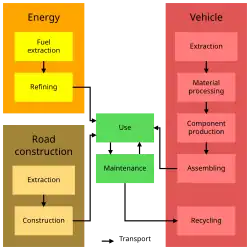
The circular economy seems more sustainable than the usual linear economy. It reduces the use of resources, waste, and pollution. But some experts say this is too simple and ignores the complexity of real systems. For example, social sustainability is often not fully considered. Sometimes, other strategies like buying new energy-efficient equipment are needed. Research from Cambridge and TU Delft identified at least eight ways circular economy relates to sustainability.[30] Innovation is also a key part of development in a circular economy.[49]
Scope
The circular economy applies to many areas: industries, products, services, and natural resources.[50] Practices and policies help understand current limitations.[51][52] It also includes strategic management and potential reuse and waste management.[53][54]
The circular economy covers products, buildings, infrastructure, and equipment.[55] It uses both technical (metals, minerals, fossil fuels) and biological resources (food, timber, fibres).[33] Many recommend switching to renewable energy and valuing diversity. Circular economy also involves finance and economic measurements.[56] Modularization can support circular economy and sustainable energy systems.[57] Renting products instead of owning them is another example. Recycling is widespread.[56]
Circle Economy reports global circular economy could cut 22.8 billion tons of emissions (39% of 2019 emissions).[13] By 2050, circular economy strategies in cement, aluminum, steel, plastics, and food could reduce almost half of emissions from goods production.[14][15][58]
Background
In 1966, Kenneth Boulding described a "closed economy" where resources stay longer, compared to an open economy.[59] This is seen as an early form of circular economy.[60]
Circular economy is based on feedback and non-linear systems from nature.[33] Concepts like cradle to cradle, industrial ecology, biomimicry, and blue economy influenced it.[30]
In 1989, David W. Pearce and R. Kerry Turner noted traditional economies lack recycling and treat environment as a waste sink.[61][62]
In the 1990s, Tim Jackson promoted preventive environmental management and circular approaches.[63][64]
Emergence of the idea
Walter Stahel and Genevieve Reday in 1976 proposed an economy in loops, creating jobs, saving resources, and reducing waste.[65] Stahel promoted longer product life and a service-based economy.[66]
China included circular economy in its 11th five-year plan (2006–2010).[67] Ellen MacArthur Foundation popularized the concept.[68]
Circular economy helps reduce dependency on cheap oil and supports low-carbon economy. Circular strategies could bridge half of the emissions reduction gap for COP21 1.5°C target.[69]
Moving away from the linear model
Linear "take, make, dispose" systems use resources and create waste. Circular economy treats systems like living organisms, keeping materials in loops.[70]
Walter R. Stahel promoted "Cradle to Cradle" instead of "Cradle to Grave". Steve D. Parker studied closed-loop agricultural systems.[71]
Cradle to Cradle
Cradle to Cradle design focuses on safe and high-quality products, not just recycling. Architect William McDonough widely implemented this approach.[72]
Levels of circularity ("R" models)
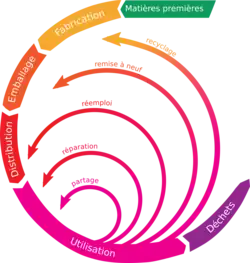
Several circular economy models use steps starting with "R". The original "Three R principle" is "Reduce, Reuse, Recycle" from the 1970s.[73][74] The most detailed "10R principle" was developed by Jacqueline Cramer.[73]
| 10R principle Cramer 2017[75] |
Ellen MacArthur Foundation 2013[76] | Ladder of Lansink 2015[77] | Three R principle (1970s) | Explanation |
|---|---|---|---|---|
| Refuse | Maintain/prolong | Prevention | Reduce | Avoid using raw materials |
| Reduce | Reduce | Use fewer raw materials | ||
| Renew/Redesign | Design products for circularity | |||
| Reuse | Reuse/redistribute | Reuse | Reuse | Use products again |
| Repair | Maintain and fix products | |||
| Refurbish | Refurbish/Remanufacture | Revive products | ||
| Remanufacture | Make new products from used ones | |||
| Repurpose | Use products for new purposes | |||
| Recycle | Recycle | Recycling | Recycle | Recover materials |
| Recover | Energy recovery | Energy recovery | Convert waste to energy | |
| Incineration | ||||
| Landfill | Landfill |
Towards the circular economy
In 2013, a report titled Towards the Circular Economy: Economic and Business Rationale for an Accelerated Transition was released. It was commissioned by the Ellen MacArthur Foundation and developed by McKinsey & Company, and it was the first report of its kind.[78][79] The report looked at the economic and business potential of a circular economy. It uses product case studies and economy-wide analysis, showing benefits across the EU. It estimates that part of the EU manufacturing sector could save up to $630 billion in materials costs by 2025, stimulating areas like product development, remanufacturing, and refurbishment. Key building blocks for circular transition were identified: skills in circular design and production, new business models, skills for cascades and reverse cycles, and cross-sector collaboration.[80] A case study from the automotive industry shows the importance of integrating circular models across product, process, and system levels.[81]
A 2015 report by WRAP and Green Alliance, "Employment and the circular economy: job creation in a more resource efficient Britain", examined policy scenarios to 2030. Without policy change, 200,000 jobs may be created, reducing unemployment by 54,000. Aggressive policy could create 500,000 jobs and reduce unemployment by 102,000.[82] The International Labour Organization predicts global circular economy adoption could create 7–8 million additional jobs by 2030.[83][15] However, circular economy adoption may also cause job losses in emerging economies.[84]
In the U.S., Ranta et al. analyzed drivers and barriers for circular economy using Scott's institutional framework.[50][85] Product-oriented case: Dell—first to offer free recycling and sell computers made from verified recycled materials.[50] Waste management case: Republic Services, second-largest US waste management company.[86] Indicators were categorized as drivers (support circular economy) or barriers (hinder it).[50]
On 2 March 2022, representatives from 175 countries pledged to create a legally binding agreement to end plastic pollution by 2024. This includes full lifecycle management of plastics and alternatives like reusability. The agreement is expected to support circular economy and reduce GHG emissions by 25%.[87][88]
The waste sector could achieve net-zero emissions with circular approaches.[89] Circular economy was highlighted at the 2024 COP29 in Baku, Azerbaijan.[90][91][92] Azerbaijan also signed a Joint Resolution on global collaboration for efficiency and circularity.[93][94]
Circular product design and standards
Product design for durability, maintenance, repair, upgrade, remanufacturing, separability, disassembly, and reassembly is key for circularity.[95] Standardization supports sustainable advantages for businesses and consumers.[96] Standardization and compatibility improve multi-functionality and modularity.[97] A "Product Family Approach" helps with commonality, compatibility, standardization, or modularization across products.[98]
Emerging technologies should be designed with circular principles from the start, including solar panels.[99]
Design of circularity processes
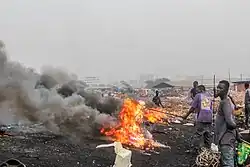
Circular process design is crucial for health and sustainability. Much e-waste is recycled far from consumption sites, with low efficiency and negative health effects.
Recycling should reduce overall environmental impacts using a life-cycle assessment approach.[100]
Mandatory certification for e-waste recyclers could incentivize high-quality processes.[101]
Digitalization can improve efficiency and minimize waste.[102]
Circular business models
Initially, focus was on re-X technologies (recycling, remanufacturing, reuse), but implementation lagged behind capability. Stakeholder collaboration is key, shifting attention to business-model innovation.[103] Rheaply, a platform for scaling reuse, supports circular business model transition.[104]
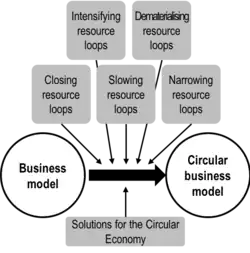
Circular business models aim to close, narrow, slow, intensify, and dematerialize resource loops, using recycling, efficiency, life extension, and service-based approaches.[105] They are enabled by circular supply chains, collaboration, and innovation.[106][107][108] Circular products and models depend on the material affordances for reuse and recovery.[109]
local adoption_and_applications_by_industry = [[
Adoption and applications by industry
Textile industry
In the textile industry, a circular economy means that clothes and fibers are kept in use for as long as possible. They are reused, repaired, redesigned and recycled so they can re-enter the economy instead of becoming waste.
This is different from the current linear model of fashion, where raw materials are taken from nature, turned into products, bought, used, and then thrown away. (Business of Fashion, 2017).[110] ‘Fast fashion’ companies make this problem worse by encouraging people to buy more clothes more often. This “take–make–dispose” model leads to more than $500 billion of economic value lost every year and also has many negative environmental and social impacts (Business of Fashion, 2018).[111] Environmental impacts include huge amounts of clothing going to landfills or being burned. Social impacts include pressure on workers and risks to human rights.
The documentary The True Cost (2015)[112] explains that in fast fashion, low wages, unsafe working conditions, and factory disasters are often accepted because they are said to provide jobs for people who have no other options. This shows that fast fashion harms both people and the planet by following a linear system.
Many people argue that using a circular economy approach can help make the textile industry more sustainable. A 2017 report by the Ellen MacArthur Foundation, "A New Textiles Economy",[113] lists four main goals to move towards a circular textiles system:
- phase out harmful substances and reduce microfiber release
- change how clothes are designed, sold, and used so they are not seen as disposable
- improve recycling by changing how clothes are designed, collected, and processed
- use resources more efficiently and switch to renewable inputs where possible
So far, only a small number of fashion designers and brands have fully taken the lead on circular practices. Some often-cited examples are Patagonia, Eileen Fisher, Nathalia JMag, and Stella McCartney. One example of a circular system within a brand is Eileen Fisher’s “Tiny Factory”. In this program, customers are encouraged to bring back their worn Eileen Fisher clothing so the company can repair, remake, and resell the items instead of throwing them away. There are similar initiatives in Europe, where several outdoor clothing companies run textile return systems that invite customers to bring back used garments for repair, redesign, resale, or recycling. [114]
In a 2018 interview,[115] Eileen Fisher said that overconsumption is a major problem in fashion. She argued that brands “need to make less and sell less”. In other words, companies can still use creativity and create value, but should not constantly create more and more new products.
Circular business models in fashion also include clothing rental services. These start-ups are growing in both the EU and the US. They offer everyday clothes, maternity wear, and baby clothes for rent, instead of selling them. Some companies, like Palanta, use a “pay as you rent” model,[116] while others, such as Rent The Runway and Le Tote, use monthly subscription models.
Both China and Europe are seen as leaders in building a circular economy. McDowall et al. (2017) argue that the Chinese view of the circular economy is broad. It covers pollution and many environmental issues together with resource and waste topics. Europe’s view is usually narrower, focusing more on waste, resource efficiency, and business opportunities.[117]
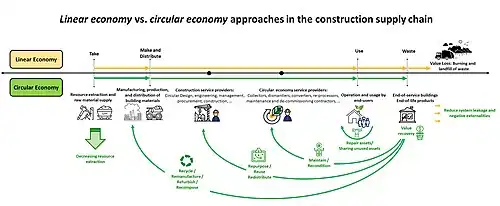
Construction industry
The construction sector is one of the world’s largest waste producers. A circular economy is seen as a useful way to reduce the environmental impact of this industry.
Construction is very important for the economy of the European Union (EU) and its member states. It provides around 18 million direct jobs and makes up about 9% of the EU’s gross domestic product (GDP).[119] However, the sector has a large environmental impact because it uses many non-renewable resources and produces a lot of waste. Both of these are increasing quickly.[120]
In the EU, people and companies together generate more than 2 billion tonnes of waste every year. This is about 4.8 tonnes per person, mainly from building, mining, and manufacturing.[15][121][122] Each person in Europe generates about half a tonne of municipal waste per year, and less than half of that is recycled.[123]
Cement production is also a major source of greenhouse gas emissions. It accounts for about 2.4% of global CO2 emissions from industrial and energy sources.[124][125]
Decisions about circular economy practices in construction can be made at different levels:
- operational level – focused on specific parts of the production process
- tactical level – focused on whole processes
- strategic level – focused on the whole company or organization
Circular decisions can be made for construction companies themselves, but also for individual construction projects, where the construction company is one of the stakeholders.
End-of-life buildings can be deconstructed instead of demolished. This means that buildings are taken apart carefully, so that construction elements can be reused in new buildings. This also frees up land for new development.[126]
Modular construction systems can also support a circular economy. Buildings made from modules can be assembled, disassembled, and reused more easily in the future, and their components are usually easier to recover at the end of life.
On the operational level, circular approaches can include using reusable or natural materials. For example, crushed and cleaned walnut husks can be used as a hard, light, natural abrasive for cleaning brick surfaces. The abrasive grains from walnut shells can be reused several times.
Researchers have also started to measure how well circular economy ideas are being implemented in construction companies. A first attempt created a measurement scale for circular practices in a building company.[127]
Studies show that the circular economy in construction can create new jobs and support economic growth.[128] According to Górecki,[129] one possible new job role is a “circular economy manager” for construction projects. This person would be responsible for planning and managing circular strategies across the project.
Automotive industry
The circular economy is also starting to grow in the automotive industry.[130] A case study in the heavy-duty and off-road industry[81] looks at how circular practices can be added to a lean manufacturing system, which is currently the most common production strategy in the automotive sector. Lean manufacturing improves efficiency by removing waste and focusing on what customers value most.[131] This helps with eco-efficiency by “narrowing” resource loops (using fewer resources for the same output). However, to fully support a circular economy, it is also important to “slow” and “close” resource loops, for example by making products last longer and by reusing and recycling materials. This leads to eco-effectiveness, which looks at the whole system, not just single processes.[132] The study finds that combining lean and circular approaches can unlock large potential benefits by focusing on products, processes, and the overall system at the same time.[81]
There are also economic reasons for carmakers to move towards circular models. A 2016 report by Accenture said that circular economy strategies could change how companies compete in the automotive sector in terms of price, quality, and convenience. It suggested that circular practices could double revenues by 2030 and reduce costs by up to 14%. So far, typical actions include:
- using parts and materials made from recycled content,[133]
- remanufacturing car parts, and
- improving the design of new cars so that they are easier to repair, reuse, and recycle.[134][135]
Remanufacturing is mainly used today for spare parts. A common example is the remanufacturing of gearboxes. A study shows that a remanufactured gearbox can reduce the global warming potential (measured in CO2-equivalent) by about 36% compared to a newly manufactured gearbox.[136]
In the EU, the vehicle recycling industry is able to recycle about 75% of each end-of-life vehicle. This means around 25% is not recycled and may end up in landfills.[137] There is therefore still a lot of room to improve circularity in the sector.
In the electric vehicle industry, disassembly robots are being developed and used to help take apart vehicles and their battery packs for recycling.[138] The EU’s ETN-Demeter project (European Training Network for the Design and Recycling of Rare-Earth Permanent Magnet Motors and Generators in Hybrid and Full Electric Vehicles)[139] looks at how to design electric motors so that permanent magnets can be easily removed and the rare-earth metals can be recycled.
Some car makers, such as Volvo, are also testing new ownership models, like “Care by Volvo”, where customers lease cars directly from the company instead of buying them.[140]
Logistics industry
The logistics industry is very important in the Netherlands because the country is in a key transit location where goods move every day. The Netherlands is an example of an EU country that is shifting towards a circular economy because its economy depends strongly on imported raw materials (for example from China). This dependence makes the country vulnerable to changing and sometimes unpredictable import costs for these primary goods.[141]
Research on the Dutch logistics industry shows that about 25% of Dutch companies know about and are interested in the circular economy. For larger companies with more than 500 employees, this rises to 57%. Sectors such as chemical industries, wholesale trade, industry, and agriculture, forestry and fisheries see potential cost savings when they reuse, recycle, and reduce imports of raw materials.[141]
Logistics companies can support a circular economy by:
- helping customers reduce costs through better shipment and route planning
- offering prepaid shipping labels
- offering smart packaging solutions
- offering take-back services for used products and packaging[141]
Moving from one-way (linear) packaging flows to circular flows (where packaging is reused or recycled) is critical for the sustainable performance and image of the packaging industry.[106]
The Dutch government has a national program to move towards a fully circular economy by 2050.[142]
Global freight transport is expected to grow in the coming years. This will increase environmental impacts and the global warming potential of transport, creating new challenges for the logistics sector.[141]
The Dutch Council for the Environment and Infrastructure (Rli) has suggested a new framework where logistics companies can create value in different ways across the Dutch economy. Examples include:
- exchanging resources such as waste or water flows between industries
- moving from a “transit port” model to a “transit hub” model, where more value is added through services and smart connections
The Rli studied the potential role of the logistics industry in three sectors: agriculture and food, chemical industries, and high-tech industries.[141]
Agriculture
Circular economy models are widely used in agriculture. Agriculture is essential for global food security and can help reduce climate change. In a circular agricultural system, resources such as water, nutrients, and organic matter are reused as much as possible.
However, there are also possible risks for human health and the environment if contaminants remain in recycled water or organic material.[143]
These risks can be reduced by working on three main areas, which will always depend on local conditions:
- monitoring contaminants
- improving collection, transport, and treatment of waste and water
- updating regulations and policy to manage risks[143]
The Netherlands wants to have a fully circular economy by 2050.[144] As part of this, it plans a shift to “circular agriculture”.[145] The goal is to have “sustainable and strong agriculture” by around 2030.[146][147]
Some key points in this Dutch plan are:
- closing the feed–manure cycle (fodder-manure cycle)
- reusing as many waste streams as possible (a team “Reststromen” will coordinate this)
- reducing the use of artificial fertilizers and using more natural manure
- allowing farms in special “experimental areas” to deviate from certain laws and regulations to test circular practices
- using common and uniform methods to measure soil quality
- giving farmers the option to sign agreements with Staatsbosbeheer (the state forest service) so their leased land can be used for natuurinclusieve landbouw (“nature-inclusive management”)
- supporting initiatives that can increase farmers’ income
Furniture industry
In the furniture industry, most products are passive, long-lasting items. For this reason, strategies that extend product life—such as repair and remanufacturing—usually have lower environmental impacts and lower costs.[148]
Some companies, such as GGMS, support a circular approach by refurbishing and reupholstering furniture so it can be reused instead of thrown away.[149]
The EU sees large potential for circularity in the furniture sector. Out of about 10,000,000 tonnes of furniture thrown away annually in the EU, most is sent to landfills or incinerated. By moving to a circular model by 2030, the EU could increase Gross Value Added by about €4.9 billion and create an estimated 163,300 jobs.[150]
A study on Danish furniture companies shows:
- 44% of companies offer maintenance as part of their business model
- 22% have take-back schemes
- 56% design furniture so it can be recycled
The authors concluded that while circular furniture models in Denmark are growing, many companies still lack knowledge about how to make the transition, and changing their business model is often seen as a major barrier.[151]
A report from the UK also sees a large potential for furniture reuse and recycling. It found that about 42% of bulky waste sent to landfills each year (1.6 million tonnes) is furniture, and that 80% of raw material used in the production phase becomes waste.
Oil and gas industry
Between 2020 and about 2050, around 600 oil and gas installations will have to be decommissioned in the UK sector of the North Sea alone. Over the next decade, about 840,000 tonnes of materials will need to be recovered, at an estimated cost of £25 billion. In 2017, North Sea oil and gas decommissioning became a net cost to the public, with UK taxpayers paying 50–70% of the total bill.[152]
Because public money is involved, there is interest in finding decommissioning solutions that are best not only economically, but also socially and environmentally.
Organizations such as Zero Waste Scotland have carried out studies to identify parts and equipment that could be reused. Equipment might continue its life in other industries or be redeployed in the oil and gas sector itself.[153]
Renewable energy industry
Oil and gas are not compatible with the idea of a truly circular economy, because they are finite resources and their use does not “meet the needs of the present without compromising the ability of future generations to meet their own needs”.[154]
A sustainable circular economy can only be powered by renewable energy sources such as wind, solar, hydropower, and geothermal energy.[155]
Many entities today aim for “net zero” carbon emissions. This means they still use fossil fuels but offset some of their emissions by removing carbon from the atmosphere. While this is an important first step, some experts, such as smart grid technologist Steve Hoy, argue that a truly circular economy needs “true zero” instead of “net zero”. “True zero” means eliminating fossil fuel use completely and producing all energy from renewable sources.[156][157]
The renewable energy industry itself is growing quickly. Building and maintaining renewable systems requires energy and raw materials. Even so, because fossil fuel power plants emit so much CO2, the total carbon footprint of renewable technologies over their whole life cycle is much lower than that of fossil fuel generation.[158]
However, many renewable systems are still designed and built in a linear way. For a fully circular economy, issues such as design for recycling, reuse of materials, and long-term resource availability must also be considered.[7]
Education industry
In 2018, The Ellen MacArthur Foundation (EMF) identified 138 institutions worldwide that offered circular economy courses.[159] Since then, circular economy topics have been added more and more to teaching programs, with plans for adoption at university, city, and even national levels.[160][161]
Zero Waste Scotland is an example of a nationwide program that aims to include circular economy topics in the Scottish education system. Their “YES Circular Economy Challenge” promotes the idea that every learning environment should have a “whole-environment approach” to learning for sustainability. This means the approach should be strong, visible, assessed, and supported by leadership at every level.[161]
A 2021 EMF report compared circular economy course offerings in London and New York. It found that there is not yet a full “whole-environment” coverage of circular economy topics. About 90% of the 80 courses analyzed covered some part of the technical cycle (materials, products, technologies), while about 50% covered some part of the biological cycle (food, biomass, ecosystems).[160]
The EMF looks critically at how circular economy courses are distributed. Researchers Julian Kirchherr and Laura Piscicelli from Utrecht University analyze the success of their introductory circular economy course in their paper "Towards an Education for the Circular Economy (ECE): Five Teaching Principles and a Case Study". With at least 114 different published definitions of the circular economy, better synthesis and collaboration between educators and institutions could help make circular economy education clearer and more widely adopted.[160]
Rare-earth elements recovery
Rare-earth element
One study suggests that by 2050, about 40–75% of the EU’s clean energy metal needs could be met through local recycling.[162]
Another study estimates the losses of 61 metals, and shows that the use lifetimes of many, often scarce, tech-critical metals are quite short.[163][164]
Using the Project Drawdown modeling framework, another study shows that, even without including the costs or practical limits of building out renewable energy generation, higher metal recycling rates can significantly help with climate change mitigation.[165]
Chemistry
Researchers have developed ways to recycle about 200 industrial waste chemicals into valuable drugs and agrochemicals. This kind of “upcycling” allows productive reuse of waste, reducing disposal costs and environmental risks.[166][167]
Another study argues that for products used directly in the open environment, such as pesticides, we need new molecules and materials that are safer and easier to manage. These products often cannot be easily circulated or recycled, so they are a special challenge for the circular economy. The study provides guidelines on how to better connect chemistry with circular economy principles for such substances.[168]
See also
- Appropriate technology
- BlueCity
- Carbon tech
- Circular procurement
- Container-deposit legislation
- Degrowth
- Digital Product Passport
- Doughnut (economic model)
- Downcycling
- Durable good
- European Green Deal
- Food vs. feed
- Ecological civilization
- Earth jurisprudence
- Rights of nature
- Scale (analytical tool)
- Government by algorithm
- Green economy
- Industrial symbiosis
- Infrastructure and economics
- Infrastructure-based development
- Life cycle assessment
- Life cycle thinking
- List of environment topics
- Loop analysis
- Path analysis (statistics)
- Regenerative economics
- Reuse
- Reverse vending machine
- Sharing economy
- Social metabolism
- Synthetic fuels
- Sustainable Product Policy Initiative
- Throwaway society
- Upcycling
- Waste & Resources Action Programme
- Waste heat recovery
References
- ↑ [ "Circularity Indicators"]. www.ellenmacarthurfoundation.org. Archived from [ the original] on 2019-07-31. Retrieved 2019-03-14.
{{cite web}}: Check|archive-url=value (help); Check|url=value (help) - 1 2 3 [ "Circular economy: definition, importance and benefits - European Parliament"]. www.europarl.europa.eu. 2015-02-12. Retrieved 2021-10-07.
{{cite web}}: Check|url=value (help) - ↑ Iacovidou, Eleni; Hahladakis, John N.; Purnell, Phil (2021). "A systems thinking approach to understanding the challenges of achieving the circular economy". Environmental Science and Pollution Research. 28 (19): 24785–24806. Bibcode:2021ESPR...2824785I. doi:10.1007/s11356-020-11725-9. PMC 8144154. PMID 33289042.
- ↑ Kirchherr, Julian; Reike, Denise; Hekkert, Marko (2017). "Conceptualizing the circular economy: An analysis of 114 definitions". Resources, Conservation and Recycling. 127: 221–232. Bibcode:2017RCR...127..221K. doi:10.1016/j.resconrec.2017.09.005.
- ↑ [ "Circular Economy Concept"]. www.ellenmacarthurfoundation.org. Retrieved 2023-04-23.
{{cite web}}: Check|url=value (help) - 1 2 [ "New to circular economy overview"]. ellenmacarthurfoundation.org. Retrieved 2021-12-06.
{{cite web}}: Check|url=value (help) - 1 2 Reuter, Markus A.; van Schaik, Antoinette; Gutzmer, Jens; Bartie, Neill; Abadías-Llamas, Alejandro (1 July 2019). "Challenges of the Circular Economy: A Material, Metallurgical, and Product Design Perspective". Annual Review of Materials Research. 49 (1): 253–274. Bibcode:2019AnRMS..49..253R. doi:10.1146/annurev-matsci-070218-010057. ISSN 1531-7331. S2CID 140525621.
- ↑ Geissdoerfer, M., Pieroni, M.P., Pigosso, D.C. and Soufani, K. (2020). [ "Circular business models: A review"]. Journal of Cleaner Production. 277 123741. Bibcode:2020JCPro.27723741G. doi:10.1016/j.jclepro.2020.123741. S2CID 225282542.
{{cite journal}}: Check|url=value (help)CS1 maint: multiple names: authors list (link) - ↑ Tunn, V. S. C.; Bocken, N. M. P.; van den Hende, E. A.; Schoormans, J. P. L. (2019-03-01). [ "Business models for sustainable consumption in the circular economy: An expert study"]. Journal of Cleaner Production. 212: 324–333. Bibcode:2019JCPro.212..324T. doi:10.1016/j.jclepro.2018.11.290. ISSN 0959-6526. S2CID 158627557.
{{cite journal}}: Check|url=value (help) - ↑ Shpak, Nestor; Kuzmin, Oleh; Melnyk, Olga; Ruda, Mariana; Sroka, Włodzimierz (August 2020). "Implementation of a Circular Economy in Ukraine: The Context of European Integration". Resources. 9 (8): 96. Bibcode:2020Resou...9...96S. doi:10.3390/resources9080096. ISSN 2079-9276.
- ↑ Calisto Friant, Martin; Vermeulen, Walter J. V.; Salomone, Roberta (2020-10-01). "A typology of circular economy discourses: Navigating the diverse visions of a contested paradigm". Resources, Conservation and Recycling. 161 104917. Bibcode:2020RCR...16104917C. doi:10.1016/j.resconrec.2020.104917. ISSN 0921-3449. S2CID 222121823.
- ↑ Castro, Camila Gonçalves; Trevisan, Adriana Hofmann; Pigosso, Daniela C. A.; Mascarenhas, Janaina (2022-04-15). "The rebound effect of circular economy: Definitions, mechanisms and a research agenda". Journal of Cleaner Production. 345 131136. Bibcode:2022JCPro.34531136C. doi:10.1016/j.jclepro.2022.131136. ISSN 0959-6526. S2CID 247150037.
- 1 2 Cite error: The named reference
Circlewas used but no text was provided for refs named (see the help page). - 1 2 [ "Completing the picture: How the circular economy tackles climate change"]. ellenmacarthurfoundation.org. 26 May 2021. Retrieved 2023-06-19.
{{cite web}}: Check|url=value (help) - 1 2 3 4 5 Bank, European Investment (26 May 2023). [ "Circular economy Overview 2023"]. European Investment Bank.
{{cite web}}: Check|url=value (help) - ↑ [ "COMPLETING THE PICTURE: HOW THE CIRCULAR ECONOMY TACKLES CLIMATE CHANGE"]. circulareconomy.europa.eu/.
{{cite web}}: Check|url=value (help) - ↑ Urbinati, Andrea; Chiaroni, Davide; Chiesa, Vittorio (2017-01-01). "Towards a new taxonomy of circular economy business models". Journal of Cleaner Production. 168: 487–498. Bibcode:2017JCPro.168..487U. doi:10.1016/j.jclepro.2017.09.047. hdl:11311/1087435. ISSN 0959-6526. S2CID 157679243.
- ↑ Bocken, Nancy M. P.; de Pauw, Ingrid; Bakker, Conny; van der Grinten, Bram (2016-07-03). [ "Product design and business model strategies for a circular economy"]. Journal of Industrial and Production Engineering. 33 (5): 308–320. doi:10.1080/21681015.2016.1172124. ISSN 2168-1015.
{{cite journal}}: Check|url=value (help) - ↑ Manninen, Kaisa; Koskela, Sirkka; Antikainen, Riina; Bocken, Nancy; Dahlbo, Helena; Aminoff, Anna (January 2018). [ "Do circular economy business models capture intended environmental value propositions?"]. Journal of Cleaner Production. 171: 413–422. Bibcode:2018JCPro.171..413M. doi:10.1016/j.jclepro.2017.10.003.
{{cite journal}}: Check|url=value (help) - ↑ Lewandowski, Mateusz (2016-01-18). "Designing the Business Models for Circular Economy—Towards the Conceptual Framework". Sustainability. 8 (1): 43. Bibcode:2016Sust....8...43L. doi:10.3390/su8010043. ISSN 2071-1050.
- ↑ Ferasso, Marcos; Beliaeva, Tatiana; Kraus, Sascha; Clauss, Thomas; Ribeiro-Soriano, Domingo (December 2020). [ "Circular economy business models: The state of research and avenues ahead"]. Business Strategy and the Environment. 29 (8): 3006–3024. Bibcode:2020BSEnv..29.3006F. doi:10.1002/bse.2554. ISSN 0964-4733.
{{cite journal}}: Check|url=value (help) - 1 2 Kirchherr, Julian; Reike, Denise; Hekkert, Marko (2017-12-01). "Conceptualizing the circular economy: An analysis of 114 definitions". Resources, Conservation and Recycling. 127: 221–232. Bibcode:2017RCR...127..221K. doi:10.1016/j.resconrec.2017.09.005. ISSN 0921-3449.
- ↑ Kirchherr, Julian; Yang, Nan-Hua Nadja; Schulze-Spüntrup, Frederik; Heerink, Maarten J.; Hartley, Kris (2023). "Conceptualizing the Circular Economy (Revisited): An Analysis of 221 Definitions". Resources, Conservation and Recycling. 194 107001. Bibcode:2023RCR...19407001K. doi:10.1016/j.resconrec.2023.107001.
- 1 2 Ghisellini, Patrizia; Cialani, Catia; Ulgiati, Sergio (2016-02-15). [ "A review on circular economy: the expected transition to a balanced interplay of environmental and economic systems"]. Journal of Cleaner Production. Towards Post Fossil Carbon Societies: Regenerative and Preventative Eco-Industrial Development. 114: 11–32. Bibcode:2016JCPro.114...11G. doi:10.1016/j.jclepro.2015.09.007. ISSN 0959-6526.
{{cite journal}}: Check|url=value (help) - ↑ Nobre, Gustavo Cattelan; Tavares, Elaine (2021-09-10). [ "The quest for a circular economy final definition: A scientific perspective"]. Journal of Cleaner Production. 314 127973. Bibcode:2021JCPro.31427973N. doi:10.1016/j.jclepro.2021.127973. ISSN 0959-6526.
{{cite journal}}: Check|url=value (help) - 1 2 3 4 Local Government for Sustainability Africa. (s. d.). Circular development | ICLEI Africa. Circular Development Pathway. Consulté le 15 mars 2021, à l'adresse
- ↑ Économie circulaire - Ellen Macarthur Foundation. (s. d.). Ellen Macarthur Foundation. Consulté le 9 mars 2021, à l'adresse
- ↑ García-Barragán, Juan F.; Eyckmans, Johan; Rousseau, Sandra (March 2019). [ "Defining and Measuring the Circular Economy: A Mathematical Approach"]. Ecological Economics. 157: 369–372. Bibcode:2019EcoEc.157..369G. doi:10.1016/j.ecolecon.2018.12.003. S2CID 158885640.
{{cite journal}}: Check|url=value (help) - ↑ Brydges, Taylor (2021-04-15). "Closing the loop on take, make, waste: Investigating circular economy practices in the Swedish fashion industry". Journal of Cleaner Production. 293 126245. Bibcode:2021JCPro.29326245B. doi:10.1016/j.jclepro.2021.126245. ISSN 0959-6526. S2CID 233577453.
- 1 2 3 Geissdoerfer, Martin; Savaget, Paulo; Bocken, Nancy M. P.; Hultink, Erik Jan (2017-02-01). [ "The Circular Economy – A new sustainability paradigm?"]. Journal of Cleaner Production. 143: 757–768. Bibcode:2017JCPro.143..757G. doi:10.1016/j.jclepro.2016.12.048. S2CID 157449142.
{{cite journal}}: Check|url=value (help) - ↑ Invernizzi, Diletta Colette; Locatelli, Giorgio; Velenturf, Anne; Love, Peter ED.; Purnell, Phil; Brookes, Naomi J. (September 2020). "Developing policies for the end-of-life of energy infrastructure: Coming to terms with the challenges of decommissioning". Energy Policy. 144 111677. Bibcode:2020EnPol.144111677I. doi:10.1016/j.enpol.2020.111677. hdl:11311/1204791. S2CID 225307513.
{{cite journal}}: Check|bibcode=length (help) - ↑ Morseletto, Piero (2020). "Restorative and regenerative: Exploring the concepts in the circular economy". Journal of Industrial Ecology. 24 (4): 763–773. Bibcode:2020JInEc..24..763M. doi:10.1111/jiec.12987. ISSN 1530-9290. S2CID 203500060.
- 1 2 3 Cite error: The named reference
EMF-2012was used but no text was provided for refs named (see the help page). - ↑ Chertow, Marian R. (2000-12-01). "Industrial symbiosis: Literature and taxonomy". Annual Review of Energy and the Environment. 25 (1): 313–337. doi:10.1146/annurev.energy.25.1.313. ISSN 1056-3466.
- ↑ Prendeville, Sharon; Cherim, Emma; Bocken, Nancy (2018-11-01). "Circular cities: Mapping six cities in transition". Environmental Innovation and Societal Transitions. 26: 171–194. Bibcode:2018EIST...26..171P. doi:10.1016/j.eist.2017.03.002. ISSN 2210-4224. S2CID 157408918.
- 1 2 Anyiego, Beldine (2022-08-15). [ "AFRICA: The Clean Oceans initiative will fund twice as many projects as expected?"]. COPIP. Retrieved 2023-02-23.
{{cite web}}: Check|url=value (help) - ↑ Wautelet, Thibaut (2018). [ "The Concept of Circular Economy: its Origins and its Evolution"]. doi:10.13140/RG.2.2.17021.87523.
{{cite journal}}: Check|url=value (help); Cite journal requires|journal=(help)</f> An early, big effort to push ideas that are now called the circular economy was led by the [now Royal] Society for the Encouragement of Arts, Manufactures and Commerce in the late 1800s. As written about by economic geographer Pierre Desrochers, people in the RSA argued that the desire to make a profit (the "profit motive"), long-distance trade, and certain people (like waste dealers and brokers) who are not common today all encouraged finding new ways to make money from leftover manufacturing materials ("residuals").<ref>Desrochers, Pierre (2025). "Lost Institutional Memory and Policy Advice: The Royal Society of Arts on the Circular Economy Through the Centuries". Recycling. 10 (2): 49. doi:10.3390/recycling10020049. - ↑ Kutschke, Anke; Rese, Alexandra; Baier, Daniel (December 2016). "The Circular Economy: An Interdisciplinary Exploration of the Concept and Application in a Global Context". Sustainability. 8 (12): 1281. doi:10.3390/su8121281.
- 1 2 Aggeri, Frank (2020). [ The Circular Economy: Historical Perspective and Contemporary Issues]. Wiley. pp. 3–12. Retrieved 2 April 2023.
{{cite book}}: Check|url=value (help) - ↑ Kneese, Allen V. (1988). "The Economics of Natural Resources". Population and Development Review. 14: 281–309. doi:10.2307/2808100. JSTOR 2808100.
- ↑ [ "Pearce & Turner, Economics Natural Resources Environment | Pearson"]. [www.pearson.com]. Retrieved 2021-10-07.
{{cite web}}: Check|url=value (help) - ↑ Zhu, Junming; Fan, Chengming; Shi, Haijia; Shi, Lei (2019). "Efforts for a Circular Economy in China: A Comprehensive Review of Policies". Journal of Industrial Ecology. 23 (1): 110–118. Bibcode:2019JInEc..23..110Z. doi:10.1111/jiec.12754. ISSN 1530-9290. S2CID 158702257.
- ↑ [ "Let's build a circular economy"]. ellenmacarthurfoundation.org. Retrieved 2021-10-07.
{{cite web}}: Check|url=value (help) - 1 2 [ "Press corner"]. European Commission - European Commission. Retrieved 2021-10-07.
{{cite web}}: Check|url=value (help) - ↑ L'économie circulaire. (2020, 4 novembre). Ministère de la Transition écologique.
- ↑ [ "Why the circular economy is all about retaining value | McKinsey"]. [www.mckinsey.com]. Retrieved 2021-10-07.
{{cite web}}: Check|url=value (help) - 1 2 Lienig, Jens; Bruemmer, Hans (2017). [ "Recycling Requirements and Design for Environmental Compliance"]. [ Fundamentals of Electronic Systems Design]. Springer. pp. 193–218. doi:10.1007/978-3-319-55840-0_7. ISBN 978-3-319-55839-4.
{{cite book}}: Check|chapter-url=value (help); Check|url=value (help) - ↑ Corvellec, Hervé; Stowell, Alison F.; Johansson, Nils (2021). "Critiques of the circular economy". Journal of Industrial Ecology. 26 (2): 421–432. Bibcode:2022JInEc..26..421C. doi:10.1111/jiec.13187. ISSN 1530-9290. S2CID 238087986.
- ↑ Cite error: The named reference
Hysa et al 2020was used but no text was provided for refs named (see the help page). - 1 2 3 4 Cite error: The named reference
Ranta-2018was used but no text was provided for refs named (see the help page). - ↑ Murray, Alan; Skene, Keith; Haynes, Kathryn (2015-05-22). "The Circular Economy: An Interdisciplinary Exploration of the Concept and Application in a Global Context". Journal of Business Ethics. 140 (3): 369–380. doi:10.1007/s10551-015-2693-2. S2CID 41486703.
- ↑ Shooshtarian S, Wong PSP, Maqsood T (2025) 'Circular economy policies for the optimal use of recycled content in built environment'. Construction Waste Lab (CWL). RMIT University, Melbourne, Australia. URL: https://www.rmit.edu.au/about/schools-colleges/property-construction-and-project-management/research/research-centres-and-groups/construction-waste-lab/circular-economy-policies
- ↑ Kaur, Guneet; Uisan, Kristiadi; Lun Ong, Khai; Sze Ki Lin, Carol (2017). "Recent trend in Green sustainable Chemistry & waste valorisation: Rethinking plastics in a circular economy". Current Opinion in Green and Sustainable Chemistry. 9: 30–39. doi:10.1016/j.cogsc.2017.11.003.
- ↑ Casarejos, Fabricio; Bastos, Claudio R.; Rufin, Carlos; Frota, Mauricio N. (November 2018). "Rethinking packaging production and consumption vis-à-vis circular economy: A case study of compostable cassava starch-based material". Journal of Cleaner Production. 201: 1019–1028. Bibcode:2018JCPro.201.1019C. doi:10.1016/j.jclepro.2018.08.114. S2CID 158684066.
- ↑ Vaughan, Josephine; Illankoon, I. M. Chethana S.; Beard, Cameron; Sher, Willy; MacKee, Jamie (2024). "26 - Hazardous building materials threaten circular economy and sustainable outcomes". Sustainability and Toxicity of Building Materials. Woodhead Publishing. pp. 573–599. doi:10.1016/B978-0-323-98336-5.00026-1. ISBN 978-0-323-98336-5.
- 1 2 Cite error: The named reference
NEWS.in-2021was used but no text was provided for refs named (see the help page). - ↑ Mignacca, Benito; Locatelli, Giorgio; Velenturf, Anne (26 Feb 2020). "Modularisation as enabler of circular economy in energy infrastructure". Energy Policy. 139 111371. Bibcode:2020EnPol.13911371M. doi:10.1016/j.enpol.2020.111371. hdl:11311/1204921.
- ↑ "COMPLETING THE PICTURE: HOW THE CIRCULAR ECONOMY TACKLES CLIMATE CHANGE" (PDF). circulareconomy.europa.eu/.
- ↑ Cite error: The named reference
Boulding1966was used but no text was provided for refs named (see the help page). - ↑ Cite error: The named reference
Allwood2014was used but no text was provided for refs named (see the help page). - ↑ David W. Pearce and R. Kerry Turner (1989). Economics of Natural Resources and the Environment. Johns Hopkins University Press. ISBN 978-0-8018-3987-0.
- ↑ Su, Biwei; Heshmati, Almas; Geng, Yong; Yu, Xiaoman (2012). "A review of the circular economy in China: moving from rhetoric to implementation". Journal of Cleaner Production. 42: 215–227. doi:10.1016/j.jclepro.2012.11.020.
- ↑ Jackson, Tim (1993). Clean Production Strategies Developing Preventive Environmental Management in the Industrial Economy. CRC Press. ISBN 978-0-87371-884-4.
- ↑ Jackson, Tim (1996). Material Concerns — Pollution, Profit and Quality of Life. Routledge.
- ↑ "Cradle to Cradle | The Product-Life Institute". Product-life.org. 2012-11-14. Retrieved 2013-11-20.
- ↑ Clift & Allwood, "Rethinking the economy", The Chemical Engineer, March 2011
- ↑ Zhijun, F; Nailing, Y (2007). "Putting a circular economy into practice in China" (PDF). Sustain Sci. 2 (1): 95–101. Bibcode:2007SuSc....2...95Z. doi:10.1007/s11625-006-0018-1. S2CID 29150129.
- ↑ "The Ellen MacArthur Foundation website". Ellenmacarthurfoundation.org. Retrieved 23 January 2013.
- ↑ Blok, Kornelis; Hoogzaad, Jelmer; Ramkumar, Shyaam; Ridley, Shyaam; Srivastav, Preeti; Tan, Irina; Terlouw, Wouter; de Wit, Terlouw. "Implementing Circular Economy Globally Makes Paris Targets Achievable". Circle Economy. Circle Economy, Ecofys. Retrieved 20 April 2017.
- ↑ https://www.sciencedirect.com/science/article/pii/S092180092500028X
- ↑ citation needed
- ↑ citation needed
- 1 2 3 Cite error: The named reference
Bretelerwas used but no text was provided for refs named (see the help page). - ↑ "The Story Behind "Reduce, Reuse, Recycle" - Pantheon Enterprises". Pantheon Enterprises. 14 November 2016. Retrieved 24 September 2022.
- ↑ Cite error: The named reference
Cramer 2017was used but no text was provided for refs named (see the help page). - ↑ Cite error: The opening
<ref>tag is malformed or has a bad name. - ↑ Cite error: The opening
<ref>tag is malformed or has a bad name. - ↑ "Towards the Circular Economy Vol. 3: Accelerating the scale-up across global supply chains | Shared by Business". emf.thirdlight.com. Archived from the original on 2021-12-06. Retrieved 2021-12-06.
- ↑ "Towards the Circular Economy" (PDF). January 2013. Archived (PDF) from the original on 2015-11-23. Retrieved 18 April 2021.
- ↑ Towards the Circular Economy: Economic and Business Rationale for an Accelerated Transition (PDF) (Report). Ellen MacArthur Foundation. 2013. Retrieved 2020-05-15. And: Towards the Circular Economy: an economic and business rationale for an accelerated transition. Ellen MacArthur Foundation. 2012. p. 60. Archived from the original on 2013-01-10. Retrieved 2012-01-30.
- 1 2 3 Cite error: The named reference
Schmitt-2021was used but no text was provided for refs named (see the help page). - ↑ Estimating Employment Effects of the Circular Economy
- ↑ "Global South circular economy could generate millions of job opportunities". www.ilo.org. 2023-05-09. Retrieved 2023-06-19.
- ↑ Repp, Lars; Hekkert, Marko; Kirchherr, Julian (2021-08-01). "Circular economy-induced global employment shifts in apparel value chains: Job reduction in apparel production activities, job growth in reuse and recycling activities". Resources, Conservation and Recycling. 171 105621. Bibcode:2021RCR...17105621R. doi:10.1016/j.resconrec.2021.105621. ISSN 0921-3449. S2CID 236242336.
- ↑ Cite error: The named reference
Scott-2008was used but no text was provided for refs named (see the help page). - ↑ Republic Services. "Republic Services Annual Report 2017" (PDF). annualreports.com. Archived from the original (PDF) on 16 December 2018. Retrieved 30 March 2019.
- ↑ "Historic day in the campaign to beat plastic pollution: Nations commit to develop a legally binding agreement". UN Environment Programme (UNEP). 2 March 2022. Retrieved 11 March 2022.
- ↑ "End plastic pollution: Towards an international legally binding instrument*" (PDF). United Nations Environmental Programm. Retrieved 13 March 2022.
- ↑ Oo, Phyo Zaw; Prapaspongsa, Trakarn; Strezov, Vladimir; Huda, Nazmul; Oshita, Kazuyuki; Takaoka, Masaki; Ren, Jun; Halog, Anthony; Gheewala, Shabbir H. (2024-12-01). "The role of global waste management and circular economy towards carbon neutrality". Sustainable Production and Consumption. 52: 498–510. Bibcode:2024SusPC..52..498O. doi:10.1016/j.spc.2024.11.021. ISSN 2352-5509.
- ↑ "COP29: Circular economy investments deliver social, economic and environmental". African Development Bank Group. 2024-11-21. Retrieved 2025-01-11.
- ↑ unfccc.int https://unfccc.int/sites/default/files/resource/Summary_Global_Climate_Action_at_COP_29.pdf. Archived (PDF) from the original on 2024-12-06. Retrieved 2025-01-11.
{{cite web}}: Missing or empty|title=(help) - ↑ "Circularity Assessment Framework". One Planet network. 2024-09-24. Retrieved 2025-01-11.
- ↑ "Ministerial Meeting on Circular Economy". www.unep.org. Retrieved 2025-01-11.
- ↑ "Ministerial Meeting on Circular Economy". 2024-11-16. Archived from the original on 2025-01-22. Retrieved 2025-11-30.
{{cite journal}}: Cite journal requires|journal=(help) - ↑ Tecchio, Paolo; McAlister, Catriona; Mathieux, Fabrice; Ardente, Fulvio (1 December 2017). "In search of standards to support circularity in product policies: A systematic approach". Journal of Cleaner Production. 168: 1533–1546. Bibcode:2017JCPro.168.1533T. doi:10.1016/j.jclepro.2017.05.198. ISSN 0959-6526. PMC 5656090. PMID 29200663.
- ↑ "Standardization in a Circular Economy – Closing the Loop" (PDF). Archived from the original (PDF) on 25 April 2023. Retrieved 29 May 2022.
- ↑ Medkova, Katerina; Fifield, Brett. "Circular Design - Design for Circular Economy" (PDF). Lahti Cleantech Annual Review 2016. Retrieved 29 May 2022.
- ↑ Parajuly, Keshav; Wenzel, Henrik (May 2017). "Product Family Approach in E-Waste Management: A Conceptual Framework for Circular Economy". Sustainability. 9 (5): 768. Bibcode:2017Sust....9..768P. doi:10.3390/su9050768. ISSN 2071-1050.
- ↑ Davies, Matthew. "Solar panels: we need to recycle parts of them to use again and avoid a mountain of waste". techxplore.com. Retrieved 29 May 2022.
- ↑ Ragossnig, Arne M; Schneider, Daniel R (February 2019). "Circular economy, recycling and end-of-waste". Waste Management & Research: The Journal for a Sustainable Circular Economy. 37 (2): 109–111. Bibcode:2019WMR....37..109R. doi:10.1177/0734242X19826776. ISSN 0734-242X. PMID 30803418. S2CID 73458186.
- ↑ Hagelüken, Christian; Lee-Shin, Ji Un; Carpentier, Annick; Heron, Chris (September 2016). "The EU Circular Economy and Its Relevance to Metal Recycling". Recycling. 1 (2): 242–253. Bibcode:2016Recyc...1..242H. doi:10.3390/recycling1020242. ISSN 2313-4321.
- ↑ Antikainen, Maria; Uusitalo, Teuvo; Kivikytö-Reponen, Päivi (1 January 2018). "Digitalisation as an Enabler of Circular Economy". Procedia CIRP. 73: 45–49. doi:10.1016/j.procir.2018.04.027. ISSN 2212-8271.
- ↑ Rashid, Amir; Asif, Farazee M.A.; Krajnik, Peter; Nicolescu, Cornel Mihai (October 2013). "Resource Conservative Manufacturing: an essential change in business and technology paradigm for sustainable manufacturing". Journal of Cleaner Production. 57: 166–177. Bibcode:2013JCPro..57..166R. doi:10.1016/j.jclepro.2013.06.012.
- ↑ "Solutions". solve.mit.edu. Retrieved 2020-05-07.
- 1 2 Cite error: The named reference
Geissdoerfer2018was used but no text was provided for refs named (see the help page). - 1 2 Cite error: The named reference
Batistawas used but no text was provided for refs named (see the help page). - ↑ Cite error: The named reference
sciencedirect.comwas used but no text was provided for refs named (see the help page). - ↑ Kaipainen, Jenni; Urbinati, Andrea; Chiaroni, Davide; Aarikka-Stenroos, Leena (2022-10-12). "How companies innovate business models and supply chains for a circular economy: a multiple-case study and framework". International Journal of Innovation Management. 26 (9) 2240024. doi:10.1142/S1363919622400242. hdl:11311/1231117. ISSN 1363-9196. S2CID 252956518. Archived from the original on 2025-01-22. Retrieved 2025-11-30.
- ↑ Babri, Maira; Corvellec, Hervé; Stål, Herman I. (2021-10-11). "Material affordances in circular products and business model development: for a relational understanding of human and material agency". Culture and Organization. 28 (1): 79–96. doi:10.1080/14759551.2021.1986506. ISSN 1475-9551. S2CID 240732205.
- ↑ "In Copenhagen, Gearing up for a Circular Fashion System". The Business of Fashion. 2017-05-11. Retrieved 2018-10-30.
- ↑ "Dame Ellen MacArthur on Building Momentum for Sustainability in Fashion". The Business of Fashion. 2018-01-11. Retrieved 2018-10-30.
- ↑ Ross, M (Producer), & Morgan, A (Director). (2015, May). The true cost [Motion Picture]. United States: Life is My Movie Entertainment.
- ↑ Ellen MacArthur Foundation, A new textiles economy: Redesigning fashion's future, (2017, http://www.ellenmacarthurfoundation.org/publications ).
- ↑ Hanssen, Martin; Sörhammar, David; Tronvoll, Bård (2024). "Circularity work: Reorienting service ecosystems towards circularity". SMR – Journal of Service Management Research. 8 (3–4): 116–134. doi:10.5771/2511-8676-2024-3-4-116.
- ↑ The Glossy Podcast. (2018, May 30). Eileen Fisher on 34 years in sustainable fashion: "It's about constantly learning" [Audio podcast]. Retrieved from https://theglossypodcast.libsyn.com/ Archived 2018-10-31 at the Wayback Machine .
- ↑ "how PALANTA works". palanta.co. Archived from the original on 23 April 2021. Retrieved 12 December 2020.
- ↑ McDowall, Will; Geng, Yong; Huang, Beijia; Barteková, Eva; Bleischwitz, Raimund; Türkeli, Serdar; Kemp, René; Doménech, Teresa (June 2017). "Circular Economy Policies in China and Europe" (PDF). Journal of Industrial Ecology. 21 (3): 651–661. Bibcode:2017JInEc..21..651M. doi:10.1111/jiec.12597. S2CID 157819895.
- ↑ Cite error: The named reference
Sadeghi-2022was used but no text was provided for refs named (see the help page). - ↑ "Construction | Growth". European Commission. 2016-07-05. Retrieved 6 December 2018.
- ↑ Nuñez-Cacho, Pedro; Górecki, Jarosław; Molina-Moreno, Valentin; Corpas-Iglesias, Francisco Antonio (2018). "New Measures of Circular Economy Thinking in Construction Companies". Journal of EU Research in Business. 2018: 1–16. doi:10.5171/2018.909360.
- ↑ "EU waste management: infographic with facts and figures | News | European Parliament". www.europarl.europa.eu. 2018-06-04. Retrieved 2023-06-19.
- ↑ Brunn, Michael (2022-11-07). "EU: 4.8 tonnes of waste generated per inhabitant". RECYCLING magazine. Retrieved 2023-06-19.
- ↑ "Municipal waste management across European countries — European Environment Agency". www.eea.europa.eu. 13 November 2016. Retrieved 2023-06-19.
- ↑ "Cement". IEA. Retrieved 2024-04-30.
- ↑ Andrew, Robbie M. (2019-11-20). "Global CO2 emissions from cement production, 1928–2018". Earth System Science Data. 11 (4): 1675–1710. Bibcode:2019ESSD...11.1675A. doi:10.5194/essd-11-1675-2019. ISSN 1866-3508. S2CID 116431097.
{{cite journal}}: CS1 maint: unflagged free DOI (link) - ↑ Ajayabi, Atta; Chen, Han-Mei; Zhou, Kan; Hopkinson, Peter; Wang, Yong; Lam, Dennis (2019-02-24). "REBUILD: Regenerative Buildings and Construction systems for a Circular Economy". IOP Conference Series: Earth and Environmental Science. 225 (1) 012015. Bibcode:2019E&ES..225a2015A. doi:10.1088/1755-1315/225/1/012015. hdl:10871/36366. ISSN 1755-1315. S2CID 116431097.
- ↑ Nuñez-Cacho, Pedro; Górecki, Jarosław; Molina-Moreno, Valentín; Corpas-Iglesias, Francisco Antonio (2018). "What Gets Measured, Gets Done: Development of a Circular Economy Measurement Scale for Building Industry". Sustainability. 10(7) (2340): 2340. Bibcode:2018Sust...10.2340N. doi:10.3390/su10072340. hdl:10481/55172.
- ↑ Górecki, Jarosław; Nuñez-Cacho, Pedro; Corpas-Iglesias, Francisco Antonio; Molina-Moreno, Valentin (2019). "How to convince players in construction market? Strategies for effective implementation of circular economy in construction sector". Cogent Engineering. 6 (1) 1690760: 1–22. doi:10.1080/23311916.2019.1690760. hdl:10481/58267.
- ↑ Górecki, Jarosław (2020). "Simulation-Based Positioning of Circular Economy Manager's Skills in Construction Projects". Symmetry. 12 (1): 50. doi:10.3390/sym12010050.
- ↑ European Circular Economy Stakeholder Platform
- ↑ Belekoukias, Ioannis; Garza-Reyes, Jose Arturo; Kumar, Vikas (2014-09-17). "The impact of lean methods and tools on the operational performance of manufacturing organisations". International Journal of Production Research. 52 (18): 5346–5366. doi:10.1080/00207543.2014.903348. hdl:10545/622279. ISSN 0020-7543. S2CID 53579492.
- ↑ Bocken, Nancy M. P.; de Pauw, Ingrid; Bakker, Conny; van der Grinten, Bram (2016-07-03). "Product design and business model strategies for a circular economy". Journal of Industrial and Production Engineering. 33 (5): 308–320. doi:10.1080/21681015.2016.1172124. ISSN 2168-1015. S2CID 11754573.
- ↑ Automakers Enter the Circular Economy
- ↑ The Circular Economy In The Automotive Sector: How Far Can We Introduce It?
- ↑ "The Circular Economy Applied to the Automotive Industry". Archived from the original on 2019-10-11. Retrieved 2019-10-15.
- ↑ Kaddoura, Mohamad; Gabhane, Pranav (2017). Remanufacturing in Circular Economy: A gearbox Example (MSc). Chalmers University of Technology. hdl:20.500.12380/252053.
- ↑ End-of-Life Vehicle Recycling in the European Union
- ↑ Robot-Assisted Disassembly for the Recycling of Electric Vehicle Batteries
- ↑ "DEMETER project". etn-demeter.eu.
- ↑ Riding the wave of change in the automotive industry with circular economy
- 1 2 3 4 5 van Buren, Nicole; Demmers, Marjolein; van der Heijden, Rob; Witlox, Frank (8 July 2016). "Towards a Circular Economy: The Role of Dutch Logistics Industries and Governments". Sustainability. 8 (7): 647. Bibcode:2016Sust....8..647V. doi:10.3390/su8070647. hdl:1854/LU-8531116.
- ↑ Zaken, Ministerie van Algemene (2016-09-14). "A Circular Economy in the Netherlands by 2050 - Policy note - Government.nl". www.government.nl. Retrieved 2020-05-08.
- 1 2 Carter, Laura J.; Dennis, Sarah; Allen, Katie; McKenna, Patrick; Chen, Xiaohui; Daniell, Tim J.; Evans, Barbara; Guest, Jeremy S.; Guo, Hongyan; Kirk, Stuart; Zhu, Yong-Guan; Anik, Asif Reza; Zuhra, Naqshe; Banwart, Steven A. (2024-02-15). "Mitigating Contaminant-Driven Risks for the Safe Expansion of the Agricultural─Sanitation Circular Economy in an Urbanizing World". ACS ES&T Water. 4 (4): 1166–1176. Bibcode:2024ACSEW...4.1166C. doi:10.1021/acsestwater.3c00803. ISSN 2690-0637. PMC 11019536. PMID 38633372.
- ↑ Zaken, Ministerie van Algemene (2017-01-23). "Circulaire economie - Rijksoverheid.nl". www.rijksoverheid.nl (in Dutch). Retrieved 2021-05-07.
- ↑ "Kringlooplandbouw". WUR (in Dutch). 2018-09-07. Archived from the original on 2021-04-15. Retrieved 2021-05-07.
- ↑ Ministerie van Landbouw, Natuur en Voedselkwaliteit (2019-06-17). "Omslag naar duurzame en sterke landbouw definitief ingezet - Nieuwsbericht - Rijksoverheid.nl". www.rijksoverheid.nl (in Dutch). Archived from the original on 2022-09-25. Retrieved 2021-05-07.
- ↑ Ministerie van Landbouw, Natuur en Voedselkwaliteit (2019-06-17). "Realisatieplan Visie LNV: Op weg met nieuw perspectief - Publicatie - Rijksoverheid.nl". www.rijksoverheid.nl (in Dutch). Retrieved 2021-05-07.
- ↑ Kaddoura, Mohamad; Kambanou, Marianna Lena; Tillman, Anne-Marie; Sakao, Tomohiko (2019). "Is Prolonging the Lifetime of Passive Durable Products a Low-Hanging Fruit of a Circular Economy? A Multiple Case Study". Sustainability. 11 (18): 4819. Bibcode:2019Sust...11.4819K. doi:10.3390/su11184819.
- ↑ "Circular economy 101". 2020-10-06.
- ↑ "Furn 360 Project | Circular Economy in furniture sectors". Furn 360. Archived from the original on 2024-12-03. Retrieved 2025-12-01.
- ↑ Katche (2018-12-19). "Circular economy in the Danish furniture sector". KATCH-e. Archived from the original on 2023-06-08. Retrieved 2025-12-01.
- ↑ "New project to apply circular economy to oil and gas decommissioning". 2019-07-24.
- ↑ "North sea oil and gas rig decommissioning & re-use opportunity report". Zero Waste Scotland. 2015-10-08.
- ↑ "Report of the World Commission on Environment and Development: Our Common Future - A/42/427 Annex - UN Documents: Gathering a body of global agreements". www.un-documents.net. Retrieved 2021-10-21.
- ↑ Desing, Harald; Widmer, Rolf; Beloin-Saint-Pierre, Didier; Hischier, Roland; Wäger, Patrick (2019-12-11). "Powering a Sustainable and Circular Economy—An Engineering Approach to Estimating Renewable Energy Potentials within Earth System Boundaries". Energies. 12 (24): 4723. doi:10.3390/en12244723. ISSN 1996-1073.
- ↑ "Net zero no more: We are entering the era of honest electricity". Canary Media. 26 May 2021. Retrieved 2021-10-21.
- ↑ "Enosi raises $1.5 million for clean energy tech, as demand for renewables ramps up". SmartCompany. 2021-10-13. Retrieved 2021-10-21.
- ↑ Gallagher, John; Basu, Biswajit; Browne, Maria; Kenna, Alan; McCormack, Sarah; Pilla, Francesco; Styles, David (2019). "Adapting Stand-Alone Renewable Energy Technologies for the Circular Economy through Eco-Design and Recycling". Journal of Industrial Ecology. 23 (1): 133–140. Bibcode:2019JInEc..23..133G. doi:10.1111/jiec.12703. ISSN 1530-9290. S2CID 55267588.
- ↑ "Global Snapshot | Shared by Learning". emf.thirdlight.com. Archived from the original on 2021-12-07. Retrieved 2021-12-06.
- 1 2 3 "The circular economy in higher education | Shared by Learning". emf.thirdlight.com. Archived from the original on 2021-12-06. Retrieved 2021-12-07.
- 1 2 Scotl, Get In Touch Zero Waste; Scotl, Limited Registered in; Floor, Ground; Office: 01786 433 930, Moray House Forthside Way Stirling FK8 1QZ (2021-06-03). "Circular economy in education". Zero Waste Scotland. Retrieved 2021-12-07.
{{cite web}}: CS1 maint: numeric names: authors list (link) - ↑ "Study quantifies metal supplies needed to reach EU's climate neutrality goal". K. U. Leuven. Retrieved 29 May 2022.
- ↑ "New life cycle assessment study shows useful life of tech-critical metals to be short". University of Bayreuth. Retrieved 23 June 2022.
- ↑ Charpentier Poncelet, Alexandre; Helbig, Christoph; Loubet, Philippe; Beylot, Antoine; Muller, Stéphanie; Villeneuve, Jacques; Laratte, Bertrand; Thorenz, Andrea; Tuma, Axel; Sonnemann, Guido (19 May 2022). "Losses and lifetimes of metals in the economy" (PDF). Nature Sustainability. 5 (8): 717–726. Bibcode:2022NatSu...5..717C. doi:10.1038/s41893-022-00895-8. ISSN 2398-9629. S2CID 248894322.
- ↑ Gorman, Miranda R.; Dzombak, David A.; Frischmann, Chad (1 September 2022). "Potential global GHG emissions reduction from increased adoption of metals recycling". Resources, Conservation and Recycling. 184 106424. Bibcode:2022RCR...18406424G. doi:10.1016/j.resconrec.2022.106424. ISSN 0921-3449. S2CID 249321004.
- ↑ Yirka, Bob. "A computer system that analyzes chemical waste and proposes ways to make new products from it". phys.org. Retrieved 12 May 2022.
- ↑ Wołos, Agnieszka; Koszelewski, Dominik; Roszak, Rafał; Szymkuć, Sara; Moskal, Martyna; Ostaszewski, Ryszard; Herrera, Brenden T.; Maier, Josef M.; Brezicki, Gordon; Samuel, Jonathon; Lummiss, Justin A. M.; McQuade, D. Tyler; Rogers, Luke; Grzybowski, Bartosz A. (April 2022). "Computer-designed repurposing of chemical wastes into drugs". Nature. 604 (7907): 668–676. Bibcode:2022Natur.604..668W. doi:10.1038/s41586-022-04503-9. ISSN 1476-4687. PMID 35478240. S2CID 248415772.
- ↑ Kümmerer, Klaus; Clark, James H.; Zuin, Vânia G. (24 January 2020). "Rethinking chemistry for a circular economy". Science. 367 (6476): 369–370. Bibcode:2020Sci...367..369K. doi:10.1126/science.aba4979. PMID 31974237. S2CID 210880064.
- "The known unknowns of plastic pollution". The Economist. 3 March 2018. Retrieved 17 June 2018.
- Thushari, G. G. N.; Senevirathna, J. D. M. (1 August 2020). "Plastic pollution in the marine environment". Heliyon. 6 (8) e04709. Bibcode:2020Heliy...604709T. doi:10.1016/j.heliyon.2020.e04709. ISSN 2405-8440. PMC 7475234. PMID 32923712.
<ref> tag with name "economist.com" defined in <references> is not used in prior text. ().Cite error: Cite error:
<ref> tag with name "10.1016/j.heliyon.2020.e04709" defined in <references> is not used in prior text. ().
| |
| Principles |
|
| Consumption |
|
| World population |
|
| Technology |
|
| Biodiversity | |
| Energy | |
| Food |
|
| Water |
|
| Accountability |
|
| Economic |
|
| Applications |
|
| Sustainable management | |
| Agreements and conferences |
|
| |

