Cape Torrens Wilderness Protection Area
| Cape Torrens Wilderness Protection Area | |
|---|---|
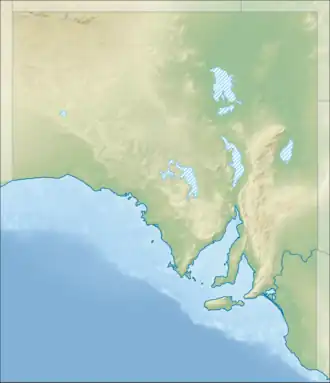  Cape Torrens Wilderness Protection Area | |
| Location | South Australia |
| Nearest city | Parndana |
| Coordinates | 35°43′30″S 136°45′00″E / 35.72500°S 136.75000°E[1] |
| Area | 9.4 km2 (3.6 sq mi)[2] |
| Established | 21 January 1971[3] |
| Governing body | Department for Environment and Water |
Cape Torrens Wilderness Protection Area is a protected area on Kangaroo Island in South Australia. It used to be called Cape Torrens Conservation Park and Cape Torrens National Park. It was first protected on January 21, 1971, to save the native plants and beautiful coastal cliffs. Later, on October 15, 1993, it became a wilderness protection area.[3][4][5]
Description
The area covers 9.4 square kilometres (3.6 sq mi) with 7 km (4.3 mi) of coastline, including Cape Torrens. It is located near the west end of the island’s north coast. The land has a coastal ridge and tall cliffs that are common on the north coast. The cliffs get lower as you go inland. On top of the cliffs, there are mostly Acacia paradoxa plants. Moving inland, the plants change to open eucalypt scrubland. The ridge has some Eucalyptus cladocalyx trees with smaller plants like Hakea rostrata, Xanthorrhoea tateana, and Lasiopetalum species growing underneath.[6] This area is classified as an IUCN Category Ib protected area, which means it is a wilderness area kept very natural.[1]
Wilderness qualities
The government says this area is special because it has very healthy native forests and woodlands and beautiful wild coastal views.ref name="2012-13report"/> It is home to the endangered Glossy Black-cockatoo. The wilderness is very natural and untouched by buildings or modern technology. There are no roads or tracks inside, and the plants are almost all original and undisturbed.
2019-2020 bushfires
The 2019-2020 bushfires burnt nearly half of Kangaroo Island, and the Cape Torrens Wilderness Protection Area was severely damaged. The park was closed, and as of 2026, it is still closed to visitors.[7]
References
- 1 2 3 "Terrestrial Protected Areas of South Australia (refer 'DETAIL' tab )". CAPAD 2016. Australian Government, Department of the Environment (DoE). 2016. Retrieved 21 February 2018.
- ↑ "Protected Areas Information System - reserve list (as of 17 Feb 2014)" (PDF). Department of Environment Water and Natural Resources. Retrieved 27 March 2014.
- 1 2 Shard, A.J. (21 January 1971). "NATIONAL PARKS ACT, 1966: VARIOUS NATIONAL PARKS DECLARED" (PDF). The South Australian Government Gazette. Government of South Australia: 186–187. Retrieved 22 December 2018.
- ↑ "Wilderness Advisory Committee Annual Report 2012-13" (PDF). Annual Report: 15. September 2013. ISSN 1832-9357. Retrieved 17 March 2014.
- ↑ Wiese, B.J. (15 October 1993). "WILDERNESS PROTECTION ACT 1992 SECTION 22(1): CONSTITUTION OF CAPE TORRENS WILDERNESS PROTECTION AREA" (PDF). The South Australian Government Gazette. Government of South Australia. p. 1755. Retrieved 25 January 2019.
- ↑ Anon (1987). Conservation Parks of Kangaroo Island Management Plan (PDF). Adelaide: Department of Environment and Planning, South Australia. ISBN 0-7243-8983-0.
- ↑ "Full closure of Cape Torrens Wilderness Protection Area". National Parks and Wildlife Service South Australia. 20 May 2024. Retrieved 12 May 2026.