Battle of Stalingrad's impacts on civilians
| Impact on civilians during the Battle of Stalingrad | |||||
|---|---|---|---|---|---|
| Part of the Battle of Stalingrad | |||||
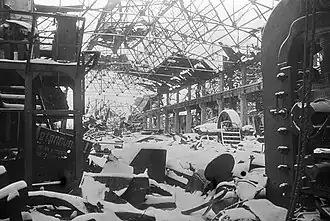 The Ruins of Stalingrad Krasny Oktyabr, a Stalingrad steel plant known in the West as the "Red October factory" lies in ruins, 1943 | |||||
| |||||
| Belligerents | |||||
 Soviet civilians |
 Germany
| ||||
| Strength | |||||
|
| ||||
| Casualties and losses | |||||
| 40,000–235,000 civilian deaths | 300,000–400,000 deaths | ||||




The Battle of Stalingrad (1942–1943), fought between the Soviet Union and the Axis powers, was the deadliest battle in human history with a total of over 2,6 million casualties in just 6 months of fighting[2] and arguably the turning point of the European theatre of World War II. Its impacts on civilians varied from many things, including mass executions, starvation, genocide,... Most of these were done by Nazi Germany and its Axis allies.
Civilian casualties came mostly from German military actions (bombardment and massacres) and the Soviet Union's refusal to help civilian safety increased the death rate. Most civilians were starved to death and had to hide in buildings for days. Civilian deaths were estimated to be around 40,000 to up to 235,000 and 99% of the city was completely destroyed.[3] Population decreased and most people left after the battle.
After the fall of Berlin in 1945 and Germany surrended and fell, reports showed that Soviet soldiers raped and killed German women and children in Berlin, most historians believe these actions were revenge for what the Germans have done in Stalingrad.[4]
Notes
- ↑ The start of the battle is debated, with some historians putting it in August, with the most common date being on 23 August 1942.
- ↑ Some German holdouts continued to operate in the city and resist until early March 1943.
- ↑ Around 6,000 men of the Croatian Home Guard served in the German 6th Army as the 369th Infantry Regiment and in the Italian 8th Army as the Light Transport Brigade.
References
- ↑ Leon E. Seltzer, ed. (1952), "Stalingrad", Columbia Lippincott Gazetteer of the World, New York: Columbia University Press, p. 1818, OL 6112221M
- ↑ Rees, Laurence (1999). War of the century : when Hitler fought Stalin. Internet Archive. New York : New Press. ISBN 978-1-56584-599-2.
{{cite book}}: CS1 maint: publisher location (link) - ↑ Craig, William (1973). Enemy at the gates : the battle for Stalingrad. Internet Archive. New York : Reader's Digest Press. ISBN 978-0-88349-000-6.
- ↑ Channing N. Morrison (2024). The Whispered Crimes of Sexual Violence in the European and Pacific Theater of World War II.