Bandicota
| Bandicota Temporal range: Holocene | |
|---|---|
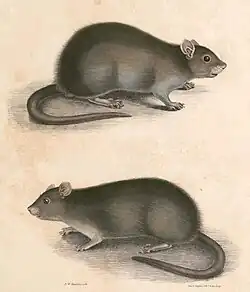 | |
| Lesser bandicoot rat (Bandicota bengalensis) | |
Scientific classification  | |
| Kingdom: | Animalia |
| Phylum: | Chordata |
| Class: | Mammalia |
| Order: | Rodentia |
| Family: | Muridae |
| Tribe: | Rattini |
| Genus: | Bandicota Gray, 1873 |
| Type species | |
| Mus giganteus[1] | |
| Species | |
|
Bandicota bengalensis | |
Bandicota is a group of rodents from Asia called bandicoot rats. Their common name and scientific name come from a word in the Telugu language, pandikokku (పందికొక్కు). DNA studies show that Bandicota forms a single family group closely related to some species of rats found in the Moluccas and Australia. They are part of a larger group called Rattus sensu lato.[2]
Species
- Greater bandicoot rat (B. indica) Bechstein, 1800
- Lesser bandicoot rat (B. bengalensis) Gray and Hardwicke, 1833
- Savile's bandicoot rat (B. savilei) Thomas, 1916
References
- ↑ Wilson, D. E.; Reeder, D. M., eds. (2005). Mammal Species of the World (3rd ed.). Johns Hopkins University Press. ISBN 978-0-8018-8221-0. OCLC 62265494.
- ↑ THOMSON, VICKI; WIEWEL, ANDREW; CHINEN, ALDO; MARYANTO, IBNU; SINAGA, M. H.; HOW, RIC; APLIN, KEN; SUZUKI, HITOSHI (2018-08-15). "A perspective for resolving the systematics of Rattus, the vertebrates with the most influence on human welfare". Zootaxa. 4459 (3): 431–452. doi:10.11646/zootaxa.4459.3.2. ISSN 1175-5334. PMID 30314119.