Anatolian beyliks
Anatolian beyliks (Turkish: Anadolu beylikleri; Ottoman Turkish: Tavâif-i mülûk, Beylik) were small Turkish principalities ruled by local beys. The earliest examples appeared after the late 11th century, but most were founded in the 13th century when the Seljuk Sultanate of Rum weakened.[1]
One of these principalities, the Ottoman beylik, ruled by the Osmanoğlu family of the Kayı tribe, expanded from its base in Bursa and eventually united the other beyliks, forming the Ottoman Empire by the end of the 15th century.[2]
The word beylik refers to a territory governed by a bey, similar to a small principality or duchy in medieval Europe.[3]
History
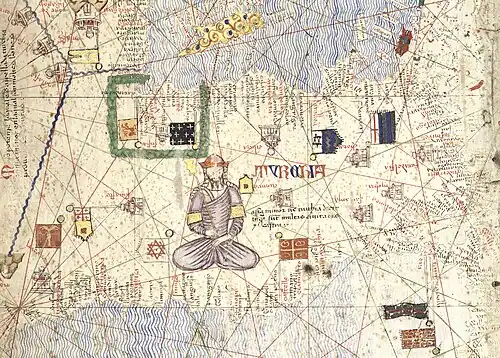
After the Seljuk victory at the Battle of Manzikert in 1071, Oghuz Turkic groups began settling across Anatolia. The Seljuks organized frontier regions under appointed uç beys, who defended borderlands and received military support in return for loyalty.[4]
Mongol pressure in the 13th century weakened Seljuk authority. Ilkhanid commanders gained influence, and many Turkish leaders who had served the Seljuks declared independence. These new rulers often cooperated with former Seljuk officials, religious leaders, and ghazi warriors from Persia and Central Asia.
As Byzantine control declined, Turkish settlement expanded westward. New beyliks formed in these regions and fought against Byzantines, Genoese, Crusader orders, and each other.[5]
By around 1300, Turkish principalities controlled much of western Anatolia. The strongest early beyliks were the Karamanids and the Germiyanids. The Ottoman beylik, still small at this time, was located around Söğüt. Along the Aegean coast, the beyliks of Karasi, Saruhan, Aydın, Menteşe, and Teke emerged. In the north, the Candar dynasty ruled around Kastamonu and Sinop.[6]
Under Osman I, the Ottomans expanded at Byzantine expense. After annexing the Beylik of Karasi and crossing into Europe in 1354, they became rivals to the Karamanids. By the late 14th century, the Ottomans had absorbed many beyliks, though some briefly regained territory after the Ottoman defeat at the Battle of Ankara (1402).
Ottoman rulers Mehmed I and Murad II reincorporated most beyliks within 25 years. Mehmed II ended Karamanid independence, and Selim I later annexed the Ramadanids and Dulkadirids. By the mid‑16th century, nearly all former beylik lands were fully integrated into the Ottoman Empire.
List of beyliks
Beyliks founded after Manzikert (1071)
In this list are the principalities founded soon after the Seljuk victory at Manzikert. These early beyliks were mostly in eastern Anatolia and often served as vassals or rivals of the Seljuk Sultanate of Rum.
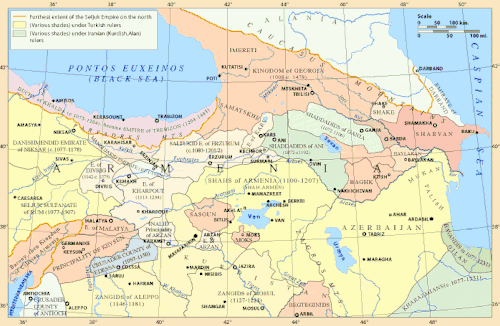
| Beylik | Capital | Dates |
|---|---|---|
| Beylik of Smyrna | İzmir | 1081–1098 |
| Shah-Armens | Ahlat | 1110–1207 |
| Artuqids | Hasankeyf, Mardin, Harput | 1102–1409 |
| Danishmend | Sivas | 1071–1178 |
| Dilmaçoğlu | Bitlis | 1085–1398 |
| İnaloğlu | Diyarbekir | 1095–1183 |
| Mengujekids | Erzincan, later Divriği | 1072–1277 |
| Saltukids | Erzurum | 1072–1202 |
| Beylik of Çubukoğulları | Harput | 1085–1112 |
| Beylik of Tanrıbermiş | Alaşehir | 1071–1098 |
Beyliks founded after Köse Dağ (1243)
These beyliks emerged after the Mongol victory at Köse Dağ weakened Seljuk central power and opened western Anatolia to new Turkish settlement.
| Beylik | Capital | Dates |
|---|---|---|
| Ahiler | Ankara | c.1290–1362 |
| Alaiye | Alanya | 1293–1471 |
| Aydinids | Birgi, later Ayasluğ | 1300–1425 |
| Candar | Eflani, later Kastamonu, Sinop | 1291–1461 |
| Dulkadirids | Elbistan, later Maraş | 1348–1522 |
| Eretnids | Sivas, later Kayseri | 1335–1390 |
| Germiyanids | Kütahya | 1300–1429 |
| Hamidids | Eğirdir | 1300–1391 |
| Karamanids | Larende (Karaman) | 1250–1487 |
| Karasids | Balıkesir, later Bergama | 1296–1357 |
| Menteşe | Milas | 1261–1424 |
| Ottoman beylik | Söğüt, later Bursa and Edirne | 1299–1922 |
| Ramadanids | Adana | 1352–1608 |
| Sarukhanids | Manisa | 1300–1410 |
| Teke | Antalya, later Korkuteli | 1321–1423 |
Society
Language
The beyliks helped spread the Turkish language and Islamic culture across Anatolia.[7] Unlike the Seljuks, who used Persian for administration, many beyliks adopted Turkish as a written and literary language.[8]
Art
Despite limited resources, artistic production flourished. Architecture, woodwork, stone carving, and tile decoration show both Seljuk influence and new regional styles.[9]
Architecture
Representative examples include the İlyas Bey Mosque (1404), İsa Bey Mosque (1375), and the Ulu Cami of Birgi (1312). Karamanid and Saruhanid buildings show early features that later became central to Ottoman architecture.[10]
See also
- History of Turkey
- Sultanate of Rum
- Taifa
References
- ↑ Douglas A. Howard, A History of Turkey, Cambridge University Press.
- ↑ Colin Imber, The Ottoman Empire, Google Books edition.
- ↑ Mohamed Hedi Cherif & Daniel Panzac, Histoire économique et sociale de l'Empire ottoman, Peeters Publishers.
- ↑ Claude Cahen, Pre-Ottoman Turkey, Internet Archive.
- ↑ Speros Vryonis, The Decline of Medieval Hellenism in Asia Minor, University of California Press.
- ↑ Kate Fleet, European and Islamic Trade in the Early Ottoman State, Cambridge University Press.
- ↑ Gábor Ágoston & Bruce Masters, Encyclopedia of the Ottoman Empire.
- ↑ ibid.
- ↑ Nurhan Atasoy, Arts of the Turkish World.
- ↑ Doğan Kuban, Ottoman Architecture.
Sources
- Douglas A. Howard, The History of Turkey, Cambridge University Press.
- Claude Cahen, Pre-Ottoman Turkey, New York University Press.
- Kate Fleet, European and Islamic Trade in the Early Ottoman State, Cambridge University Press.
- Speros Vryonis, The Decline of Medieval Hellenism in Asia Minor, University of California Press.
External links

| History |
| ||||||||||||
|---|---|---|---|---|---|---|---|---|---|---|---|---|---|
| Geography |
| ||||||||||||
| Government |
| ||||||||||||
| Economy |
| ||||||||||||
| Demographics |
| ||||||||||||
| Society |
| ||||||||||||
| |||||||||||||