Ahmadiyya in Pakistan
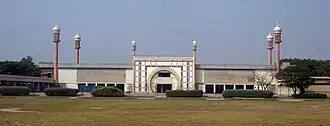
Ahmadiyya's in Pakistan are people who follow the Ahmadiyya religion or sect. There are different estimates, but they make up a small percentage, between 0.22% and 2.2%, of the population of Pakistan. The country has the largest number of Ahmadis in the world, between 2 to 5 million.[1][2] Rabwah, in Punjab, used to be the main Ahmadi headquarters before it was moved to London, England.
The Ahmadiyya movement started in Qadian, India, and after Pakistan gained its independence, Ahmadis moved to Rabwah. Some well-known Pakistanis who were Ahmadis include Abdus Salam, the country's first Nobel Prize winner, and Muhammad Zafarullah Khan, Pakistan's first foreign minister.[3]
Ahmadis in Pakistan mainly live in Punjab, but they can be found also in large cities like Karachi, Islamabad, and Peshawar.[4] Most Ahmadiyya's belong to a united group, called the Ahmadiyya Muslim Community (AMC), led by its caliph. Another group, called the Lahore Ahmadiyya Movement, is smaller and represents less than 0.2% of all Ahmadiyya's in Pakistan and rest of the world.[5]
Prosecution of Ahmadiyya's in Pakistan
Ahmadiyya moslims are controversial in Pakistan, mainly due to their dispute about the last prophet with Sunni and Shia muslims.[6]
In 1953, a series of riots broke out against the Ahmadiyya community, primarily in Lahore but also in other parts of the Punjab region. These riots were stoked by extremist conservative Islamic groups. The army suppressed the riots, resulting in many deaths. The riots had a significant impact on the Ahmadiyya community in Pakistan. This was the first major outbreak of violence directed against this community. It highlighted the vulnerability of this Muslim minority group and it showed that the state was unable to effectively protect them. It marked the beginning of the social exclusion of Ahmadiyya Muslims. [7]
In 1974, during the constitutional amendment, Ahmadiyya Muslims were declared non-Muslims, as the state was granted the authority to determine who is and who is not a Muslim. Before this constitutional amendment was enacted, Ahmadiyya Muslims were still formally recognized as full Pakistani citizens. They could call upon the Constitution of Pakistan, which guarantees the freedom to choose one’s own religion. This was also completely in line with the vision upon which Pakistan was founded; Mohammad Ali Jinnah believed that in Pakistan, one could choose one’s own religion and that the state should not interfere in this matter.[8] Following the constitutional amendment under Prime Minister Zulfikar Ali Bhutto in 1974, the process was set in motion for the legal persecution and restriction of the rights of Ahmadiyya Muslims in Pakistan.[9]
In 1984, it became a criminal offense for Ahmadiyya Muslims to identify themselves as Muslims. On April 26, 1984, a blasphemy law, Ordinance XX, was enacted. Under Ordinance XX, the rights of minorities were severely curtailed. For Ahmadiyya Muslims, the following became criminal offenses: calling oneself a Muslim; pretending to be a Muslim; referring to places of worship as “mosques”; using the Islamic greeting “Salaam Alaikum”; professing the faith (publicly or privately); spreading the faith; using Islamic terminology (in general); behaving in any way that offends the feelings of constitutionally recognized Muslims.[10]
Currently, it appears that the position of Ahmadiyya Muslims remains under pressure, despite international attention. In the complex landscape of Pakistani politics, a clear pattern can be identified in the failure of institutions to address institutional discrimination against minorities and the emergence of a climate that fosters religious extremism. There is still a pattern of attacks on the Ahmadiyya community. Places of worship and religious symbols are the primary targets of vandalism, arson, and even shootings. Notably, there are incidents in which the authorities are also involved or even collaborate in these attacks.[11]
References
- ↑ Refugees, United Nations High Commissioner for. "Refworld | Pakistan: The situation of Ahmadis, including legal status and political, education and employment rights; societal attitudes toward Ahmadis (2006 - Nov. 2008)". Refworld. Retrieved 2023-11-24.
- ↑ 4.910.000: James Minahan: Encyclopedia of the stateless nations. Ethnic and national groups around the world. Greenwood Press . Westport 2002, page 52
- ↑ "The Muslim genius forgotten by history". www.bbc.com. Retrieved 2023-11-24.
- ↑ Valentine, Simon Ross (2008). Islam and the Ahmadiyya Jamaʻat: History, Belief, Practice. Columbia University Press. ISBN 978-0-231-70094-8.
- ↑ Refugees, United Nations High Commissioner for. "Refworld | Pakistan: Situation of members of the Lahori Ahmadiyya Movement in Pakistan; whether differences exist between the treatment of Lahori Ahmadis and Qadiani Ahmadis; procedure for verification of membership in Lahori Ahmadiyya Movement (February 2006)". Refworld. Retrieved 2023-11-24.
- ↑ QASMI, ALI USMAN (2014-05-15). The Ahmadis and the Politics of Religious Exclusion in Pakistan. Anthem Press. ISBN 978-1-78308-236-0.
- ↑ "GESIS-Suche". search.gesis.org. Retrieved 2026-05-23.
- ↑ Rashid, Qasim (2011-01-01). "PAKISTAN'S FAILED COMMITMENT: How Pakistan's Institutionalized Persecution of the Ahmadiyya Muslim Community Violates the International Covenant on Civil and Political Rights". Richmond Journal of Global Law & Business. 11 (1): 1–42.
- ↑ Wolf, Siegfried O. (2019-05-10). "SADF Research Report- Persecution against the Ahmadiyya Muslim Community in Pakistan: A multi-dimensional perspective". SADF. Retrieved 2026-05-23.
- ↑ Rashid, Qasim (2011-01-01). "PAKISTAN'S FAILED COMMITMENT: How Pakistan's Institutionalized Persecution of the Ahmadiyya Muslim Community Violates the International Covenant on Civil and Political Rights". Richmond Journal of Global Law & Business. 11 (1): 1–42.
- ↑ National Commission for Human Rights, Pakistan, Situation Report: Monitoring the Plight of the Ahmadiyya Community (NCHR, 2023), 12-5.