African wildcat
| African wildcat | |
|---|---|
 | |
| Scientific classification | |
| Kingdom: | |
| Class: | |
| Order: | |
| Family: | |
| Genus: | |
| Species: | |
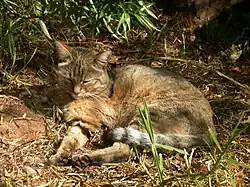
The African wildcats (Felis lybica) is a small, fierce cat that live in forests, grasslands, and brush lands in Africa and the Middle East. They are the closest living relatives of the domestic cat.
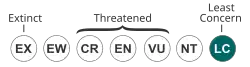
The african wildcat isn't just the closest relative to the cat, it is the exact species the which the domestic cat was bred from. The species occurs across northern Africa and extends around the edges of the Arabian Peninsula to the Caspian Sea. It is the most common and widely distributed wild cat, and is listed as Least Concern by IUCN since 2002.[1]
Some individual African wildcats were first domesticated about 10,000 years ago in the Middle East, and are the ancestors of the domestic cat.[2] Remains of domesticated cats were found in human burials in Cyprus, done by Neolithic farmers about 9,500 years ago.[3] Hybrids between domestic cats and African wildcats are still common today.[4] The african wild cat was listed as a subspecies of the European wildcat until 2017 when it was listed as its very own species.
Description
African wildcats are generally crepuscular, hunting at dawn and dusk. They are diurnal (most active during the day) in very cold weather. They are very good climbers. African Wildcats live for 12 to 15 years. They are about 50 percent larger than domesticated (tame) cats.
Diet
African wildcats are carnivores, like most cats. These fast, solitary hunters eat small to medium-sized mammals, birds, reptiles, frogs, invertebrates, and eggs.
References


- ↑ Driscoll, C., Nowell, K. (2010). "Felis lybica". IUCN Red List of Threatened Species. Version 2012.2. International Union for Conservation of Nature.
{{cite web}}: CS1 maint: multiple names: authors list (link) - ↑ Driscoll C.A. et al 2007. The near eastern origin of cat domestication. Science 317, 519–523. The Near Eastern Origin of Cat Domestication | Science
- ↑ Vigne J.D. et al 2004. Early taming of the cat in Cyprus. Science 304 (5668): 259–259.
- ↑ Kingdon, Jonathan (1988). East African Mammals: An Atlas of Evolution in Africa, Volume 3, Part A: Carnivores. University of Chicago Press. ISBN 978-0-226-43721-7.