Zhuyin
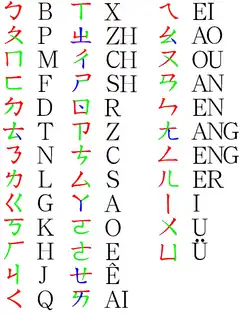
Zhuyin Fuhao, often shortened as zhuyin and commonly called bopomofo, is a type of sound-based writing for the Chinese language. In Chinese, "bo", "po", "mo" and "fo" are the first four of the conventional ordering of available syllables. As a result, the four syllables together have been used to refer to many different phonetic systems. For Chinese speakers who were first introduced to the Zhuyin system, "bopomofo" means zhuyin fuhao.
| Zhuyin | Pinyin | Origin |
|---|---|---|
| Initials | ||
| ㄅ | b | From 勹, the top portion 包, bāo |
| ㄆ | p | From 攵, the combining form of 攴, pū |
| ㄇ | m | From 冂, the archaic form of the radical 冖, mì |
| ㄈ | f | From 匚, fāng |
| ㄉ | d | From the archaic form of 刀, dāo. Compare the bamboo form. |
| ㄊ | t | From the upside-down 子 seen at the top of 充 |
| ㄋ | n | From 𠄎, ancient form of 乃, nǎi |
| ㄌ | l | Calligraphic form of 力, lì |
| ㄍ | g | From the obsolete character 巜, guì/kuài, 'river' |
| ㄎ | k | From 丂 from 考, kǎo |
| ㄏ | h | From 厂, hàn |
| ㄐ | j | From the archaic character 丩 from 纠, jiū |
| ㄑ | q | From the archaic character ㄑ, quǎn, graphic root of the character 巛, chuān (modern 川) |
| ㄒ | x | From 丅, a seal form of 下, xià. |
| ㄓ | zh | From  /𡳿, archaic form of 之, zhī. |
| ㄔ | ch | From the radical 彳, chì |
| ㄕ | sh | From the character 尸, shī |
| ㄖ | r | A semi-cursive form of 日, rì |
| ㄗ | z | From the radical 卩 节, jié, dialectically zié |
| ㄘ | c | Variant of 七, qī, dialectically ciī. Compare semi-cursive form and seal-script. |
| ㄙ | s | From the old character 厶, sī, which was later replaced by its compound 私, sī. |
| Finals | ||
| ㄧ | i, y | From 一, yī |
| ㄨ | u, w | From 㐅, ancient form of 五, wǔ. |
| ㄩ | ü, yu | From the ancient character 凵, qū, which remains as a radical |
| ㄚ | a | From 丫, yā |
| ㄛ | o | From the obsolete character 𠀀 hē, inhalation, the reverse of 丂 考, kǎo, which is preserved as a phonetic in the compound 可, kě.[1] |
| ㄜ | e | Derived from its allophone in Standard Mandarin, ㄛ, o |
| ㄝ | e | From 也, yě. Compare the Warring States bamboo form. |
| ㄞ | ai | From 𠀅 hài, bronze form of 亥. |
| ㄟ | ei | From 乁 yí, an obsolete character meaning 移, yí, "to move". |
| ㄠ | ao | From 幺, yāo |
| ㄡ | ou | From 又, yòu |
| ㄢ | an | From the obsolete character ㄢ, hàn, "to bloom", preserved as a phonetic in the compound 犯, fàn |
| ㄣ | en | From 乚, yǐn |
| ㄤ | ang | From 尢, wāng |
| ㄥ | eng | From 厶, an obsolete form of 厷, gōng |
| ㄦ | er | From 儿, the bottom portion of 兒, ér used as a cursive form |
| ㄭ | i | ( and inverted ㄓ) Perhaps 市, in addition to ㄓ. It is the minimal vowel of ㄓ, ㄔ, ㄕ, ㄖ, ㄗ, ㄘ, ㄙ that is spelled "ih" in Tongyong Pinyin and Wade-Giles and "i" in pinyin. |
The zhuyin characters are represented in typographic fonts as if drawn with an ink brush (as in Regular Script). They are encoded in Unicode in the bopomofo block, in the range U+3105 ... U+312D.
History
After the fall of the Qing dynasty in the 1911 Xinhai Revolution, the Ministry of Education of the Republic of China established the Commission on the Unification of Pronunciation in 1913 to promote a standardized national language. In 1918, the government officially introduced Zhuyin Fuhao (commonly known as Bopomofo) as a phonetic notation system designed to help the public learn Mandarin pronunciation and literacy.[2][3]
After the Chinese Civil War ended in 1949, the People’s Republic of China was founded on the mainland, while the Republic of China government retreated to Taiwan, continuing its governance there.[4] In the 1950s, the PRC introduced the Hanyu Pinyin system, which used the Latin alphabet to represent Mandarin pronunciation and gradually replaced Zhuyin in mainland China.[5]
However, Zhuyin Fuhao remained in use in Taiwan, where it continues to serve as an essential tool for teaching Mandarin pronunciation and for typing Chinese characters on computers and mobile devices.[6]
Features
Zhuyin was made to closely represent the sounds of Mandarin Chinese. Symbols are divided into two categories, the initials (the first sounds in a syllable) and the finals (the main vowel, the glide consonants ([y/i; IPA:/j/] and [w/u; IPA:/w/]) that come before the main vowel and all the sound that comes after it). There are 4 tone marks to represent the 5 Mandarin tones.
References
- ↑ "Unihan data for U+ 20000".
- ↑ Norman, Jerry (1988). Chinese. Cambridge University Press. pp. 259–261.
- ↑ DeFrancis, John (1984). The Chinese Language: Fact and Fantasy. University of Hawaii Press. pp. 125–127.
- ↑ Fairbank, John K. (1992). China: A New History. Harvard University Press. pp. 323–325.
- ↑ Norman, Jerry (1988). Chinese. Cambridge University Press. p. 261.
- ↑ Chen, Ping (1999). Modern Chinese: History and Sociolinguistics. Cambridge University Press. pp. 208–210.