Yugoslav massacres of Kosovo Albanians during the Kosovo War
During the Kosovo War, the Yugoslav police and armed forces committed a series of massacres against Kosovo Albanians.[1]
Casualties
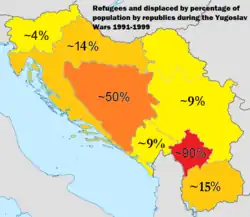
7,000–9,000 Kosovo Albanians were killed,[1] while 848,000 of them were expelled from Kosovo during the war.[2] The number of Kosovo Albanians killed by the Yugoslavs is roughly the same as that of the Bosniaks killed in the Bosnian genocide.[3][4]
Timeline
March 1998
- Likoshan and Çirez massacres – 26 Albanian civilians were killed.[5]
- Drenica massacre – there were 29 identified corpses discovered in a mass-grave, committed by Serbian law enforcement.[6]
- Attack on Prekaz – Serbian forces launched an operation aimed at killing Adem Jashari and his family on March 5–7, 1998. Approximately 58 members of the Jashari family were killed, including at least three non-combatants by summary execution and 28 women and young children.[7]
July 1998
- Orahovac massacre – Serbian forces executed 79 ethnic Albanians on 17–20 July 1998.[8]
September 1998
January 1999
- Račak massacre on January 15, 1999 – 45 Albanians were rounded up and killed by Serbian special forces. The first forensic report, by a joint Yugoslavian and Belarusian team, concluded that those killed were not civilians. The massacre provoked a shift in Western policy towards the war.[11]
March 1999
- Pastasel massacre – Serbian forces entered the village of Pastasel and expelled the women to Albania. Men from the village were gathered and 106 were executed.
- Krusha massacres – The ICTY discovered 98 bodies at Velika Kruša and, according to HRW, the number of people killed could exceed this number.[12] According to the ICTY, Sava Matić participated in the murder 42 persons on March 26, 1999.[13] There were also reports of mass rape.[14]
- Suva Reka massacre on March 26, 1999 – 48 Albanian civilians killed, among them many children.[15]
- Imeraj massacre on March 26, 1999 – Serbian forces entered the village of Pemishtë/Cërkolez and killed 19 Albanian civilians including 13 women and children.[16]
- Bela Crkva massacre – 62 known fatalities[17]
- Izbica massacre – Serbian forces killed at least 93 Albanian civilians.[18][19]
- Podujevo massacre – 14 Albanian civilians were killed and 5 wounded, including women, children and the elderly.[20]
April 1999
- Poklek massacre – at least 47 people were forced into one room and systematically gunned down on April 17, 1999. The precise number of dead is unknown, although it is certain that 23 children under the age of fifteen were killed in the massacre.[21]
- Mala Kaludra massacre on April 19, 1999 – 23 Albanian refugees were killed by Serbian paramilitaries as they fled towards Montenegro.[22]
- Rezala massacre – About 83 Albanian civilians were captured and most of them were executed, leaving only two survivors.[23]
- Meja massacre – at least 377 persons were killed by Serbian police and paramilitary forces on April 27–28 1999.[24][25]
May 1999
- Vushtrri massacre – More than 100 Kosovo refugees were killed by Serbian Police.[26]
- Ćuška massacre – 41 known victims.[27]
- Dubrava Prison massacre – Prison guards killed more than 70 Albanian prisoners in Dubrava Prison.[28]
- Albanian leaders massacre – 5 Albanian leaders were killed after they had attended the funeral of Albanian lawyer Bajram Kelmendi.[29][30]
Related pages
References
- 1 2 Simons, Marlise (July 10, 2006). "Tribunal focuses on Serbia's Kosovo war – Europe – International Herald Tribune". The New York Times. Retrieved April 4, 2023.
- ↑ Judah, Tim (1997). The Serbs: History, Myth and the Destruction of Yugoslavia (2009, 3rd ed.). New Haven, Connecticut: Yale University Press. p. 150. ISBN 978-0-300-15826-7. Retrieved January 3, 2021 – via Google Books.
[t]he Serbian police began clearing [...] people [who] were marched down to the station and deported [...] the UNCHR registered 848,000 people who had either been forcibly expelled or had fled.
- ↑
- "Bosnia and Herzegovina, 1992–1995". United States Holocaust Memorial Museum (USHMM). United States Holocaust Museum. Retrieved November 2, 2021.
- "Srebrenica Genocide: No Room For Denial". International Criminal Tribunal for the former Yugoslavia (ICTY). Retrieved December 11, 2024.
- "Srebrenica genocide | Facts, History, Map, & Photos". Britannica. October 25, 2024. Retrieved November 2, 2021.
- "Remembering Srebrenica - Remembering the Bosnian Genocide". Remembering Srebrenica. Retrieved December 11, 2024.
- "Bosnia: 1995". Holocaust Memorial Day Trust. Retrieved December 11, 2024.
- "War and Genocide in Bosnia-Herzegovina". USC Shoah Foundation. Retrieved December 11, 2024.
- ↑
- "The Bosnian genocide and the Srebrenica massacre". Bosnian Studies: Journal for research of Bosnian thought and culture. 5 (1): 40–52. 2021. Retrieved November 5, 2024.
- Smith, R. "Srebrenica massacre". Brittanica. Encyclopaedia Britannica. Retrieved November 2, 2021.
- Simic, Olivera (February 1, 2024). ""Celebrating" Srebrenica Genocide: Impunity and Indoctrination as Contributing Factors to the Glorification of Mass Atrocities". Journal of Genocide Research. doi:10.1080/14623528.2024.2308326. Retrieved November 5, 2024.
- "UN establishes Srebrenica genocide memorial day". DW News. May 23, 2024. Retrieved November 5, 2024.
- "Srebrenica massacre: 'What happened should be known'". BBC News. July 10, 2024. Retrieved November 5, 2024.
- ↑
- "Violations of the Rules of War by Government Forces - Violations in the Drenica Region". Human Rights Watch. 1998-10-04. Retrieved 2020-12-25.
- Kandić, Nataša (2011-09-30). "The Kosovo Memory Book 1998-2000". Humanitarian Law Center. Retrieved 2021-03-04.
- Kafexholli, Halim (2021-03-01). "Deadly Provocation: How Village Killings Kindled Kosovo's Resistance". Balkan Insight. Retrieved 2021-03-04.
- ↑ "Drenica Region Massacres (Feb–March 1998)". Archived from the original on 12 January 2010. Retrieved 17 March 2018.
- ↑ Krieger, Heike (2001). The Kosovo Conflict and International Law: An Analytical Documentation 1974–1999. Cambridge University Press. p. 96. ISBN 0-521-80071-4.
- ↑ "On the spot: The battle of Orahovac". tol.org. Prague: Transitions Online. July 25, 1998.
- ↑ Europe | Serbs attack Kosovo massacre reports Archived October 19, 2013, at the Wayback Machine. BBC News (October 1, 1998). Retrieved on 2011-04-30.
- ↑ "A WEEK OF TERROR IN DRENICA". www.hrw.org. Archived from the original on April 24, 2016. Retrieved March 17, 2018.
- ↑
- Europe | Racak massacre haunts Milosevic trial Archived February 12, 2013, at the Wayback Machine. BBC News (February 14, 2002). Retrieved on 2011-04-30.
- The Washington Post. "Slaughter in Racak Changed Kosovo Policy". The Washington Post. Archived from the original on October 20, 2019. Retrieved August 22, 2017.
- Human Rights Watch. "Yugoslav Forces Guilty of War Crimes in Racak, Kosovo". Archived from the original on January 11, 2023. Retrieved December 4, 2016.
- PBS. "Interviews – Ambassador William Walker". PBS. Archived from the original on January 11, 2023. Retrieved September 18, 2017.
- ↑ "THE PRIZREN-DJAKOVICA (Gjakove) Road Orahovac (Rrahovec) and Prizren Municipalities". Human Rights Watch.
- ↑ SUĐENJA ZA RATNE ZLOČINE – Presuda Savi Matiću zasnovana je na dokazima – Fond za humanitarno pravo Archived 28 October 2010 at the Wayback Machine. Hlc-rdc.org. Retrieved on 2011-04-30.
- ↑ Dla Myvedete wojna się nie skończyła Archived 24 March 2008 at the Wayback Machine. Serwisy.gazeta.pl. Retrieved on 2011-04-30.
- ↑ Serbia jails ex-policemen for the Kosovo massacre – Europe, World Archived September 25, 2015, at the Wayback Machine. The Independent (April 23, 2009). Retrieved on 2011-04-30.
- ↑ Milosevic faces justice for the Serbs' crimes against humanity Archived January 11, 2023, at the Wayback Machine. Telegraph. Retrieved on 2022-02-26.
- ↑ "Balkan Witness: News and Progressive Perspectives on the Yugoslav Wars". citycellar.com. Archived from the original on March 7, 2001. Retrieved March 17, 2018.
- ↑ U.S. Massacre video matches mass grave evidence Archived 3 March 2016 at the Wayback Machine. CNN (May 19, 1999). Retrieved on 2011-04-30.
- ↑ "OSCE Daily Broadcast Media Overview" Archived February 16, 2010, at the Wayback Machine UNMIKonline.org March 28, 2000 Link Retrieved January 5, 2010
- ↑ Massacre described at Kosovo war crimes trial – International News | News of the World | Middle East News | Europe News Archived March 3, 2016, at the Wayback Machine. FOXNews.com (December 11, 2008). Retrieved on 2011-04-30.
- ↑ UNDER ORDERS: War Crimes in Kosovo – 5. Drenica Region Archived 6 March 2016 at the Wayback Machine. Hrw.org. Retrieved on 2011-04-30.
- ↑ Idriz Rreci dhe grupi i tij u vra nga Jovica Utviq Archived February 26, 2022, at the Wayback Machine. ekonomia (albanian) (January 7, 2013).
- ↑ "UNDER ORDERS: War Crimes in Kosovo – 5. Drenica Region". Retrieved 6 April 2015.
- ↑ "UNDER ORDERS: War Crimes in Kosovo – 6. Djakovica Municipality". www.hrw.org. Archived from the original on March 6, 2016. Retrieved March 17, 2018.
- ↑ Stojanovic, Milica (August 16, 2022). "Kosovo War Criminal Elected VP of Serbian Parliament". Genocide Watch.
- ↑ "ICTY: THE KOSOVO CASE, 1998–1999". Archived from the original on September 28, 2017. Retrieved March 9, 2010.
- ↑ Qyshk Archived June 14, 2011, at the Wayback Machine. Americanradioworks.publicradio.org. Retrieved on 2011-04-30.
- ↑ Human Rights Watch (Organization) (November 1, 2001). Under orders: war crimes in Kosovo. Human Rights Watch. ISBN 978-1-56432-264-7. Archived from the original on January 11, 2023. Retrieved April 30, 2011.
- ↑ The Washington Post (March 29, 1999). "NATO: Five Kosovo Albanian Leaders Executed". The Washington Post. Archived from the original on 29 May 2017. Retrieved August 22, 2017.
- ↑ Document – Federal Republic of Yugoslavia: Kosovo -Outrageous Execution of ethnic Albanian leaders | Amnesty International Archived November 22, 2018, at the Wayback Machine. Amnesty.org (March 29, 1999). Retrieved on 2011-04-30.