Xanthorrhoea australis
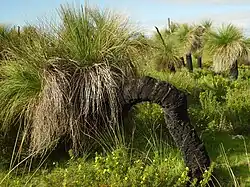
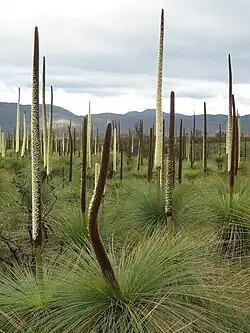
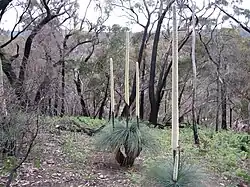
Xanthorrhoea australis, also called the grass tree or austral grasstree, is a plant from Australia.[1] It is the most common type of Xanthorrhoea. Its trunk can grow several meters tall and sometimes has branches. Some Aboriginal people call it bukkup, baggup, or kawee.[1]
Description
You can recognize Xanthorrhoea by the shape of its leaves when you look at a cross-section. For X. australis, the leaf cross-section looks like a rough diamond and the leaves are blue-green.
This plant usually has a rough trunk that can be black because of bushfires.[2] The trunk can grow more than 3 metres (9.8 ft) tall and up to 1 metre (3.3 ft) wide. Sometimes the trunk branches. The bark is thick, rough, and corky.[3] The plant grows very slowly, and the trunk only appears after many years. The long, thin leaves grow close together at the top of the trunk.[2]
X. australis takes many years to flower and does not flower every year. But after a bushfire, it flowers a lot. The flowers grow on a tall spike that can be up to 2 m (6 ft 7 in) tall. The flowers have 6 petals and cover most of the spike.
The leaves form a round shape at the top of the trunk. They grow in a spiral and look like a tight bunch when young. As the plant grows, the leaves spread out and the oldest leaves hang down, making a skirt around the trunk. The leaves are blue-green, needle-like, 14 to 30 centimetres (5.5 to 11.8 in) long, and have a waxy surface.[3] The leaves are softer than other Xanthorrhoea plants. The old leaves hanging down partly cover the blackened trunk. X. australis flowers from July to December, but younger plants may flower in June.
The name "grass tree" is correct because the trunk and branches are made from the bases of the leaves, not wood.[4]
Grass trees can live a very long time, some for 350 to 450 years.[5]
Taxonomy
The plant was first described by the botanist Robert Brown in 1810.[6]
The name Xanthorrhoea comes from Greek words meaning "yellow" and "to flow," because the plant produces a yellow resin. The species name australis means "southern," which shows where the plant grows.[2]
Where it grows
This plant grows in New South Wales, the Australian Capital Territory, South Australia, Tasmania, and Victoria. It is the most widely spread species of its kind.[2] It grows in old, poor soils and does not like phosphorus. It is also very sensitive to a disease called dieback, caused by a soil fungus, Phytophthora cinnamomi.[3]
Uses
Indigenous Australians used the flowering spikes to make a sweet drink by soaking them in water. They ate the soft, white parts at the base of the leaves and the growing tip of the stem. The flower spike produces a sticky resin used to glue tools together. The stem was used to make the bottom part of a spear and to help start fires. The resin was also collected and made into lacquer for furniture.[1]
In 1915, people were worried because German agents had been buying large amounts of grass tree resin for many years. The resin was used to make explosives that were even stronger than dynamite.[4]
References
- 1 2 3 "Botanical name: Xanthorrhoea australis". Australian National Botanic Gardens. February 2003. Retrieved 4 June 2017.
- 1 2 3 4 "Xanthorrhoea australis". Australian Native Plants Society (Australia). Archived from the original on 4 March 2016. Retrieved 4 June 2017.
- 1 2 3 "Xanthorrhoea australis - Southern grasstree" (PDF). Flora of Tasmania. Government of Tasmania. Archived from the original (PDF) on 23 March 2016. Retrieved 4 June 2017.
- 1 2 This Wikipedia article incorporates text from Xanthorrhoeas - An Australian Explosive (9 July 2021) published by the State Library of Queensland under CC BY licence, accessed on 9 July 2021.
- ↑ "Grass trees". Bush Heritage Australia. Retrieved 4 June 2017.
- ↑ "Xanthorrhoea australis R.Br. Grass tree". Atlas of Living Australia. Global Biodiversity Information Facility. Retrieved 4 June 2017.
Other websites
- Images
- Archived 2006-05-01 at the Wayback Machine, Archived 2007-02-20 at the Wayback Machine, Archived 2011-06-07 at the Wayback Machine, , [5]


