World War II in Africa
| World War II in Africa | |||||||
|---|---|---|---|---|---|---|---|
| Part of World War II | |||||||
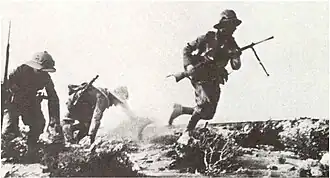 Italian forces charging during the North African Campaign | |||||||
| |||||||
| Belligerents | |||||||
 Germany  Vichy France (until 1942) |
 Arbegnoch (until 1941)  Ethiopia (from 1941)  Australia[2]  South Africa  United States (from 1942)  Egypt (and others) | ||||||
| Commanders and leaders | |||||||
 Benito Mussolini Adolf Hitler  Philippe Pétain |
 Winston Churchill  Charles de Gaulle Franklin D. Roosevelt | ||||||




World War II in Africa Began on June 10 1940 when the (Fascist-led) Kingdom of Italy declared war on the Western Allied powers (France and the United Kingdom). France surrendered to the Axis powers (Germany and Italy) 12 days after the Italian declaration of war and a Puppet state in the mainland of France. And the French colonies (including the ones in Africa) were given to the new puppet state called the French State. After the Fall of France to the axis, Italy began to attack allied colonial strongpoints in East and North Africa. Meanwhile in French Equatorial Africa, the colonies there began pledging allegiance to the Free French movement located in London (capital of the UK). But the only colony in French Equitorial Africa that remained on the Vichy—Axis side was Gabon, which was taken by the allies (Free French and UK) by force. At the same time in North and East Africa, Italian forces were being pushed back by Commonwealth—Allied forces. The allies invaded the Italia East Africa in 1941 and linked up with the Ethiopian resistance. Soon the Italians surrenderded and parts of the colony were occupied by other colonial powers, while Ethiopian independence was restored. In North Africa, Italian—German forces overran allied forces back to Egypt. Then the axis were pushed back to Libya. Then the allies were pushed back to Egypt again. The Allies were stationed at the port city of El Alamein, where two battles were fought. The First Battle ended in a stalemate, but the Second Battle ended with an allied victory and the Axis were pushed back to Libya again. Meanwhile, in the South-West of the Mediterranean, Anglo—US forces landed on the Coasts of Vichy controlled Morocco and Algeria and gained a foothold in both colonies. The Axis (Germany and Italy) occupied French Tunisia to prevent that colony from ending up in allied control. In 1943, Italian Libya was overrun by the allies advancing from Egypt. Meaning that Tunisia was the only Axis strongpoint in Africa. The Axis tried to push back at Kasserine Pass, and succeeded. But that success in the region wouldn’t last long, as the last offensives would start in March and would eventually end with the Axis Surrender in May 1943.