Wilcannia
Wilcannia is a small town in the far west of New South Wales, Australia. It sits on the Darling River (which the local Aboriginal people call the "Baaka"). As of 2021, Wilcannia had a population of 735.[1]
| Wilcannia New South Wales | |||||||||
|---|---|---|---|---|---|---|---|---|---|
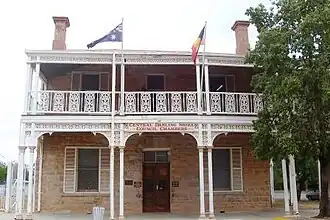 Central Darling Council Chambers | |||||||||
  Wilcannia | |||||||||
| Coordinates | 31°33′25″S 143°22′45″E / 31.55694°S 143.37917°E | ||||||||
| Population | 735 (as of 2021) | ||||||||
| Established | 1866 | ||||||||
| Postcode(s) | 2836 | ||||||||
| Elevation | 75.0 m (246 ft) | ||||||||
| Location |
| ||||||||
| |||||||||
History
In the late 1800s, Wilcannia was very important. It was the third-largest inland port in all of Australia. The town grew because of the paddle steamers that travelled along the Darling River. These boats carried huge amounts of wool and other goods for trade.
Because so much money and business passed through, Wilcannia was sometimes called the "Queen City of the West." Many large, beautiful buildings made of local sandstone were built during this time. You can still see them today, like the old Courthouse and Post Office.
When railways and better roads were built, the river trade stopped, and the town became much smaller.
- ↑ "2021 Wilcannia, Census All persons QuickStats | Australian Bureau of Statistics". abs.gov.au. Retrieved 2024-11-08.