Vinyl alcohol
| |||
| Names | |||
|---|---|---|---|
| Preferred IUPAC name
Ethenol | |||
| Other names
Hydroxyethene Hydroxyethylene Ethylenol | |||
| Identifiers | |||
| |||
3D model (JSmol) |
|||
| ChEMBL | |||
| ChemSpider | |||
| ECHA InfoCard | 100.008.350 | ||
PubChem CID |
|||
| UNII | |||
CompTox Dashboard (EPA) |
|||
SMILES
| |||
| Properties | |||
| C2H4O | |||
| Molar mass | 44.053 g/mol | ||
| Related compounds | |||
Related compounds |
Allyl alcohol | ||
Except where otherwise noted, data are given for materials in their standard state (at 25 °C [77 °F], 100 kPa). | |||
 verify (what is  ?) | |||
| Infobox references | |||
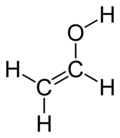
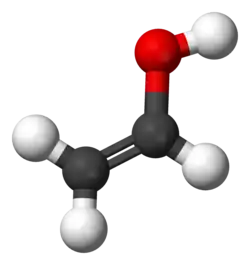
Vinyl alcohol is an unstable chemical compound. It is the simplest enol. Because of the tautomerism common to enols, it changes into acetaldehyde almost as soon as it is made. Because it lasts for so little time, it can't be used in chemical reactions except when made as a reaction intermediate.
Even though it can't be made or used easily, derivatives of vinyl alcohol are important ingredients in the chemical industry. Vinyl esters, which replace the hydrogen atom of the hydroxy group with an acyl group, can polymerise into vinyl polymers like polyvinyl acetate. Hydrolysis of these polymers makes polyvinyl alcohol, the homopolymer of vinyl alcohol.