Van Gujjar people
The Van Gujjar or Ban Gujjar (also known as Muhamadan Gujjars or Jungali (forest) Gurjars) is a pastoral and nomadic ethnic group of the Gurjar community.[1][2]
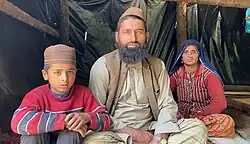
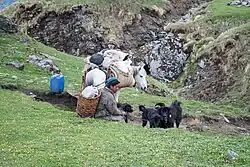
They are traditionally herders primarily residing in the Shivalik Hills of Uttarakhand, Himachal Pradesh and Western Uttar Pradesh.[3] They are followers of Islam. The Van Gujjars of Uttarakhand and Uttar Pradesh have strong ties with the Muslim Gujjars (Bakarwal Gurjars) of Himachal Pradesh and Jammu Kashmir, with intermarriages being common.[4][5]
References
- ↑ Srivastava, Raghav (2022). "The making of pastoralisms: An account of the Gaddis and Van Gujjars in the Indian Himalaya". Pastoralism: Research, Policy and Practice. 12 (1): 42. doi:10.1186/s13570-022-00259-z. ISSN 2041-7136. PMC 9590384. PMID 36311345.
{{cite journal}}: CS1 maint: unflagged free DOI (link) - ↑ "Outside the jungle book". www.thehindubusinessline.com. Retrieved 2026-02-15.
- ↑ Karlsson, B. G. (2013-11-19). Contested Belonging: An Indigenous People's Struggle for Forest and Identity in Sub-Himalayan Bengal. Routledge. ISBN 978-1-136-82753-2.
- ↑ Gujjar, Rahim Bhatti (2025-01-01). "The Gujjar People: An Ethnohistorical and Linguistic Survey with a Focus on Central Asian Origins and Gojri's Hindko Affinities". Independent.
- ↑ Rawat, Ajay Singh (1993). Man and Forests: The Khatta and Gujjar Settlements of Sub-Himalayan Tarai. Indus Publishing. ISBN 978-81-85182-97-1.