Utagawa Kuniyoshi
- In this Japanese name, the family name is Utagawa.
Utagawa Kuniyoshi (Japanese: 歌川 國芳, [ɯtaɡaɰa kɯɲijoɕi]; January 1, 1798[1] – April 14, 1861) also called Kuniyoshi, was a Japanese artist. He was a masters of the ukiyo-e style of woodblock prints and painting.[2]

Career
Kuniyoshi was part of the Utagawa school of artists.[3]
The range of Kuniyoshi's subjects included landscapes, beautiful women, Kabuki actors, cats, and mythical animals. He is known images of the battles of samurai and legendary heroes.[4] His work was affected by Western art and caricature.[2]
Tsukioka Yoshitoshi was one of his students.
His work influenced Toyohara Chikanobu.[5]
Takashi Murakami credits the influence of Kuniyoshi in his work.[4]
List of print series
- This list is not finished; you can help Wikipedia by adding to it.
- Illustrated Abridged Biography of the Founder (c. 1831)
- Famous Views of the Eastern Capital (c. 1834)
- Heroes of Our Country's Suikoden (c. 1836)
- Stories of Wise and Virtuous Women (c. 1841-1842)
- Fifty-Three Parallels for the Tōkaidō (1843–1845)
- Twenty-Four Paragons of Filial Piety (1843–1846)
- Mirror of the Twenty-Four Paragons of Filial Piety (1844–1846)
- Six Crystal Rivers (1847–1848)
- Fidelity in Revenge (c. 1848)
- Twenty-Four Chinese Paragons of Filial Piety (c. 1848)
- Sixty-Nine Stations along the Kisokaido (1852)
- Portraits of Samurai of True Loyalty (1852)
- 24 Generals of the Kai Provence (1853)
Gallery
Multi-panel impressions, tryptichs
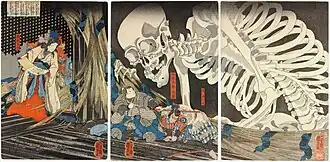 Takiyasha the Witch and the Skeleton Spectre
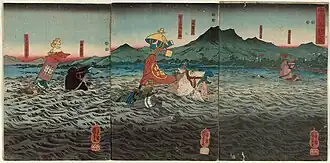 Kajiwara Kagesue, Sasaki Takatsuna, and Hatakeyama Shigetada racing to cross the Uji River before the second battle of Uji during the Genpei War[6]
Yoko-e, a print in horizontal or "landscape" format
 At the shore of the Sumida River
 Mt fuji from Sumida
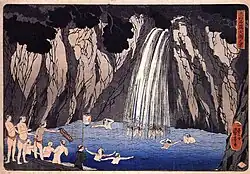 Pilgrims in the waterfall
Single panel format
 Banners for boys' day festival
 Courtesan in training
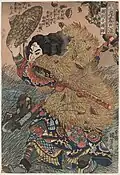 from the series Heroes of Our Country's Suikoden
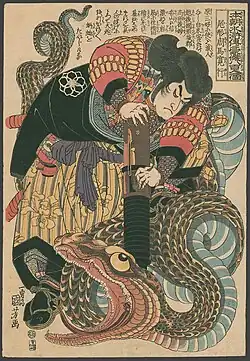 from the series Heroes of Our Country's Suikoden
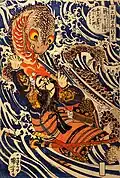 Hanagami Danjo no jo Arakage fighting a giant salamander
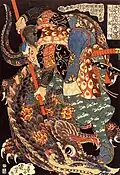 Miyamoto Musashi[7] killing a giant shark
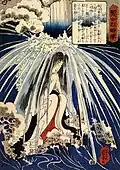 Hatsuhana doing penance under the Tonosawa waterfall
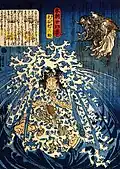 Keyamura Rokusuke under the Hikosan Gongen waterfall
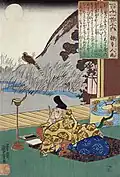 Kakinomoto no Hitomaro[8]
Themes
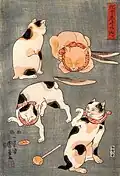
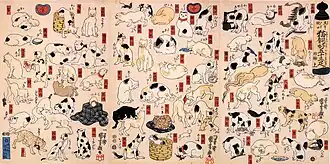
Kuniyoshi made many images of cats.
|
|
|
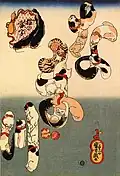
Kuniyoshi made images which were caricatures.
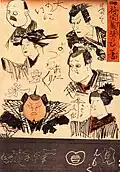 Scribbling on the storehouse wall
 At first glance he looks very fierce, but he is actually a kind person
References
- ↑ Ōkubo, Junichi (1994), "Utagawa Kuniyoshi", Asashi Nihon rekishi jinbutsu jiten (朝日日本歴史人物事典) (in Japanese), Tokyo, Japan: Asahi Shimbun Company, ISBN 4023400521, archived from the original on 2016-10-05
- 1 2 Nussbaum, Louis Frédéric et al. (2005). "Kuniyoshi" in Japan Encyclopedia, p. 576.
- ↑ Nussbaum, "Utagawa-ryū" at p. 1018.
- 1 2 Lubow, Arthur. "Everything But the Robots: A Kuniyoshi Retrospective Reveals the Roots of Manga," New York Magazine. March 7, 2010; retrieved 2012-3-29.
- ↑ "Yōshū Chikanobu [obituary]," Miyako Shimbun, No. 8847, October 2, 1912. p. 195.
- ↑ Kitagawa, Hiroshi et al. (1975). The Tale of the Heike, pp. 511-513.
- ↑ Nussbaum, "Miyamoto Musashi" at p. 650.
- ↑ Nussbaum, "Kakinomoto no hitomaro" at p. 456.
Other websites

Wikimedia Commons has media related to Utagawa Kuniyoshi.
- University of Vienna, Ukiyo-e Caricatures 1842-1905
- JapanSociety.org, Graphic Heroes, Magic Monsters Archived 2010-03-13 at the Wayback Machine
- Kuniyoshi Project
- Artencyclopedia.com, Utagawa Kuniyoshi
- Artelino.com, Utagawa Kuniyoshi