United Nations Security Council Resolution 757
| UN Security Council Resolution 757 | ||
|---|---|---|
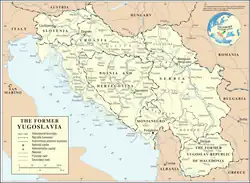 Map of former Yugoslavia | ||
| Date | 30 May 1992 | |
| Meeting no. | 3,082 | |
| Code | S/RES/757 (Document) | |
| Subject | Yugoslavia | |
Voting summary |
| |
| Result | Adopted | |
| Security Council composition | ||
Permanent members | ||
Non-permanent members | ||
| ||




United Nations Security Council resolution 757 was adopted on 30 May 1992. After reaffirming resolutions 713 (1991), 721 (1991), 724 (1991), 727 (1992), 740 (1992) 743 (1992), 749 (1992) and 752 (1992), the Council disapproved the failure of the Federal Republic of Yugoslavia (Serbia and Montenegro) to carry out Resolution 752.
The resolution stated that until Resolution 752 was carried out, all UN Member States should:[1][2]
- (a) stop the import of all products from Yugoslavia;
- (b) stop the sale of all products to Yugoslavia, except for humanitarian aid;
- (c) not make any financial resources available to Yugoslavia;
- (d) not allow permission to aircraft to take of from, land or fly over their country if the aircraft is heading to or coming from Yugoslavia, except on humanitarian grounds;
- (e) not allow the maintenance or engineering of aircraft in or operated by Yugoslavia;
- (f) lower the number of diplomatic and consular staff in Yugoslavia;
- (g) not allow the participation of people and teams representing Yugoslavia in sporting events hosted in their countries;
- (h) suspend scientific, technical and cultural exchanges and visits.
The Council also decided that the sanctions should not apply to the United Nations Protection Force, the Conference on Yugoslavia or European Community Monitoring Mission. It also called for a security zone to be set up in Sarajevo and its airport, and for the security council committee created in Resolution 724 to monitor the arms embargo in Yugoslavia.
Resolution 757 was adopted by 13 votes to none against, with two abstentions from China and Zimbabwe.
Sports sanctions
Association football
The Yugoslavia national football team had qualified for the Euro 1992 finals, but were disqualified under the UN sanctions. They were replaced by Denmark, who had finished behind Yugoslavia in qualifying, and would win the tournament against Germany.[3][4] Yugoslavia were also banned from both the 1994 FIFA World Cup and UEFA Euro 1996.[5][6]
Olympics
The International Olympic Committee reached a compromise with the UN about Yugoslavia's participation at the 1992 Summer Olympics. The Yugoslav Olympic Committee would not invited to the games, but Yugoslav athletes were allowed to compete under the label of Independent Olympic Participants. This was also done with the 1992 Summer Paralympics, where Yugoslav athletes competed as Independent Paralympic Participants.[7][8]
Related pages
References
- ↑ Gowlland-Debbas, Vera; Tehindrazanarivelo, Djacoba Liva (2004). National implementation of United Nations sanctions: a comparative study. Martinus Nijhoff Publishers. p. 358. ISBN 978-90-04-14090-5.
- ↑ Weiss, Thomas George (1997). Political gain and civilian pain: humanitarian impacts of economic sanctions. Rowman & Littlefield. pp. 158–159. ISBN 978-0-8476-8703-9.
- ↑ "Yugoslavia barred from European Championships". UPI. Retrieved 2022-03-31.
- ↑ "Sports ban hits Yugoslavia - UPI Archives". UPI. Retrieved 2024-01-07.
- ↑ "Yugoslavia banned for 1994 World - UPI Archives". UPI. Retrieved 2024-01-07.
- ↑ Lowe, Sid (2020-05-29). "Slavisa Jokanovic: 'Euro 92 was taken away from us. We were better than Denmark'". The Guardian. ISSN 0261-3077. Retrieved 2024-01-07.
- ↑ Kidane, Fekrou (February–March 1998). "The Olympic Truce" (PDF). Olympic Review. XXVI (19): 5–7. Archived from the original (PDF) on 26 August 2016.
- ↑ "U.N. Bans Yugoslav Teams From Olympics : Summer Games: Ruling paves way for individuals to compete in Barcelona". Los Angeles Times. 1992-07-22. Retrieved 2022-03-31.
Other websites
 Works related to United Nations Security Council Resolution 757 at Wikisource
- Text of the Resolution at undocs.org