Tuskaloosa
Tuskaloosa | |
|---|---|
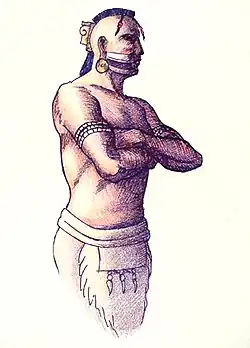 Chief Tuskaloosa in an illustration by H. Roe | |
| Died | 1540 Mabila, present-day Alabama |
| Occupation | Chieftain |
| Title | Cacique (Chief) of Tuskalusa |
Tuskaloosa (also written Tuskalusa, Tastaluca, or Tuskaluza) (birthdate unknown – 1540) was a major paramount chief of a Mississippian chiefdom in what is now Alabama. His people were ancestors of later Native American groups in the region, including the Choctaw and Creek peoples. The modern city of Tuscaloosa, Alabama is named after him.
Tuskaloosa is best known for his role in the Battle of Mabila against the Spanish expedition of Hernando de Soto. He was taken hostage by the Spanish, but later prepared an attack at his fortified town of Mabila. The battle ended in a Spanish victory.
Contemporary Spanish reports describe Tuskaloosa as a very tall and strong man. His name comes from the western Muskogean language words tashka and losa, meaning “Black Warrior.”[1]
[Tuskaloosa]'s appearance was full of dignity… He was tall, muscular, and well formed… feared by his vassals and neighboring nations.
— Gentleman of Elvas, 1557[2]
De Soto expedition
Tuskaloosa was first mentioned in the accounts of the 1539–1543 expedition of Hernando de Soto, who traveled across modern-day Florida, Georgia, South Carolina, and Alabama. The expedition often took Native Americans as guides, interpreters, and hostages to ensure safe passage.
By October 1540, the expedition reached central Alabama. De Soto expected local chiefs to provide food, laborers, and women, and often used threats to enforce obedience.
Province of Tuskaloosa
Tuskaloosa ruled a large province made of many villages along the Coosa and Alabama rivers. Each village had its own chief but answered to him.
The Spanish first met Tuskaloosa’s son at the town of Talisi. After several days of travel through the province, they arrived at Tuskaloosa’s main town, Atahachi, where they met the chief on a platform mound. Tuskaloosa showed dignity and calm, even when the Spanish tried to intimidate him.[3]
A later Spanish report described Tuskaloosa sitting on high cushions, dressed in a feather mantle, with attendants beside him.[4]
The Spanish took Tuskaloosa as a hostage when he refused their demands for porters and women. He told them they should travel to his town of Mabila for what they wanted.[1]
Battle of Mabila
On October 18, 1540, the Spanish arrived at Mabila, a strongly fortified town filled with young warriors. When the Spanish tried to seize the chief of Mabila, fighting broke out.
The battle lasted eight to nine hours. The Spanish eventually broke through the walls, burned the town, and killed most of the defenders.[5]
We entered the town and set it on fire… The fighting continued until nightfall. Almost none of the Indians escaped.
— Luys Biedma, 1544[6]
Tuskaloosa himself was not found among the dead, but his son was. Spanish sources say more than five thousand Native Americans were in the town.[6]
Archaeology
Some archaeologists believe the Taskigi Mound site near the meeting point of the Coosa, Tallapoosa, and Alabama rivers may represent part of the Tuskaloosa province. The site is preserved within the Fort Toulouse–Fort Jackson State Historic Site.[7][8]
After the battle
After Mabila was destroyed, the Spanish searched nearby villages for supplies and found many wounded warriors. Over time, peoples of the region—including groups from the Coosa and Tuskaloosa areas—later formed part of the Choctaw.[9]
See also
- Mississippian culture#Known Mississippian chiefdoms
- Southeastern Ceremonial Complex
References
- 1 2 Hudson, Charles M. (1997). Knights of Spain, Warriors of the Sun. University of Georgia Press. pp. 230–232. ISBN 9780820318882.
- ↑ Gentleman of Elvas (1557). "Chapter XVII". Narratives of the Career of Hernando De Soto in the Conquest of Florida. Kallman Publishing Co. (1968), Translated by Buckingham Smith. p. 81.
- ↑ Hudson (1997), pp. 226–229
- ↑ "A Narrative of de Soto's Expedition based on Rodrigo Ranjel". 1554. Archived from the original on 2009-03-17.
- ↑ Hudson (1997), pp. 234–238
- 1 2 "Relation of the Conquest of Florida by Luys Hernandez de Biedma". 1554. Archived from the original on 2008-10-15.
- ↑ "Mound at Fort Toulouse – Fort Jackson Park". University of Alabama.
- ↑ Jenkins, Ned J.; Sheldon, Craig T. (2016). "Late Mississippian/Protohistoric Ceramic Chronology". Journal of Alabama Archaeology. 62.
- ↑ Patricia Galloway (1995). Choctaw Genesis – 1500 to 1700. University of Nebraska Press.
| |||||||||||
| Middle Mississippian |
| ||||||||||
| South Appalachian Mississippian |
| ||||||||||
| Fort Walton culture |
| ||||||||||
| Pensacola culture |
| ||||||||||
| Plaquemine Mississippian |
| ||||||||||
| Caddoan Mississippian |
| ||||||||||
| Upper Mississippian cultures |
| ||||||||||
| Culture |
| ||||||||||
| |||||||||||
