Transparent conducting film
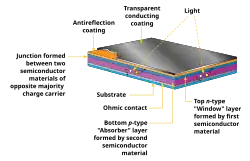
A transparent conducting film is a type of material that both conducts electricity and is transparent to light. This is important for optoelectronics and photovoltaics that need to have both light and electrical current. Because these materials are normally made in thin layers, they are called films.
Common conductors like copper and gold are not transparent, and common transparent materials like glass and polycarbonate are not conductors. In general, more conductive materials have more charge carriers, which also scatter light and make the compound less transparent. Because of this, special materials need to be used to make transparent conductors.
The main material used to make transparent conducting films is indium tin oxide or ITO,[1] but because indium is rare and expensive, materials science is researching other materials as possible alternatives to ITO, including other oxides, conductive polymers, and materials based on carbon nanotubes.[2]
Sources
- ↑ . doi:10.1016/j.tsf.2025.140784.
{{cite journal}}: Cite journal requires|journal=(help); Missing or empty|title=(help) - ↑ . doi:10.1002/pat.5797.
{{cite journal}}: Cite journal requires|journal=(help); Missing or empty|title=(help)