Trams in Melbourne
| Public Transport Victoria | ||||||||||||||||||||||||||||||||
 | ||||||||||||||||||||||||||||||||
 E-class Melbourne trams on Bourke Street, December 2013 | ||||||||||||||||||||||||||||||||
| Operation | ||||||||||||||||||||||||||||||||
|---|---|---|---|---|---|---|---|---|---|---|---|---|---|---|---|---|---|---|---|---|---|---|---|---|---|---|---|---|---|---|---|---|
| Locale | Melbourne, Victoria, Australia | |||||||||||||||||||||||||||||||
| Infrastructure | ||||||||||||||||||||||||||||||||
| Track gauge | 1,435 mm (4 ft 8 1⁄2 in) standard gauge | |||||||||||||||||||||||||||||||
| ||||||||||||||||||||||||||||||||

Melbourne, Australia introduced trams in 1885 and now it is the largest tram network in the world,[3] consisting of 250 kilometres (160 miles) of tracks, 500 trams, 24 routes, and 1,700 tram stops.[4]
The trams are powered using 600V DC delivered by overhead wires and run on standard gauge track.
Currently, the network is operated by a private company, Yarra Trams under contract from the Victorian Government, the owner of the network. Melbourne's trams give a lot to the city's distinctive character and are loved by the people of Melbourne.
In 2023-2024, a total of 154.8 million passengers took rides on Melbourne’s trams.
History
Horse tram era (1884 – 1923)
Before the city had electric trams, they used horse trams. The first was from Fairfield station to a real property area, opened on 20 December 1884 but closed in 1890. There were seven horse tram lines in Melbourne.[5]
Cable tram era (1885 – 1940)
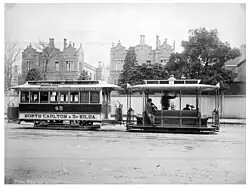
Cable trams were next to be bought on the network, starting from 11 November 1885 up to 27 October 1891. A line was built from Bourke Street to Hawthorn Bridge, the first of its kind.[6][7]
Electric tram era (1906 – present)
The tramways were slowly converted from cable to electricity, however not all. Some were left abandoned because people wanted buses more. The last cable tram closed on 26 October 1940.[8][9]
The first electric trams line ran from Box Hill Station to Doncaster. That idea had failed and was closed in 1896. Then, electric trams returned on a line from St Kilda, Victoria to Brighton, Victoria and Essendon, Victoria.
By 1970s, other cities in Australia had discarded their trams for motorways and cars. Residents wanted to keep the trams and so resisted shutting down the tramways. As a result, Melbourne became the only major city in Australia to have a tram network. [10]
Melbourne's tram network transferred management to two private companies starting 1 July 1997; those being M>Tram and Yarra Trams. M>Tram no longer operates the network, because in 2004 it agreed for Yarra Trams to take-over the whole network.[8]
The Free Tram Zone, a special area in the city of Melbourne where tram travel is free, was added in 2015.[11]
Routes
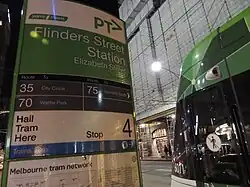
There are 24 total routes the trams take in Melbourne.[12]
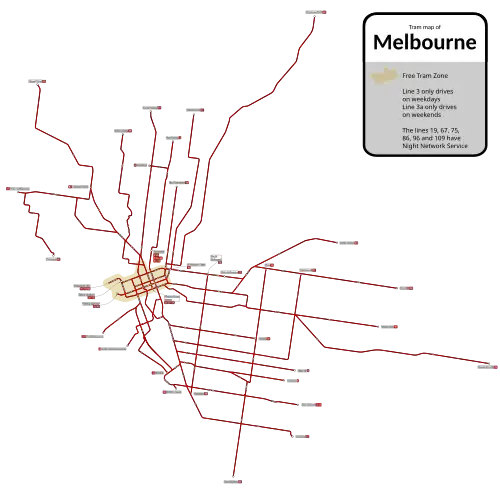
| Route | From | To | |
|---|---|---|---|
| 1 | East Coburg | South Melbourne Beach | |
| 3 | Melbourne University | East Malvern | |
| 5 | Melbourne University | Malvern | |
| 6 | Moreland | Glen Iris | |
| 11 | West Preston | Victoria Harbour Docklands | |
| 12 | Victoria Gardens Shopping Centre | St Kilda | |
| 16 | Melbourne University | Kew | |
| 19 (Night Network) | North Coburg | Flinders Street Railway Station | |
| 30 | St Vincent's Plaza | Central Pier in Docklands | |
| City Circle 35 | Waterfront City The District Docklands | Loops around the city to go back to The District Docklands Shopping Centre | |
| 48 | North Balwyn | Victoria Harbour Docklands | |
| 57 | West Maribyrnong | Flinders Street Railway Station | |
| 58 | West Coburg | Toorak | |
| 59 | Airport West (Essendon) | Flinders Street Railway Station | |
| 64 | Melbourne University | East Brighton | |
| 67 (Night Network) | Melbourne University | Carnegie | |
| 70 | Wattle Park | Waterfront City The District Docklands | |
| 72 | Melbourne University | Camberwell | |
| 75 (Night Network) | Vermont South | Central Pier, Docklands | |
| 78 (Does not go into City) | North Richmond | Balaclava | |
| 82 (Does not go into City) | Footscray | Moonee Ponds | |
| 86 (Night Network) | RMIT University in Bundoora | Waterfront City The District Docklands | |
| 96 (Night Network) | East Brunswick | St Kilda Beach | |
| 109 (Night Network | Box Hill Shopping Mall | Port Melbourne | |
| Notes | Night Network means the trams will run overnight on Saturday and Sunday mornings. | The 35 acts a tourist route instead of a normal one, and runs clockwise from 9:30 am to 5:00 pm every day, except Good Friday and Christmas Day. | [13] |
Fleet
In 2023, the network had a total of 520 trams.[14]
W-class
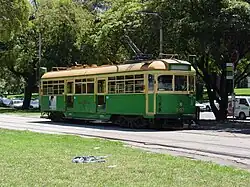
Built and introduced in 1923, it is the oldest on the network, used on the Route 35 tourist attraction.[15]
Z-class

These are one carriages long. They were first built in 1975 by Commonwealth Engineering. Some of them have already been scrapped, and the rest will be retired in the near future. [16]
A-class
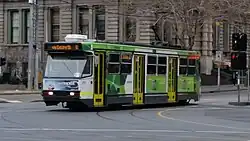
The A class are also built by Commonwealth Engineering. The trams looks like the Z class, just a little wider. Like the Z class, they will also retire in the near future. [17]
B-class
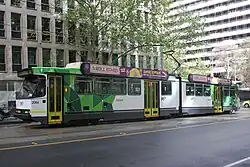
The B class looks very similar to the A class, but it is 2 carriages long. They are the first trams in Melbourne to have a cooling system. [18]
C-class
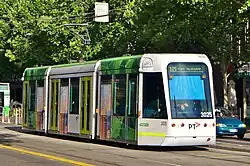
The C classes are Citadis trams built by Alstom in France.
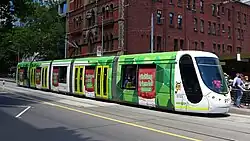
C1 Class
The first modern tram in Melbourne's tram network. Ordered by Yarra Trams to replace the aging Z class trams back in 2001.[19]
C2-class
Leased from Mulhouse, France, these special trams were loved so much by the residents that the city decided to keep them. Nicknamed bumblebees, because when they came, the trams had a yellow colour.[20]
D-class
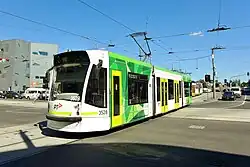

The D class was made in Germany and was ordered by M>Tram to replace the Z class trams. The D1 is 3 carriages long and the D2 is 5 carriages long.[21][22]
E-class
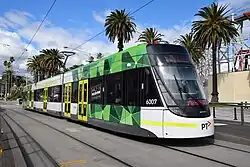
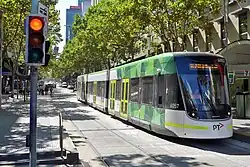
The E class is the latest generation of trams. Named the Flexity, the trams entered the network in 4, November 2013. There are 100 of them in total. [23]
G-class

This will be in service later this year. Known as the G class.[24]
See also
- Transport in Australia
- Railways in Melbourne
References
- ↑ David Hoadley (1998). "Trams Currently in Service". Trams of Australia. Archived from the original on 13 March 2018. Retrieved 16 December 2011.
- ↑ "Department of Transport and Planning Annual Report 2023-24" (PDF). Parliament of Victoria. Retrieved 4 November 2024.
- ↑ DoI (2008). . Retrieved 28 April 2008.
- ↑ "Yarra Trams Facts & Figures". Archived from the original on 2007-03-14. Retrieved 2008-12-13.
- ↑ Russell Jones (2003). "Hooves and iron: Melbourne's horse trams". Friends of Hawthorn Tram Depot. Archived from the original on 1 March 2015. Retrieved 16 January 2012.
- ↑ "The Melbourne Tramway & Omnibus Company Limited" (PDF). Running Journal Vol9 No3. June 1972. Archived from the original (PDF) on 12 May 2013. Retrieved 10 November 2011.
- ↑ David Hoadley (8 January 1996). "Melbourne's cable trams". Trams of Australia. Archived from the original on 21 November 2011. Retrieved 10 November 2011.
- 1 2 "Trams in Melbourne". Yarra Trams. Archived from the original on 27 September 2016. Retrieved 26 January 2012.
- ↑ "Early history of public transport". Public Transport Victoria. Archived from the original on 7 August 2012. Retrieved 9 July 2012.
- ↑ Keenan, David R. "Melbourne's Tramways in 1974." (Transit Press, 1974)
- ↑ Carey, Adam (2014-12-31). "Free tram travel in CBD and Docklands a touchy subject for some". The Age. Archived from the original on 29 August 2021. Retrieved 2021-08-29.
- ↑ "Facts & figures about Melbourne's tram network - Yarra Trams". yarratrams.com.au. Retrieved 2024-02-06.
- ↑ "Melbourne tram network - Transport Victoria" (PDF). transport.vic.gov.au. Retrieved 2026-05-09.
- ↑ "Melbourne's tram fleet". Yarra Trams. Archived from the original on 25 May 2023. Retrieved 2023-05-25.
- ↑ "VICSIG". vicsig.net. Archived from the original on 7 November 2020. Retrieved 2020-09-28.
- ↑ "Melbourne's Z-class tram". Trams of Australia. Archived from the original on 19 February 2011. Retrieved 6 November 2011.
- ↑ "Melbourne's A-class tram". Trams of Australia. Archived from the original on 11 October 2011. Retrieved 6 November 2011.
- ↑ "Melbourne's B-class tram". Trams of Australia. Archived from the original on 11 October 2011. Retrieved 25 April 2020.
- ↑ "C Class". Vicsig. Archived from the original on 20 February 2015. Retrieved 6 November 2011.
- ↑ "C2 Class", Vicsig, archived from the original on 29 September 2018, retrieved 6 November 2011
- ↑ "D1 Class". Vicsig. Archived from the original on 9 February 2022. Retrieved 25 April 2020.
- ↑ "D2 Class". Vicsig. Archived from the original on 30 June 2013. Retrieved 6 November 2011.
- ↑ "E Class". VICSIG. Archived from the original on 12 February 2021. Retrieved 19 November 2011.
- ↑ Department of Economic Development, Jobs. "New train and tram orders". transport.vic.gov.au. Archived from the original on 1 December 2021. Retrieved 15 February 2021.