Tracheal intubation
| Tracheal intubation | |
|---|---|
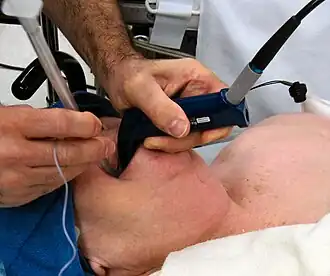 Anesthesiologist using the Glidescope video laryngoscope to intubate the trachea of a morbidly obese elderly person with challenging airway anatomy | |
| Specialty | Anesthesiology, emergency medicine, critical care medicine |
| ICD-9-CM | 96.04 |
| MeSH | D007442 |
| OPS-301 code | 8-701 |
| MedlinePlus | 003449 |
Tracheal intubation, usually known as intubation, is when a flexible plastic tube is put into the trachea (windpipe) to keep an open airway or to help put certain drugs into the body.[1] It is normally done in critically injured, ill, or anesthetized patients to keep air moving in and out of the lungs, including mechanical ventilation, and to prevent the possibility of asphyxiation.[2]
References
- ↑ Jones, JH; Murphy, MP; Dickson, RL; Somerville, GG; Brizendine, EJ (2004). "Emergency physician-verified out-of-hospital intubation: miss rates by paramedics". Academic Emergency Medicine. 11 (6): 707–9. doi:10.1197/j.aem.2003.12.026. PMID 15175215.
- ↑ Lee, W; Koltai, P; Harrison, AM; Appachi, E; Bourdakos, D; Davis, S; Weise, K; McHugh, M; Connor, J (2002). "Indications for tracheotomy in the pediatric intensive care unit population: a pilot study". Archives of Otolaryngology–Head & Neck Surgery. 128 (11): 1249–52. doi:10.1001/archotol.128.11.1249. PMID 12431164. S2CID 20209753.