Tin(II) oxide
 | |
 | |
 | |
| Names | |
|---|---|
| IUPAC name
Tin(II) oxide | |
| Other names
Stannous oxide, tin monoxide | |
| Identifiers | |
3D model (JSmol) |
|
| ECHA InfoCard | 100.040.439 |
| EC Number |
|
PubChem CID |
|
| RTECS number |
|
CompTox Dashboard (EPA) |
|
SMILES
| |
| Properties | |
| SnO | |
| Molar mass | 134.709 g/mol |
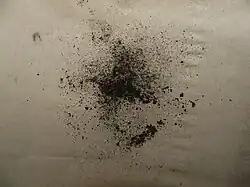
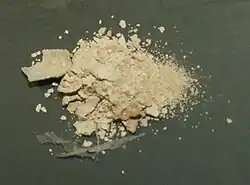
| Appearance | black or red powder when anhydrous, white when hydrated |
| Density | 6.45 g/cm3 |
| Melting point | 1,080 °C (1,980 °F; 1,350 K)[1] |
| insoluble | |
| −19.0·10−6 cm3/mol | |
| Structure | |
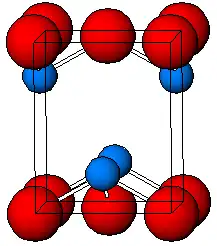
| tetragonal | |
| Thermochemistry | |
| Std enthalpy of formation ΔfH |
−285 kJ·mol−1[2] |
| Standard molar entropy S |
56 J·mol−1·K−1[2] |
| Hazards | |
| Flash point | Non-flammable |
| NIOSH (US health exposure limits): | |
PEL (Permissible) |
none |
REL (Recommended) |
TWA 2 mg/m3 |
IDLH (Immediate danger) |
N.D.[3] |
| Safety data sheet (SDS) | ICSC 0956 |
| Related compounds | |
Other anions |
Tin sulfide Tin selenide Tin telluride |
Other cations |
Carbon monoxide Silicon monoxide Germanium(II) oxide Lead(II) oxide |
| Tin dioxide | |
Except where otherwise noted, data are given for materials in their standard state (at 25 °C [77 °F], 100 kPa). | |
 verify (what is  ?) | |
| Infobox references | |
Tin(II) oxide, also known as stannous oxide, is a chemical compound. Its chemical formula is SnO. It has tin in an oxidation state of +2. It also has oxide ions in it.
Properties
It is normally a blue-black solid. It can be red but the red form is more unstable. It burns in air with a green flame to make tin(IV) oxide. It is a reducing agent. It is rarer than tin(IV) oxide. It dissolves in acids to make a colorless solution.
Preparation
It can be made by reacting sulfuric acid with tin and reacting the tin(II) sulfate made with sodium hydroxide to make the tin(II) oxide hydrate. This is heated to get the tin(II) oxide.
Uses
It is used in touchscreens. It is used to make a glass with gold in it called ruby glass.
Related pages
References
- ↑ Tin and Inorganic Tin Compounds: Concise International Chemical Assessment Document 65, (2005), World Health Organization
- 1 2 Zumdahl, Steven S. (2009). Chemical Principles 6th Ed. Houghton Mifflin Company. p. A23. ISBN 978-0-618-94690-7.
- ↑ NIOSH Pocket Guide to Chemical Hazards. "#0615". National Institute for Occupational Safety and Health (NIOSH).