Theistic Satanism
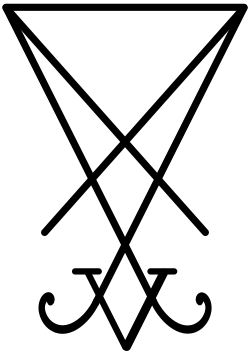
Theistic Satanism is the belief that Satan is a god or force, and the worship of him.[1] It is a kind of Satanism. It is different from Atheistic Satanism, which sees Satan only as a symbol.
Theistic Satanists do not all believe the same things. Many have their own ideas. They disagree with Anton LaVey, who said that Satan is only a symbol.[2][3] Both kinds of Satanists may believe in magic and use rituals. But Theistic Satanists also believe that Satan is real and pray to him.[4] Some say people in the past worshipped Satan in the same way, such as La Voisin, a French witch. Some even say they learned Satanism from their family.[5]
History
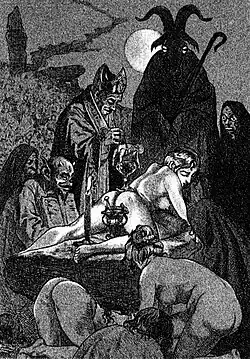
In history, many people were called Satanists when they only had unusual beliefs. Because of this, it is hard to know if people really worshipped Satan.[6] Paul Tuitean says that the idea of "reverse Christianity" was invented by the Inquisition.[7] George Bataille, however, says that a Black Mass may have existed before the witch trials.[8]
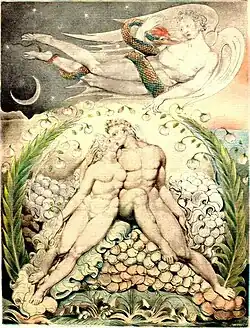
The poet John Milton was not a Theistic Satanist. But his poem Paradise Lost inspired many people who later admired Satan. The poet William Blake said that Milton was "of the Devil’s party without knowing it."[9]
Nikolas Schreck says that writers like Milton, Dante, Marlowe, and Goethe created the modern idea of Satan. He argues that these writers had a special "Luciferian vision" and a "diabolical consciousness" that shaped their works.[10]
Related pages
- Satanism
- Azazel
- Devil
- Left Hand Path
- Luciferianism
- Stregheria
- Magic
- Folk religion
References
- ↑ Partridge, Christopher Hugh (2004). The Re-enchantment of the West. p. 82.
- ↑ Sylvan, Robin (2002). Traces of the Spirit: The Religious Dimensions of Popular Music. p. 82.
- ↑ Satanism: The Feared Religion
- ↑ "Prayers to Satan". Archived from the original on 2019-04-15. Retrieved 2008-08-24.
- ↑ Lewis, James R.; Petersen, Jesper Aagaard (2004). Controversial New Religions. Oxford University Press. p. 437.
- ↑ Behrendt, Stephen C. (1983). The Moment of Explosion: Blake and the Illustration of Milton. U of Nebraska Press. p. 437.
- ↑ Tuitean, Paul; Daniels, Estelle (1998). Pocket Guide to Wicca. The Crossing Press. p. 22.
- ↑ Battaille, George (1986). Erotism: Death and Sensuality. Translated by Dalwood, Mary. City Lights. p. 126.
- ↑ "John Milton". www.kirjasto.sci.fi. Retrieved 2025-09-30.
- ↑ "Flowers From Hell: A Satanic Reader, edited by Nikolas Schreck". www.communistvampires.com. Retrieved 2024-01-04.
Further reading
- Ellis, Bill, Raising the Devil: Satanism, New Religions and the Media (Lexington: University Press of Kentucky, 2000).
- Hertenstein, Mike; Jon Trott, Selling Satan: The Evangelical Media and the Mike Warnke Scandal (Chicago: Cornerstone, 1993).
- Brown, Seth "Think you're the only one?" (Barnes & Noble Books 2004)
- Medway, Gareth J., The Lure of the Sinister: The Unnatural History of Satanism (New York and London: New York University Press, 2001).
- Michelet, Jules, Satanism and Witchcraft: A Study in Medieval Superstition (English translation of 1862 French work).
- Palermo, George B.; Michele C. Del Re: Satanism: Psychiatric and Legal Views (American Series in Behavioral Science and Law) . Charles C Thomas Pub Ltd (November 1999)
- Pike, Albert, Morals and Dogma (1871)
- Richardson, James T.; Joel Best; David G. Bromley, The Satanism Scare (New York: Aldine de Gruyter, 1991).
- Vera, Diane, Theistic Satanism Archived 2013-05-19 at the Wayback Machine: The new Satanisms of the era of the Internet
- Zacharias, Gerhard (1980). The Satanic Cult. ISBN 0041330080. Translated from the German 'Satanskult und Schwarze Messe' by Christine Trollope.
Other websites
- Articles and essays about Theistic Satanism Archived 2006-06-17 at the Wayback Machine from about.com
- Theistic Satanism and Left Hand Path oriented links Archived 2013-05-19 at the Wayback Machine
- Open Directory Project: Satanism Organizations Archived 2008-12-08 at the Wayback Machine
- Sinagogue of Satan Archived 2008-08-22 at the Wayback Machine