The Mammals of Australia
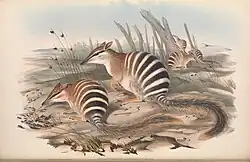
The Mammals of Australia is a book in three parts written and published by John Gould between 1845 and 1863. It has 182 pictures made by John Gould and his artist H. C. Richter. The book was meant to show all the new kinds of mammals, like marsupials, found in Australia’s colonies.
The author
John Gould, the author, is famous for his book The Birds of Australia and other important bird studies. He visited Australia in 1838. In his introduction, Gould said it was only when he got to Australia and saw many strange animals, as if he was on another planet, that he decided to study the mammals there.[1]
While he was there for a short time, he watched the animals and used his skills as a taxidermist to prepare animal specimens for preservation.
First survey
John Gould published this big work after his 1841 book about kangaroos called A Monograph of the Macropodidae or Family of Kangaroos.[2] This was the first full study of Australian mammals. It explained how the animals were grouped and described. Gould also wrote down the local names for the animals from the lists he made while in Australia.[3] He used these names to ask local people for animal samples and noted where the names were used.[2] This helped save some common names, like "dibbler" (Parantechinus apicalis), which experts later agreed to use.
Artwork
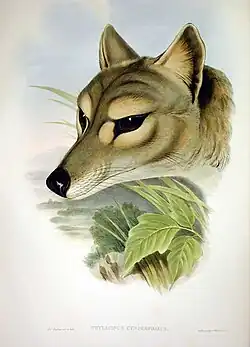
The big pictures were made from the artwork of Richter, based on drawings and watercolors made in Australia by Gould and his wife, Elizabeth. (Elizabeth's work was not officially credited.) A team of artists, led by Gabriel Bayfield, hand-colored 26,572 plates. The pictures made during their visit to Australia, along with the animal samples brought back to England, showed the details of the animals. These pictures have become famous images of Australian mammals.[5] One of the best-known pictures is of the Thylacinus cynocephalus (Tasmanian tiger). This image has been copied many times since the book was published.[4] It became even more famous when Cascade Brewery used it on their label in 1987.[3] The Tasmanian government also printed a black-and-white version of the same picture in 1934.[6] The author Louisa Anne Meredith copied it for her book Tasmanian Friends and Foes in 1881.[4]
Subscription format
The Mammals of Australia was published in parts called a subscription. It was in a large book size called Imperial Folio. There were 13 parts in three volumes, published from 1845 to 1863. The author also added a separate book called An Introduction to The Mammals of Australia in 1863. This book gave corrections, updates, a new introduction, and a list of the animals in the three volumes. The first two volumes covered marsupials, and the third volume included rodents. Together, they showed all the known Australian mammals at that time. With the new Introduction, the total number of species described was 166. The book did not include sea mammals like whales, but it did include a paper about the dugong by Charles Coxen.[7][8]
Besides its scientific importance, the book is also used to talk about protecting animals. Some animals in the book, like the Onychogalea lunata (crescent nailtail wallaby), have disappeared because of changes to the land after Europeans settled in Australia.[2]
The book was praised, but it was very expensive to make, especially because of the colored pictures. The full set cost £41, which was a lot of money then.[8] Many people were curious about Australia’s unique animals, and this beautiful and detailed book helped satisfy that interest. It also inspired other books in Australia. For example, Gerard Krefft, the curator of the Australian Museum, made a cheaper book called The Mammals of Australia in 1871 for teaching, using Gould’s pictures as a guide.[9] Another book, Birds and Mammals of Australia by Gracius Broinowski in 1884, copied Gould’s pictures so closely that its publisher almost took legal action.[4]
References
- ↑ Hetherington, M. John Gould's Birds of Australia in Peter Cochrane ed. Remarkable Occurrences: The National Library of Australia’s First 100 Years, 1901–2001. National Library of Australia
- 1 2 3 "Mammals of Australia". Gould the Naturalist. Australian Museum. 2004. Retrieved 2009-04-28.
- 1 2 Stephens, Matthew; Robyn Williams (13 June 2004). "John Gould's place in Australian culture". Ockham's Razor – Radio National. Australian Broadcasting Corporation. Retrieved 2009-04-28.
- 1 2 3 4 University Librarian (24 September 2007). "The Exotic Thylacine". Imaging the Thylacine. University of Tasmania. Retrieved 2009-04-30.
- ↑ Cantrell, Carol (2002). "John Gould and the bird illustrators". The Australian Museum Society. Australian Museum. Retrieved 2009-04-28.
- ↑ Government Tourist Bureau, Tasmania. Tasmania: The Wonderland. Hobart: Government Printer, Tasmania, 1934
- ↑ "...interesting letter respecting the Dugong, which has been forwarded to me by my brother-in-law, Charles Coxen, Esq., of Brisbane, Queensland" Gould, 1963
- 1 2 Gould, J. "Preface". An Introduction to The Mammals of Australia (1 ed.). OCLC 10249957.
- ↑ Krefft, G. 1871. The Mammals of Australia, illustrated by Miss Harriet Scott, and Mrs Helena Forde, for the Council of Education; with a short account of all the species hitherto described. Sydney : T. Richards, Govt. Printer 51 pp. 16 pls
Other websites
- Mammals of Australia / National Library of Australia collection copy of the published work
- National Library of Australia collection copy of key plates (or pattern plates) - digitised
- Introduction to The Mammals of Australia / National Library of Australia collection copy
