The Fall of the House of Usher
| "The Fall of the House of Usher" | |
|---|---|
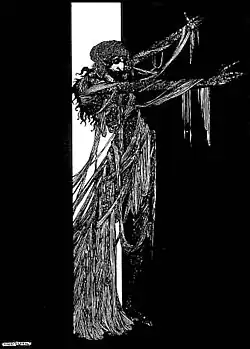 Illustration by Harry Clarke, 1919 | |
| Author | Edgar Allan Poe |
| Country | United States |
| Language | English |
| Genre(s) | Horror |
| Published in | Burton's Gentleman's Magazine |
| Media type | |
| Publication date | September 1839 |

The Fall of the House of Usher is a short story by Edgar Allan Poe. It was first published in September 1839 in Burton's Gentleman's Magazine. It was slightly revised in 1840 and published in a collection of Poe's stories called Tales of the Grotesque and Arabesque. The poem "The Haunted Palace" is part of the story. Vincent Price and Myrna Fahey starred in a 1960 Roger Corman movie based on the story.
Story
This story is by an unnamed narrator who is a friend of Roderick Usher-who believes he is sick and dying. His house is crumbling. Usher has a sister, Madeleine. She falls into a catatonic state. She appears dead.
Roderick knows she is not dead. He places her in the family tomb. On a stormy night, she rises from the tomb. She falls upon her brother. She is dead. Her brother dies from terror. The house crumbles and falls. The narrator flees and sees the spot where the house was has been covered by water.
Analysis
In modern literature, authors often use narrators as a plot device to add to the immersive nature of their stories. Authors like Edgar Allan Poe purposefully make some of their narrators unreliable due to insanity, immaturity, or other factors, and as a result, the telling of the story cannot fully be trusted. Poe implies that the narrator of “The Fall of the House of Usher” becomes unreliable throughout the story, adding to the unnerving ambiguity of Poe’s writing.
The line between reality and fantasy becomes blurred for the narrator of “The Fall of the House of Usher” as he spends more time in the house. As the narrator arrives at the estate, he provides clear descriptions of the building and its surroundings, as well as his impressions of the area. The “bleak walls” and “white trunks of decayed trees” give the narrator an “utter depression of soul,” but this reaction is reasonable given the dark, gothic architecture and the foreboding unkempt grounds of the manor (Poe). However, as he spends more and more time in the house, he starts losing touch with reality. Late at night, as he is reading a book aloud, he starts hearing the sounds described in the story as reality. For example, the book he is reading describes a “brazen shield” falling onto the floor with a “terrible ringing sound,” and as this is happening, the narrator hears a “hollow, metallic, and clangorous” sound, and thinks to himself that it is “as if a shield of brass” had fallen on the ground (Poe). While some may say that this is reasonable because he is making a connection to the text, it is evident in his description that he is at least considering the fact that these sounds are one and the same as the ones in the book. This instantaneous association of the fiction that he is reading with the sounds of reality shows that the narrator is losing his grasp of the distinction between the two. The progression of the narrator from a normal person to a reality-challenged person adds to the mystique and horror of Poe’s writing in multiple ways, as well as showcasing his true purpose. The fact that the change is implied (and not outright stated) allows the reader to come to this realization on their own, making the reader question where the change happens - where the story becomes something they can’t fully trust. In this piece, Poe purposefully leaves it up to the reader to whether the things that are happening are purely psychological, supernatural, or a blend of the two, and throwing an unreliable narrator into the mix provides his audience with the perfect amount of uncertainty and ambiguity to allow them to fill in the gaps and blank space with whatever scares them the most. In addition to the psychological change adding ambiguity to the story, the narrator beginning as a normal person provides the audience with a relatable person to put themselves in the shoes of. Then, as the narrator starts to lose touch, the reader feels like this could/is happening to them, making them all the more terrified. In addition, the narrator losing touch with what is real and what is not makes the audience wonder what about the House of Usher (referring both to the dwelling and its inhabitants) causes this mental deterioration, as we see it in Roderick Usher as well.
Because Poe does not provide a specific cause for this deterioration, it can be viewed as a commentary on the class system in and of itself (as in the story all who associate with the upper class suffer), and how the self-centeredness and pride of the upper class in Poe’s time - as well as the physical representations of that self-bestowed superiority (the estates of those people) - caused those people to lose touch with the reality of the world. While they may have seen reality and fiction as one and the same, the upper class was often unaware or indifferent to the problems of the lower class - disease, poverty, death, and mistreatment. The upper class’s removed status and abundance of wealth made them unaffected by these problems, and due to human nature, uncaring. Poe is highlighting the problems with the class system, hyperbolically describing the disconnect from reality that the aristocracy experiences. By portraying these disconnected individuals in a negative light, he encourages his audiences to stay grounded in reality and not discount the problems of other people or groups. The use of this subtle change in the narrator both terrifies the audience, making them feel more connected to the story, as well as teaching his audience an important lesson about society. The change in the narrator’s perception of the distinction between fantasy and reality brings the audience further into the story and enables a combination of ambiguity and personal connection with the narrator to truly terrify Poe’s audience. Furthermore, the parallel between the narrators’ change and the upper class of the time allows Poe to teach his readers a lesson about keeping themselves grounded in the real-world problems of others, highlighting the dangers of allowing yourself to drift away from the cold, hard truth.
Other websites

- The Fall of the House of Usher at Project Gutenberg
- The Fall of the House of Usher at Project Gutenberg (audiobook)
- Full text as reprinted in The Works of the Late Edgar Allan Poe (1850)
- Full text at Bartelby.com
- "The Fall of the House of Usher" with annotated vocabulary at PoeStories.com
- Full text Archived 2012-03-02 at the Wayback Machine at American Literature
- Study guide Archived 2012-02-24 at the Wayback Machine
- Analysis by Martha Womack