The Cheviot
| The Cheviot | |
|---|---|
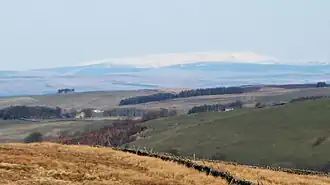 The Cheviot under snow | |
| Highest point | |
| Elevation | 815 m (2,674 ft)[1][2] |
| Prominence | 556 m (1,824 ft)[2] |
| Parent peak | Broad Law |
| Listing | Marilyn, Hewitt, County Top, Nuttall |
| Coordinates | 55°28′42″N 2°08′44″W / 55.47823°N 2.14553°W |
| Naming | |
| English translation | (Hill) having the quality of a ridge |
| Language of name | Common Brittonic |
| Geography | |
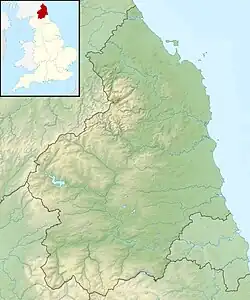  The Cheviot The Cheviot in Northumberland | |
| Location | Cheviot Hills, England |
| OS grid | NT909205 |
| Topo map | OS Landranger 74/75 |
| Geology | |
| Age of rock | Early Devonian[3] |
| Mountain type | Stratovolcano (extinct) |
| Last eruption | +393 MYA[3] |
The Cheviot is an extinct volcano and the highest peak in Northumberland[4] at 815 meters (2,674 feet) which is 1+1⁄4 miles (2 kilometres) from the Scottish border.[5]
It would have formed 390 million years ago during the Caledonian orogeny,[6] when the mantle crust would melt after an eruption, which may have measured a height of 3,000 meters (10,000 feet) almost the same height as Mount Etna in Italy,[7] and a diameter of 37 miles. during its last eruptions they could have been explosive and violent and the lava could have flowed up to Branxton and Flodden Ridge[8] while the pyroclastics flows up to Coquetdale and Ingram.[9]
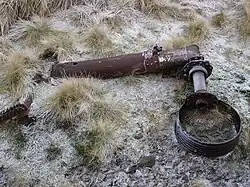
Currently, the rest of this extinct volcano has been intensely eroded[7] where several bodies of water would radiate.[5]
References
- ↑ Bathurst, David (2012). Walking the county high points of England. Chichester: Summersdale. pp. 264-271. ISBN 978-1-84-953239-6.
- 1 2 "The Cheviot". Archived from the original on 2020-08-14. Retrieved 2022-03-27.
- 1 2 Scrutton, Colin. "Page 1 Cheviot - early Devonian volcanic rocks,granite and basement". Archived from the original on 2021-06-11. Retrieved 2022-03-27.
- ↑ Hall, Gemma (2012). Slow Northumberland and Durham. Slow Northumberland and Durham - Including Newcastle, Hadrian's Wall and the Coast: Bradt Travel Guides. ISBN 9781841624334.
- 1 2 "The Cheviot Hills". Geology North. Archived from the original on 26 December 2019. Retrieved 22 March 2021.
- ↑ How this tranquil part of the North East is far from the madding crowd . Chronicle Live. Retrieved November 28, 2021.
- 1 2 "Walking in a volcano". Retrieved 10 June 2021.
- 1 2 Kille, Ian. "15. Geology of the battlefield and wider landscape". Flodden 1513. Archived from the original on 24 April 2024. Retrieved 19 November 2020.
- ↑ Upton, B. G. J. (2015). Volcanoes and the Making of Scotland. Dunedin Academic Press Ltd. ISBN 978-1780465418. Retrieved 14 August 2019.
Other websites
- Computer generated summit panorama The Cheviot Archived 2021-12-15 at the Wayback Machine

