Terephthaloyl chloride
 | |
| Names | |
|---|---|
| Preferred IUPAC name
benzene-1,4-dicarbonyl dichloride | |
Other names
| |
| Properties | |
| C6H4(COCl)2 | |
| Molar mass | 203.02 g·mol−1 |
Except where otherwise noted, data are given for materials in their standard state (at 25 °C [77 °F], 100 kPa). | |
| Infobox references | |
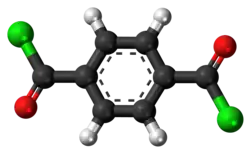
Terephthaloyl chloride is an organic compound. It is the acyl chloride related to terephthalic acid, with the chemical formula C6H4(COCl)2. It is one of three isomers of benzenedioyl chloride, defined by having the acyl chloride groups on opposite sides of the aromatic ring.
Preparation
1,4-bis(trichloromethyl)benzene will react with terephthalic acid with only hydrogen chloride as a byproduct:
- C6H4(COOH)2 + C6H4(CCl3)2 → 2 C6H4(COCl)2 + 2 HCl
It also reacts with sulfur dioxide, which makes thionyl chloride as a byproduct:[1]
- C6H4(CCl3)2 + 2 SO2 → C6H4(COCl)2 + 2 SOCl2
Like other acyl chlorides, it may also be prepared using thionyl chloride or phosgene:
- C6H4(COOH)2 + SOCl2 → C6H4(COCl)2 + HCl
- C6H4(COOH)2 + COCl2 → C6H4(COCl)2 + CO2
Uses
Terephthaloyl chloride is a monomer used to make aramids, a type of synthetic fibre. Kevlar is a well-known trade name for an aramid. The other ingredient in aramids is an aromatic diamine like p-phenylenediamine. The amine groups react with the acyl chloride groups to make amide groups (the Schotten-Baumann reaction).[2]
As well as aramids, it can be used instead of terephthalic acid to make polyesters like polyethylene terephthalate.
Sources
- ↑ . doi:10.1021/jo00884a017.
{{cite journal}}: Cite journal requires|journal=(help); Missing or empty|title=(help) - ↑ . doi:10.3139/9781569905258.008.
{{cite journal}}: Cite journal requires|journal=(help); Missing or empty|title=(help)